 Add to Chrome
 Add to Firefox
 Add to Edge
Efficient Online Proportional Sampling with Applications to Smoothed Online Learning
Jul 13, 2026
We study the problem of efficient online proportional sampling from a high-dimensional domain under a $σ$-smoothed adversary, where the sampling distribution is induced by a dynamically evolving weight function defined over a sequence of piecewise-structured partitions. This setting captures a broad range of applications, including principal-agent games (e.g., pricing and contract design), and algorithm configuration and parameter tuning. The central challenge is maintaining an efficient data structure as the induced partition grows increasingly complex over time -- naively, the number of subregions can grow as $O(t^d)$ by round $t$ in $d$ dimensions. We design a data structure that supports efficient updates and proportional sampling while avoiding the cost of explicitly maintaining this exponential growth, where the discontinuities are structured from axis-parallel hyperplanes. Under a $σ$-smoothed adaptive adversary, we prove a tight $O(\sqrt{σT})$ bound on the depth of our data structure, and an $O(\log T)$ bound under a random-order adversary -- to our knowledge, the first such results for this class of problems. We apply this framework to online learning with piecewise-structured rewards, obtaining efficient no-regret algorithms under both full-information and bandit feedback, with provable sublinear regret guarantees.

Bandit Learning in Matching Markets with Interviews
Feb 12, 2026Two-sided matching markets rely on preferences from both sides, yet it is often impractical to evaluate preferences. Participants, therefore, conduct a limited number of interviews, which provide early, noisy impressions and shape final decisions. We study bandit learning in matching markets with interviews, modeling interviews as \textit{low-cost hints} that reveal partial preference information to both sides. Our framework departs from existing work by allowing firm-side uncertainty: firms, like agents, may be unsure of their own preferences and can make early hiring mistakes by hiring less preferred agents. To handle this, we extend the firm's action space to allow \emph{strategic deferral} (choosing not to hire in a round), enabling recovery from suboptimal hires and supporting decentralized learning without coordination. We design novel algorithms for (i) a centralized setting with an omniscient interview allocator and (ii) decentralized settings with two types of firm-side feedback. Across all settings, our algorithms achieve time-independent regret, a substantial improvement over the $O(\log T)$ regret bounds known for learning stable matchings without interviews. Also, under mild structured markets, decentralized performance matches the centralized counterpart up to polynomial factors in the number of agents and firms.
Heterogeneous Multi-Agent Bandits with Parsimonious Hints
Feb 22, 2025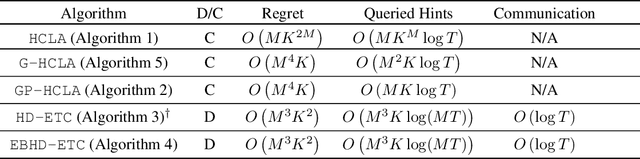
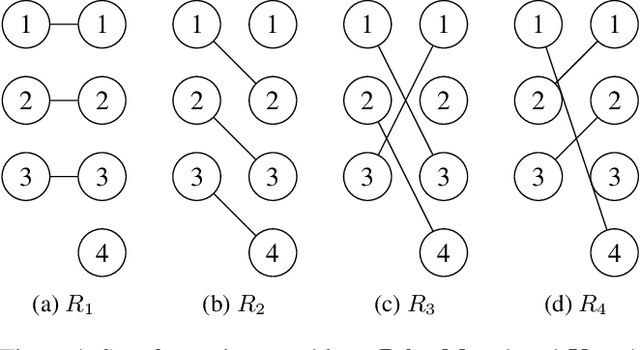
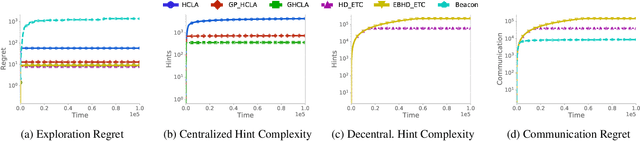
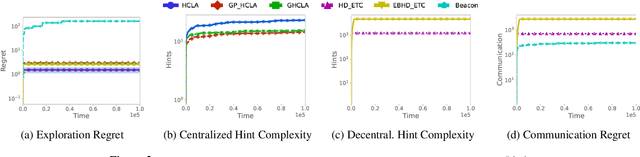
We study a hinted heterogeneous multi-agent multi-armed bandits problem (HMA2B), where agents can query low-cost observations (hints) in addition to pulling arms. In this framework, each of the $M$ agents has a unique reward distribution over $K$ arms, and in $T$ rounds, they can observe the reward of the arm they pull only if no other agent pulls that arm. The goal is to maximize the total utility by querying the minimal necessary hints without pulling arms, achieving time-independent regret. We study HMA2B in both centralized and decentralized setups. Our main centralized algorithm, GP-HCLA, which is an extension of HCLA, uses a central decision-maker for arm-pulling and hint queries, achieving $O(M^4K)$ regret with $O(MK\log T)$ adaptive hints. In decentralized setups, we propose two algorithms, HD-ETC and EBHD-ETC, that allow agents to choose actions independently through collision-based communication and query hints uniformly until stopping, yielding $O(M^3K^2)$ regret with $O(M^3K\log T)$ hints, where the former requires knowledge of the minimum gap and the latter does not. Finally, we establish lower bounds to prove the optimality of our results and verify them through numerical simulations.
Online Fair Revenue Maximizing Cake Division with Non-Contiguous Pieces in Adversarial Bandits
Nov 29, 2021The classic cake-cutting problem provides a model for addressing the fair and efficient allocation of a divisible, heterogeneous resource among agents with distinct preferences. Focusing on a standard formulation of cake cutting, in which each agent must receive a contiguous piece of the cake in an offline setting, this work instead focuses on online allocating non-contiguous pieces of cake among agents and establishes algorithmic results for fairness measures. In this regard, we made use of classic adversarial multi-armed bandits to achieve sub-linear Fairness and Revenue Regret at the same time. Adversarial bandits are powerful tools to model the adversarial reinforcement learning environments, that provide strong upper-bounds for regret of learning with just observing one action's reward in each step by applying smart trade-off between exploration and exploitation. This work studies the power of the famous EXP_3 algorithm that is based on exponential wight{-}importance updating probability distribution through time horizon.