 Add to Chrome
 Add to Firefox
 Add to Edge
Tube Diffusion Policy: Reactive Visual-Tactile Policy Learning for Contact-rich Manipulation
Apr 26, 2026
Contact-rich manipulation is central to many everyday human activities, requiring continuous adaptation to contact uncertainty and external disturbances through multi-modal perception, particularly vision and tactile feedback. While imitation learning has shown strong potential for learning complex manipulation behaviors, most existing approaches rely on action chunking, which fundamentally limits their ability to react to unforeseen observations during execution. This limitation becomes especially critical in contact-rich scenarios, where physical uncertainty and high-frequency tactile feedback demand rapid, reactive control. To address this challenge, we propose Tube Diffusion Policy (TDP), a novel reactive visual-tactile policy learning framework that bridges diffusion-based imitation learning with tube-based feedback control. By leveraging the expressive power of generative models, TDP learns an observation-conditioned feedback flow around nominal action chunks, forming an action tube that enables fast and adaptive reactions during execution. We evaluate TDP on the widely used Push-T benchmark and three additional challenging visual-tactile dexterous manipulation tasks. Across all benchmarks, TDP consistently outperforms state-of-the-art imitation learning baselines. Two real-world experiments further validate its robust reactivity under contact uncertainty and external disturbances. Moreover, the step-wise correction mechanism enabled by action tube significantly reduces the required denoising steps, making TDP well suited for real-time, high-frequency feedback control in contact-rich manipulation.

Stiffness Copilot: An Impedance Policy for Contact-Rich Teleoperation
Mar 14, 2026In teleoperation of contact-rich manipulation tasks, selecting robot impedance is critical but difficult. The robot must be compliant to avoid damaging the environment, but stiff to remain responsive and to apply force when needed. In this paper, we present Stiffness Copilot, a vision-based policy for shared-control teleoperation in which the operator commands robot pose and the policy adjusts robot impedance online. To train Stiffness Copilot, we first infer direction-dependent stiffness matrices in simulation using privileged contact information. We then use these matrices to supervise a lightweight vision policy that predicts robot stiffness from wrist-camera images and transfers zero-shot to real images at runtime. In a human-subject study, Stiffness Copilot achieved safety comparable to using a constant low stiffness while matching the efficiency of using a constant high stiffness.
Effect of Haptic Assistance Strategy on Mental Engagement in Fine Motor Tasks
Mar 16, 2023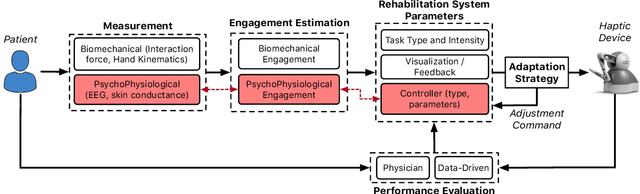
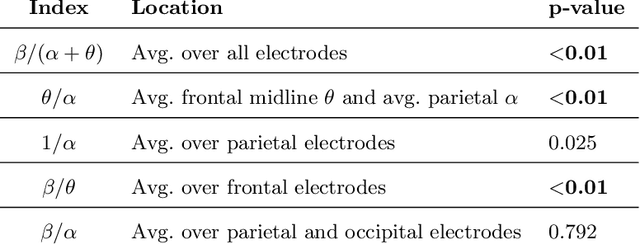
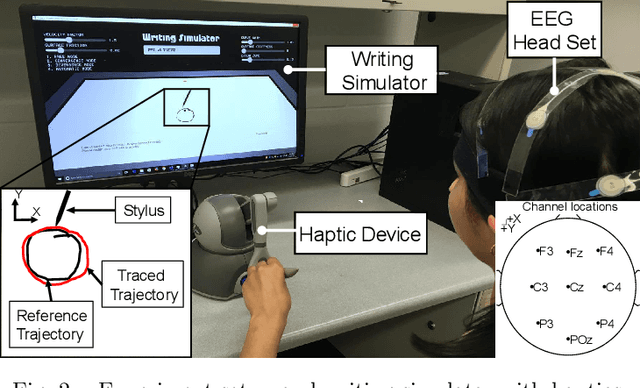

This study investigates the effect of haptic control strategies on a subject's mental engagement during a fine motor handwriting rehabilitation task. The considered control strategies include an error-reduction (ER) and an error-augmentation (EA), which are tested on both dominant and non-dominant hand. A non-invasive brain-computer interface is used to monitor the electroencephalogram (EEG) activities of the subjects and evaluate the subject's mental engagement using the power of multiple frequency bands (theta, alpha, and beta). Statistical analysis of the effect of the control strategy on mental engagement revealed that the choice of the haptic control strategy has a significant effect (p < 0.001) on mental engagement depending on the type of hand (dominant or non-dominant). Among the evaluated strategies, EA is shown to be more mentally engaging when compared with the ER under the non-dominant hand.
* 18 Pages, 11 Figures, Journal Pre-print