 Add to Chrome
 Add to Firefox
 Add to Edge
Think Shallow, Solve Deep: Controlling Recurrent Dynamics for Reliable Test-Time Depth
Aug 18, 2026
Recurrent-depth reasoners aim to solve harder problems by iterating their update longer at test time, but additional iterations can improve, preserve, or degrade an answer. We show that a measurable property of the trained operator, its finite-time dynamical regime (estimated as settling, marginal, or drifting), indicates which of these occurs. We give a sufficient condition for depth-safety: once an operator's per-step displacement is small relative to the decoder margin, the decoded answer cannot change under further iterations. Empirically, on algorithmic tasks trained from $800$ unaugmented examples per difficulty tier, settling operators do not degrade with added depth, and on some tasks convert it into higher accuracy on harder unseen instances (Sudoku, $0.19$ to $0.34$ past the training horizon). A single terminal fixed-point objective moves the regime and the depth behavior together: removing it induces drift and removes the gains, and adding it to a generic recurrence yields depth-safe extrapolation on carry propagation. We give four operational criteria for useful test-time depth, use them to catalogue failure modes, and, as a consistency check, apply the same measurements to Huginn-3.5B, which falls in the non-settling family.

AttackER: Towards Enhancing Cyber-Attack Attribution with a Named Entity Recognition Dataset
Aug 09, 2024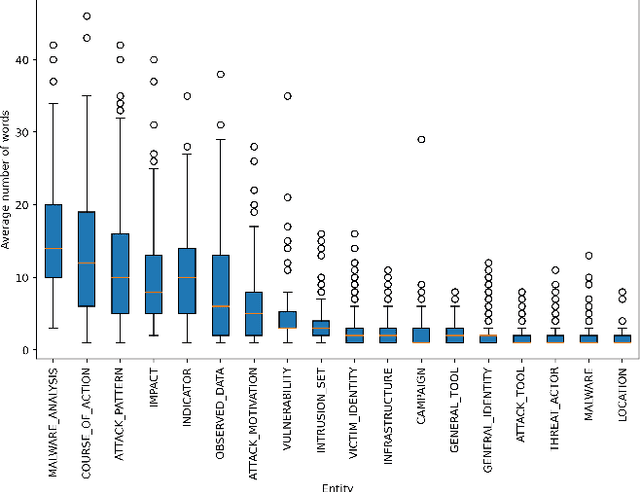
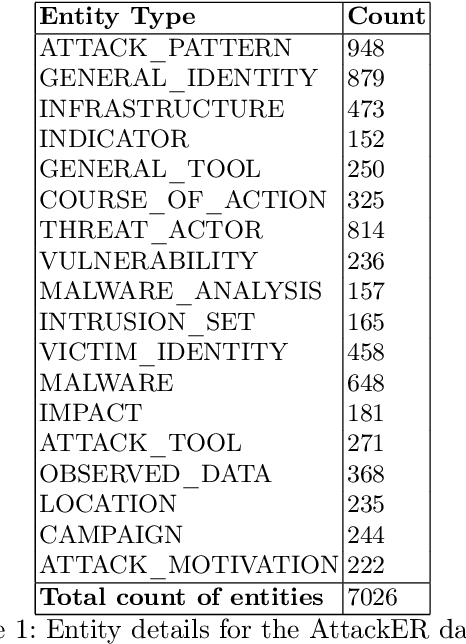
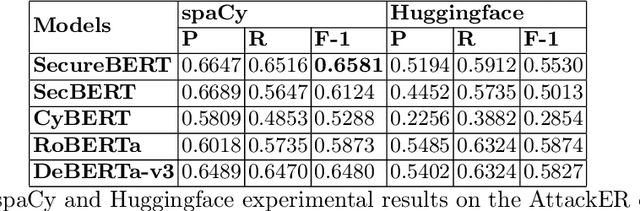
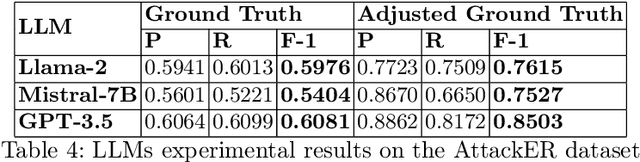
Cyber-attack attribution is an important process that allows experts to put in place attacker-oriented countermeasures and legal actions. The analysts mainly perform attribution manually, given the complex nature of this task. AI and, more specifically, Natural Language Processing (NLP) techniques can be leveraged to support cybersecurity analysts during the attribution process. However powerful these techniques are, they need to deal with the lack of datasets in the attack attribution domain. In this work, we will fill this gap and will provide, to the best of our knowledge, the first dataset on cyber-attack attribution. We designed our dataset with the primary goal of extracting attack attribution information from cybersecurity texts, utilizing named entity recognition (NER) methodologies from the field of NLP. Unlike other cybersecurity NER datasets, ours offers a rich set of annotations with contextual details, including some that span phrases and sentences. We conducted extensive experiments and applied NLP techniques to demonstrate the dataset's effectiveness for attack attribution. These experiments highlight the potential of Large Language Models (LLMs) capabilities to improve the NER tasks in cybersecurity datasets for cyber-attack attribution.