 Add to Chrome
 Add to Firefox
 Add to Edge
Think Shallow, Solve Deep: Controlling Recurrent Dynamics for Reliable Test-Time Depth
Aug 18, 2026
Recurrent-depth reasoners aim to solve harder problems by iterating their update longer at test time, but additional iterations can improve, preserve, or degrade an answer. We show that a measurable property of the trained operator, its finite-time dynamical regime (estimated as settling, marginal, or drifting), indicates which of these occurs. We give a sufficient condition for depth-safety: once an operator's per-step displacement is small relative to the decoder margin, the decoded answer cannot change under further iterations. Empirically, on algorithmic tasks trained from $800$ unaugmented examples per difficulty tier, settling operators do not degrade with added depth, and on some tasks convert it into higher accuracy on harder unseen instances (Sudoku, $0.19$ to $0.34$ past the training horizon). A single terminal fixed-point objective moves the regime and the depth behavior together: removing it induces drift and removes the gains, and adding it to a generic recurrence yields depth-safe extrapolation on carry propagation. We give four operational criteria for useful test-time depth, use them to catalogue failure modes, and, as a consistency check, apply the same measurements to Huginn-3.5B, which falls in the non-settling family.

Linear Features Observation Model for Autonomous Vehicle Localization
Feb 28, 2020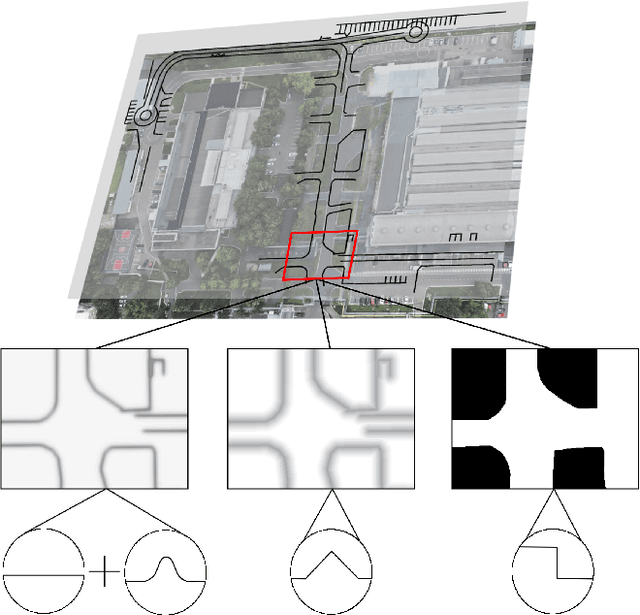


Precise localization is a core ability of an autonomous vehicle. It is a prerequisite for motion planning and execution. The well-established localization approaches such as Kalman and particle filters require a probabilistic observation model allowing to compute a likelihood of measurement given a system state vector, usually vehicle pose, and a map. The higher precision of the localization system may be achieved through the development of a more sophisticated observation model considering various measurement error sources. Meanwhile model needs to be simple to be computable in real-time. This paper proposes an observation model for visually detected linear features. Examples of such features include, but not limited to, road markings and road boundaries. The proposed observation model depicts two core detection error sources: shift error and angular error. It also considers the probability of false-positive detection. The structure of the proposed model allows precomputing and incorporating the measurement error directly into the map represented by a multichannel digital image. Measurement error precomputation and storing the map as an image speeds up observation likelihood computation and in turn localization system. The experimental evaluation on real autonomous vehicle demonstrates that the proposed model allows for precise and reliable localization in a variety of scenarios.