 Add to Chrome
 Add to Firefox
 Add to Edge
Spend Bits Where Queries Look: KV Cache Vector Quantization with Attention-Preserving Transforms
Aug 04, 2026
Long-context LLM decoding reads the key-value (KV) cache at every step. Loading it takes longer than computing attention over it, so throughput is bandwidth-bound. Hence, reducing the cache size can raise both decoding speed and serving capacity. The challenge is to reduce cache size while preserving the attention products, keeping reconstruction cheap, and using a fixed per-token bit count. At two bits per element, the most competitive methods rely on orthogonal transforms. However, existing techniques are either data-oblivious or use the query statistics without deriving the transform from a distortion criterion. Moreover, they rely on transforms built on top of random or Hadamard rotations, which equalize variances across entries rather than compacting energy, and fixed-width scalar quantizers, which are suboptimal at low rates. In this paper, we formulate KV cache quantization as a transform coding problem in which distortion is the error in the attention products. We derive closed-form optimal transforms for keys and values from calibration statistics, under a high-resolution model. We show that the optimal key transform is not orthogonal and satisfies a generalized Parseval relation: the attention-aware distortion becomes mean-squared error (MSE) in the transform domain. Thus, we can use MSE-optimal vector quantizers applied directly to the transformed key coefficients. To meet the fixed-width layout requirement, we show that grouping coefficients into equal-volume partitions makes equal-size codebooks attain the variable-rate optimum under the same high-resolution model. At two bits per element, our method, termed NOVA-KV, recovers most of the long-context retrieval accuracy lost by scalar quantization methods at comparable throughput.

ORBIT: Training-Free Multi-Attribute Behavioral Steering via Orthogonal Subspace Rotation
Jun 21, 2026Language models are widely used in assistant settings, where controlling behavioral attributes is often essential. Activation steering modifies hidden-state representations at inference time, providing a lightweight, training-free mechanism that can be toggled at runtime. Existing methods, however, have focused primarily on steering a single attribute at a time. When multiple attributes must be controlled simultaneously, naive summation of per-attribute steering vectors suffers from norm imbalance and directional cancellation, while classifier-based approaches require retraining whenever the attribute set changes. We introduce ORBIT (Orthogonal Rotation-Based Intervention Technique), a training-free extension of rotation-based steering to the multi-attribute setting. Our method constructs a joint subspace from per-attribute steering planes via singular value decomposition and applies a single norm-preserving rotation within that subspace toward a combined target direction. Adaptive per-token gating identifies which attributes need correction at each position, and an optional additive boost strengthens attributes with weak initial projection. We also introduce TraitFactory, a new multi-attribute benchmark that focuses on behavioral tendencies rather than surface-level style. We evaluate ORBIT on TraitFactory and ToneBank across three models (Llama-3.2-3B, Qwen-2.5-7B, Llama-3.1-8B) while steering multiple attributes simultaneously, showing that it achieves stronger and more balanced multi-attribute steering than existing training-free baselines while better preserving output coherence.
Hawk: Accurate and Fast Privacy-Preserving Machine Learning Using Secure Lookup Table Computation
Mar 26, 2024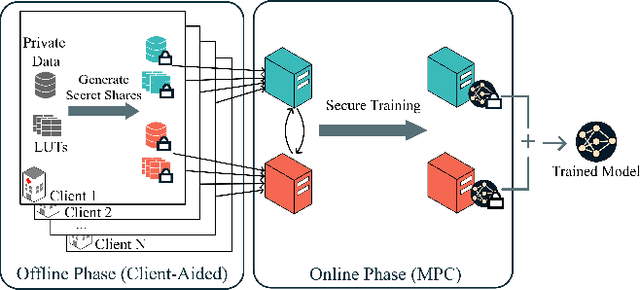
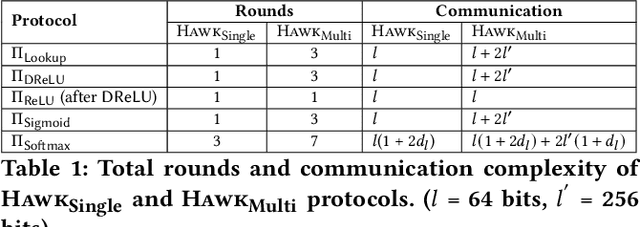
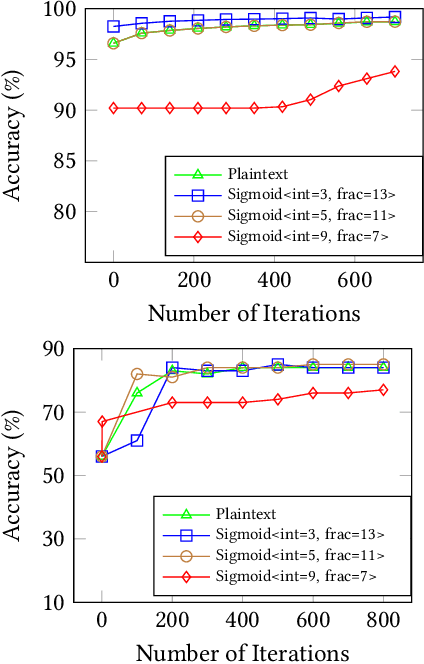
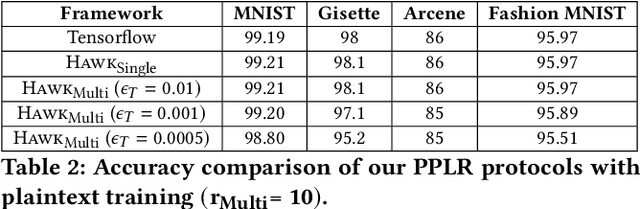
Training machine learning models on data from multiple entities without direct data sharing can unlock applications otherwise hindered by business, legal, or ethical constraints. In this work, we design and implement new privacy-preserving machine learning protocols for logistic regression and neural network models. We adopt a two-server model where data owners secret-share their data between two servers that train and evaluate the model on the joint data. A significant source of inefficiency and inaccuracy in existing methods arises from using Yao's garbled circuits to compute non-linear activation functions. We propose new methods for computing non-linear functions based on secret-shared lookup tables, offering both computational efficiency and improved accuracy. Beyond introducing leakage-free techniques, we initiate the exploration of relaxed security measures for privacy-preserving machine learning. Instead of claiming that the servers gain no knowledge during the computation, we contend that while some information is revealed about access patterns to lookup tables, it maintains epsilon-dX-privacy. Leveraging this relaxation significantly reduces the computational resources needed for training. We present new cryptographic protocols tailored to this relaxed security paradigm and define and analyze the leakage. Our evaluations show that our logistic regression protocol is up to 9x faster, and the neural network training is up to 688x faster than SecureML. Notably, our neural network achieves an accuracy of 96.6% on MNIST in 15 epochs, outperforming prior benchmarks that capped at 93.4% using the same architecture.