 Add to Chrome
 Add to Firefox
 Add to Edge
MME: Mixture of Mesh Experts with Random Walk Transformer Gating
Feb 28, 2026
In recent years, various methods have been proposed for mesh analysis, each offering distinct advantages and often excelling on different object classes. We present a novel Mixture of Experts (MoE) framework designed to harness the complementary strengths of these diverse approaches. We propose a new gate architecture that encourages each expert to specialise in the classes it excels in. Our design is guided by two key ideas: (1) random walks over the mesh surface effectively capture the regions that individual experts attend to, and (2) an attention mechanism that enables the gate to focus on the areas most informative for each expert's decision-making. To further enhance performance, we introduce a dynamic loss balancing scheme that adjusts a trade-off between diversity and similarity losses throughout the training, where diversity prompts expert specialization, and similarity enables knowledge sharing among the experts. Our framework achieves state-of-the-art results in mesh classification, retrieval, and semantic segmentation tasks. Our code is available at: https://github.com/amirbelder/MME-Mixture-of-Mesh-Experts.

A Game of Bundle Adjustment -- Learning Efficient Convergence
Aug 25, 2023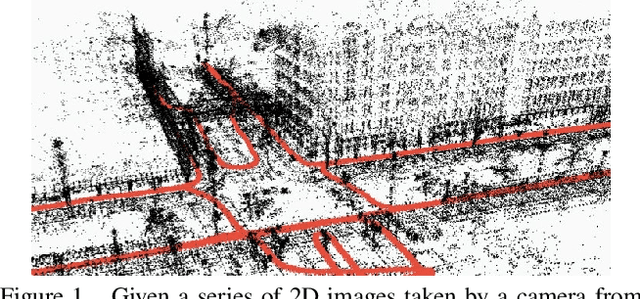

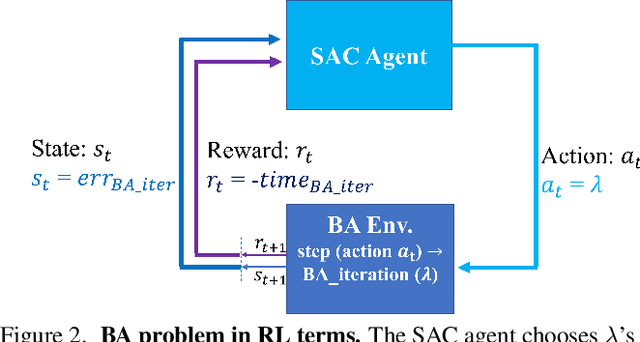

Bundle adjustment is the common way to solve localization and mapping. It is an iterative process in which a system of non-linear equations is solved using two optimization methods, weighted by a damping factor. In the classic approach, the latter is chosen heuristically by the Levenberg-Marquardt algorithm on each iteration. This might take many iterations, making the process computationally expensive, which might be harmful to real-time applications. We propose to replace this heuristic by viewing the problem in a holistic manner, as a game, and formulating it as a reinforcement-learning task. We set an environment which solves the non-linear equations and train an agent to choose the damping factor in a learned manner. We demonstrate that our approach considerably reduces the number of iterations required to reach the bundle adjustment's convergence, on both synthetic and real-life scenarios. We show that this reduction benefits the classic approach and can be integrated with other bundle adjustment acceleration methods.
Random Walks for Adversarial Meshes
Feb 15, 2022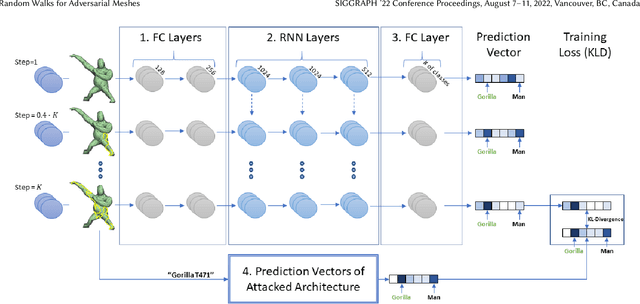
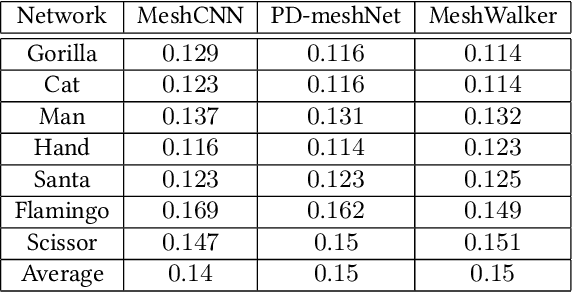
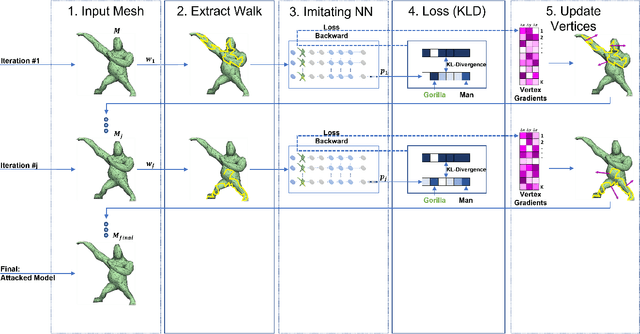
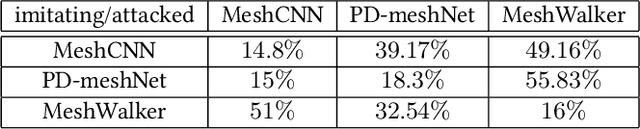
A polygonal mesh is the most-commonly used representation of surfaces in computer graphics; thus, a variety of classification networks have been recently proposed. However, while adversarial attacks are wildly researched in 2D, almost no works on adversarial meshes exist. This paper proposes a novel, unified, and general adversarial attack, which leads to misclassification of numerous state-of-the-art mesh classification neural networks. Our attack approach is black-box, i.e. it has access only to the network's predictions, but not to the network's full architecture or gradients. The key idea is to train a network to imitate a given classification network. This is done by utilizing random walks along the mesh surface, which gather geometric information. These walks provide insight onto the regions of the mesh that are important for the correct prediction of the given classification network. These mesh regions are then modified more than other regions in order to attack the network in a manner that is barely visible to the naked eye.