 Add to Chrome
 Add to Firefox
 Add to Edge
Fail-RAG : A Retrieval Augmented Generation Informed Framework for Robot Failure Identification
Jun 17, 2026
Industry automation is witnessing an evolution in robotics driven by both technological breakthroughs and societal changes: progress towards generalist robots, embodied and physical artificial intelligence (AI), and increasing labor shortage in manufacturing.An intelligent autonomous robot needs to not only act according to planned motions but also react to any unexpected events. In this study, we focus on such unexpected events in warehouses where robots are used for material handling. Specifically, we refer to any unexpected events as failures and develop methods to detect robot operations related failures. Rule-based detection methods may break since the form of failures could change due to the dynamic nature of both environments and tasks. We propose 'Fail-RAG', a Retrieval Augmented Generation (RAG)-based failure detection framework where failure images and context information are embedded and queried against a failure database by calculating their similarities. Vision-Language Models (VLMs) are further used to analyze failures and provide details by following our instruction template. We evaluated the performance of Fail-RAG by conducting both simulation and physical experiments using fixed robot arms and a mobile manipulator for multiple tasks that are common in warehouse automation. Fail-RAG achieved 25 percentage point higher failure detection accuracy on average across five types of robot operations compared to using off-the-shelf VLMs, indicating its effectiveness for real-world failure detection.

Characterizing gaussian mixture of motion modes for skid-steer state estimation
Apr 30, 2025Skid-steered wheel mobile robots (SSWMRs) are characterized by the unique domination of the tire-terrain skidding for the robot to move. The lack of reliable friction models cascade into unreliable motion models, especially the reduced ordered variants used for state estimation and robot control. Ensemble modeling is an emerging research direction where the overall motion model is broken down into a family of local models to distribute the performance and resource requirement and provide a fast real-time prediction. To this end, a gaussian mixture model based modeling identification of model clusters is adopted and implemented within an interactive multiple model (IMM) based state estimation. The framework is adopted and implemented for angular velocity as the estimated state for a mid scaled skid-steered wheel mobile robot platform.
Online identification of skidding modes with interactive multiple model estimation
Sep 30, 2024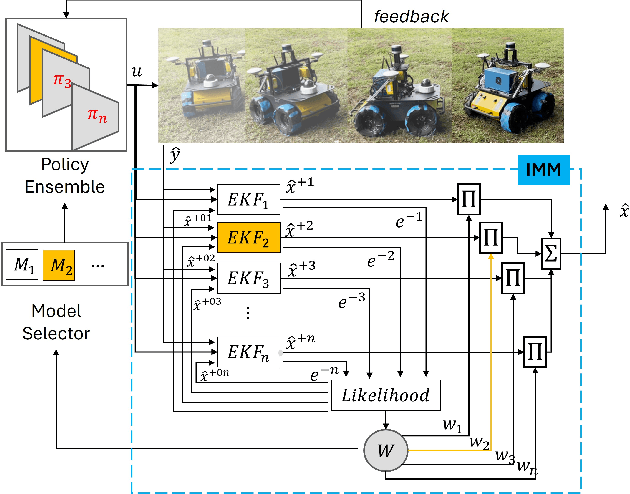
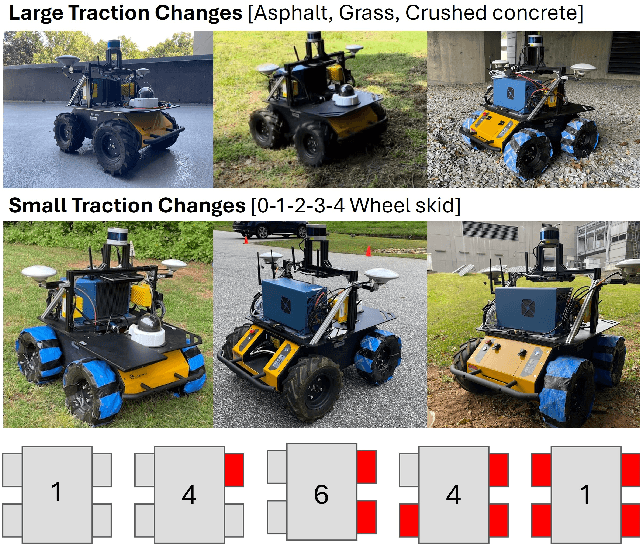
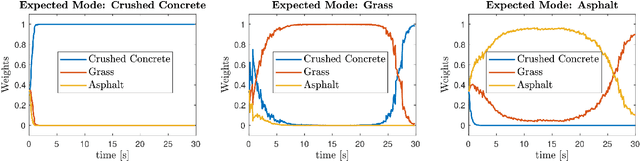
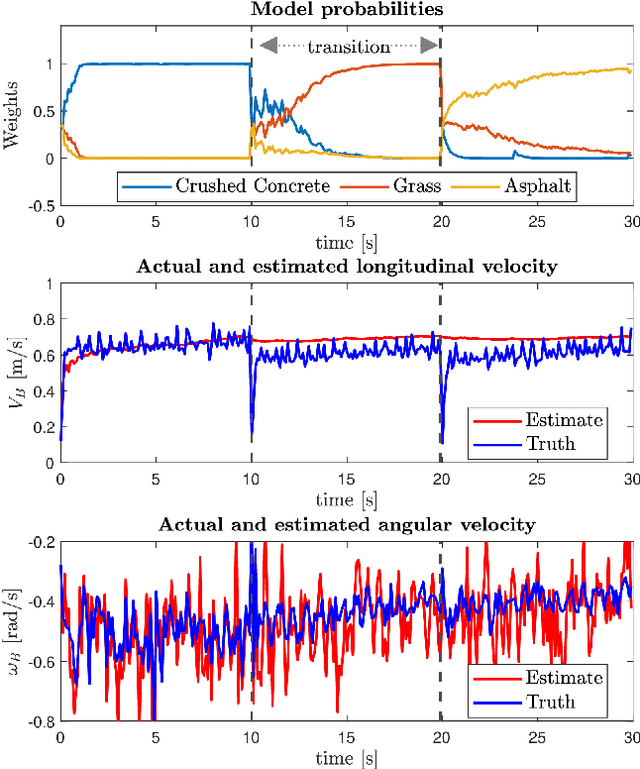
Skid-steered wheel mobile robots (SSWMRs) operate in a variety of outdoor environments exhibiting motion behaviors dominated by the effects of complex wheel-ground interactions. Characterizing these interactions is crucial both from the immediate robot autonomy perspective (for motion prediction and control) as well as a long-term predictive maintenance and diagnostics perspective. An ideal solution entails capturing precise state measurements for decisions and controls, which is considerably difficult, especially in increasingly unstructured outdoor regimes of operations for these robots. In this milieu, a framework to identify pre-determined discrete modes of operation can considerably simplify the motion model identification process. To this end, we propose an interactive multiple model (IMM) based filtering framework to probabilistically identify predefined robot operation modes that could arise due to traversal in different terrains or loss of wheel traction.
Stabilization of vertical motion of a vehicle on bumpy terrain using deep reinforcement learning
Sep 21, 2024Stabilizing vertical dynamics for on-road and off-road vehicles is an important research area that has been looked at mostly from the point of view of ride comfort. The advent of autonomous vehicles now shifts the focus more towards developing stabilizing techniques from the point of view of onboard proprioceptive and exteroceptive sensors whose real-time measurements influence the performance of an autonomous vehicle. The current solutions to this problem of managing the vertical oscillations usually limit themselves to the realm of active suspension systems without much consideration to modulating the vehicle velocity, which plays an important role by the virtue of the fact that vertical and longitudinal dynamics of a ground vehicle are coupled. The task of stabilizing vertical oscillations for military ground vehicles becomes even more challenging due lack of structured environments, like city roads or highways, in off-road scenarios. Moreover, changes in structural parameters of the vehicle, such as mass (due to changes in vehicle loading), suspension stiffness and damping values can have significant effect on the controller's performance. This demands the need for developing deep learning based control policies, that can take into account an extremely large number of input features and approximate a near optimal control action. In this work, these problems are addressed by training a deep reinforcement learning agent to minimize the vertical acceleration of a scaled vehicle travelling over bumps by controlling its velocity.