 Add to Chrome
 Add to Firefox
 Add to Edge
A Neurosymbolic Approach for Explainable Early Diagnosis of Alzheimer's Disease
Jul 31, 2026
Identifying reliable Alzheimer's disease (AD) markers typically requires manual, labor-intensive transcription and expert analysis, limiting its scale. We introduce an automated pipeline that extracts qualitative knowledge about potential AD progression indicators directly from audio recordings of verbal fluency tests. Our method uses pretrained foundation models to process raw audio and extract clinically relevant variables to construct a Bayesian Network (BN); this BN is used to reason about the AD progression markers and infer their qualitative relationships. Our system successfully recovers known clinical knowledge and identifies novel relationships between linguistic markers.

Learning Relational Dependency Networks for Relation Extraction
Jul 01, 2016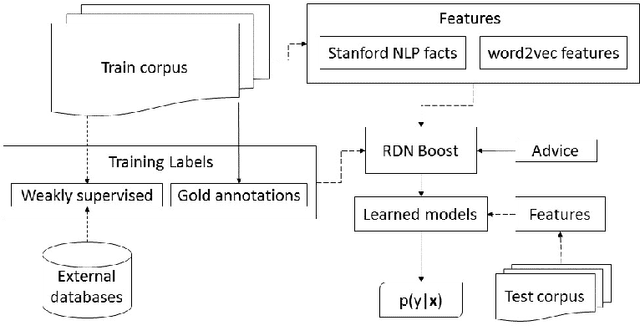

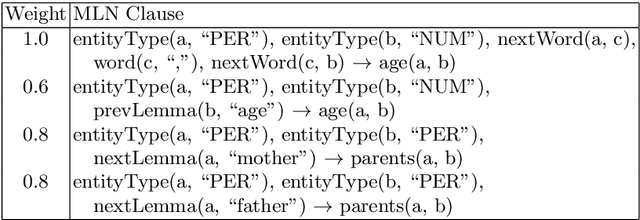
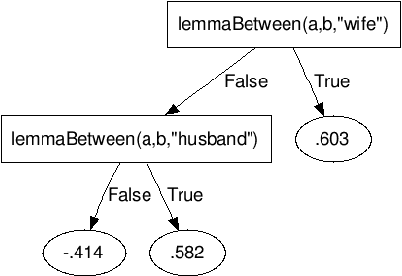
We consider the task of KBP slot filling -- extracting relation information from newswire documents for knowledge base construction. We present our pipeline, which employs Relational Dependency Networks (RDNs) to learn linguistic patterns for relation extraction. Additionally, we demonstrate how several components such as weak supervision, word2vec features, joint learning and the use of human advice, can be incorporated in this relational framework. We evaluate the different components in the benchmark KBP 2015 task and show that RDNs effectively model a diverse set of features and perform competitively with current state-of-the-art relation extraction.