 Add to Chrome
 Add to Firefox
 Add to Edge
From Design to Validation: Preparing a LEO-Capable UE for End-to-End System Evaluation
Mar 09, 2026
The extension of 5G connectivity through Low-Earth Orbit satellite systems introduces significant technical challenges, particularly due to time-varying propagation delays and high Doppler shifts resulting from satellite motion. While the Third Generation Partnership Project Release 17 established the initial framework for non-terrestrial networks, the ongoing developments in Release 19 further enhance this effort by introducing support for regenerative payload architectures, where part of the communication protocol stack is processed directly on board the satellite. In this work, we present the design of a 5G user equipment adapted for Low-Earth Orbit satellite connectivity, with specific focus on strategies for managing variable delay and Doppler compensation. Additionally, we describe a custom experimental platform based on a drone-mounted software-defined radio platform capable of emulating both transparent and regenerative satellite payloads. Although full end-to-end system validation is not yet complete, initial laboratory tests confirm the feasibility of the architecture and lay the groundwork for future experimental campaigns.

Spatially Consistent Air-to-Ground Channel Modeling via Generative Neural Networks
Feb 05, 2024

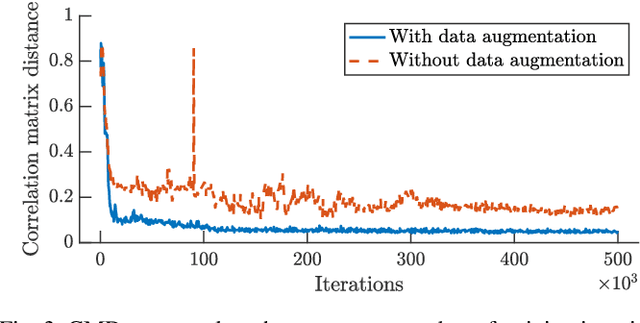
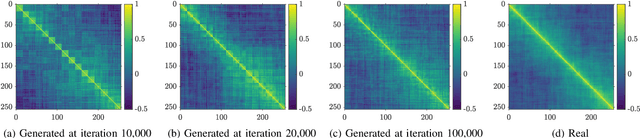
This article proposes a generative neural network architecture for spatially consistent air-to-ground channel modeling. The approach considers the trajectories of uncrewed aerial vehicles along typical urban paths, capturing spatial dependencies within received signal strength (RSS) sequences from multiple cellular base stations (gNBs). Through the incorporation of conditioning data, the model accurately discriminates between gNBs and drives the correlation matrix distance between real and generated sequences to minimal values. This enables evaluating performance and mobility management metrics with spatially (and by extension temporally) consistent RSS values, rather than independent snapshots. For some tasks underpinned by these metrics, say handovers, consistency is essential.