 Add to Chrome
 Add to Firefox
 Add to Edge
From Design to Validation: Preparing a LEO-Capable UE for End-to-End System Evaluation
Mar 09, 2026
The extension of 5G connectivity through Low-Earth Orbit satellite systems introduces significant technical challenges, particularly due to time-varying propagation delays and high Doppler shifts resulting from satellite motion. While the Third Generation Partnership Project Release 17 established the initial framework for non-terrestrial networks, the ongoing developments in Release 19 further enhance this effort by introducing support for regenerative payload architectures, where part of the communication protocol stack is processed directly on board the satellite. In this work, we present the design of a 5G user equipment adapted for Low-Earth Orbit satellite connectivity, with specific focus on strategies for managing variable delay and Doppler compensation. Additionally, we describe a custom experimental platform based on a drone-mounted software-defined radio platform capable of emulating both transparent and regenerative satellite payloads. Although full end-to-end system validation is not yet complete, initial laboratory tests confirm the feasibility of the architecture and lay the groundwork for future experimental campaigns.

Pragmatic Earth-Fixed Beam Management for 3GPP NTN Common Signaling in LEO Satellites
Dec 16, 2025This work proposes a pragmatic method for the design of beam footprint layouts and beam hopping illumination patterns to efficiently broadcast 3GPP NTN common signaling to large coverage areas using EIRP-limited LEO satellites. This method minimizes the time resources required to sweep over the whole coverage while ensuring that the signal-to-interference-plus-noise ratio received by users is above a given threshold. It discusses the design of: (i) an Earth-fixed grid of beam layouts; (ii) beamforming vectors and beam power allocation; (iii) beam hopping patterns and (iv) space, time and frequency resource allocation of 3GPP common signaling. Two main beam layout solutions are proposed to significantly reduce the number of beams required to illuminate the coverage area: one based on phased array beams with low beam crossover levels and the other on widened beams. A numerical evaluation using practical system parameters showed that both solutions perform similarly, but that the best result is obtained with phased arrays beams with optimized beam cross over levels. Indeed, for the system evaluated, they allowed reducing the total number of beams from 1723 to 451, which combined with a proper beam hopping pattern and scheduling scheme allowed obtaining a coverage ratio of 100% and a common signaling efficiency (i.e. number of slots carrying common signaling over total number of slots) up to 80.6% for the most stringent common signaling periodicity of 20 ms considered by 3GPP.
Kolmogorov-Arnold Networks (KANs) for Time Series Analysis
May 14, 2024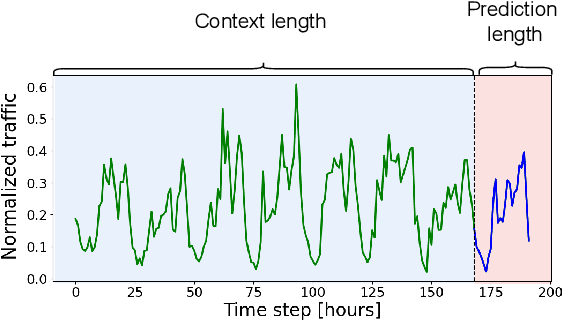

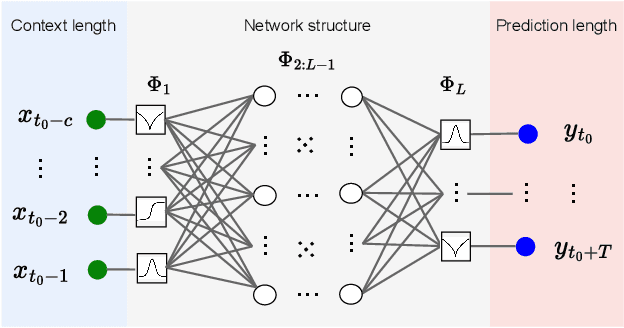
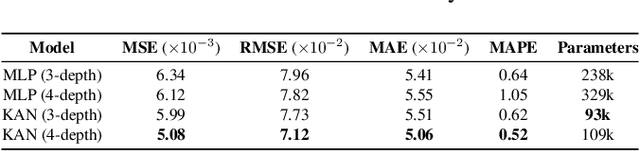
This paper introduces a novel application of Kolmogorov-Arnold Networks (KANs) to time series forecasting, leveraging their adaptive activation functions for enhanced predictive modeling. Inspired by the Kolmogorov-Arnold representation theorem, KANs replace traditional linear weights with spline-parametrized univariate functions, allowing them to learn activation patterns dynamically. We demonstrate that KANs outperforms conventional Multi-Layer Perceptrons (MLPs) in a real-world satellite traffic forecasting task, providing more accurate results with considerably fewer number of learnable parameters. We also provide an ablation study of KAN-specific parameters impact on performance. The proposed approach opens new avenues for adaptive forecasting models, emphasizing the potential of KANs as a powerful tool in predictive analytics.
From 5G to 6G: Revolutionizing Satellite Networks through TRANTOR Foundation
Nov 02, 2023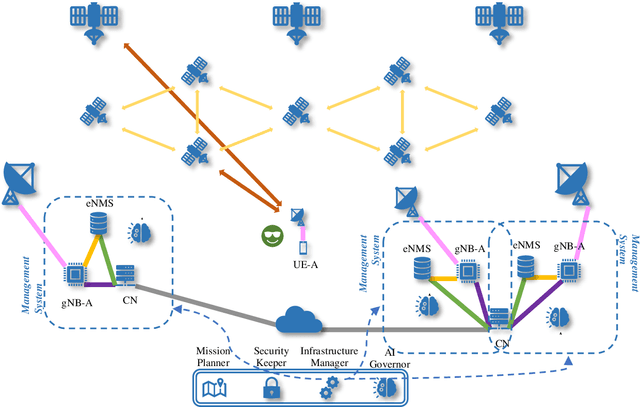
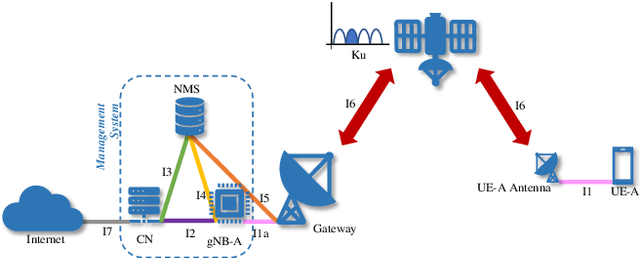
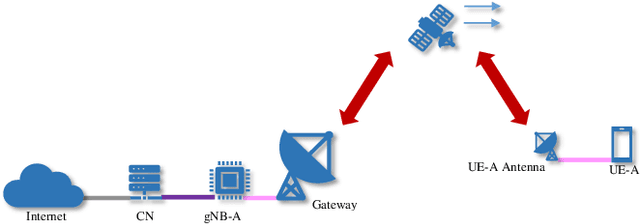
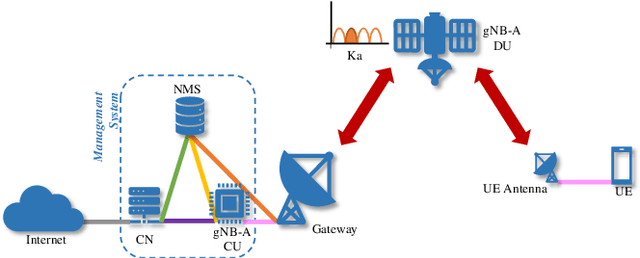
5G technology will drastically change the way satellite internet providers deliver services by offering higher data speeds, massive network capacity, reduced latency, improved reliability and increased availability. A standardised 5G ecosystem will enable adapting 5G to satellite needs. The EU-funded TRANTOR project will seek to develop novel and secure satellite network management solutions that allow scaling up heterogeneous satellite traffic demands and capacities in a cost-effective and highly dynamic way. Researchers also target the development of flexible 6G non-terrestrial access architectures. The focus will be on the design of a multi-orbit and multi-band antenna for satellite user equipment (UE), as well as the development of gNodeB (gNB) and UE 5G non-terrestrial network equipment to support multi-connectivity.