 Add to Chrome
 Add to Firefox
 Add to Edge
Context-Aware CSI Prediction for Access Point Selection Utilizing Conditional VAEs
Apr 15, 2026
Indoor wireless communication environments are strongly influenced by dynamic conditions, which affect channel state information (CSI) and, consequently, the precoding strategy and the selection of the access point (AP). Device-free sensing and localization functionalities can provide information about these conditions, including, for example, the user's position and the position of mobile blocking objects. To model the statistical relationship between the CSI and the provided conditions, we employ a conditional variational autoencoder (cVAE). We treat the user and object positions - referred to as context information - as conditional inputs to the cVAE. The proposed model does not rely on ground-truth CSI and is trained directly on noisy data. Once trained, the framework can infer channel statistics solely from user and blocking object positions, enabling proactive AP selection based on inferred statistical CSI without requiring continuous CSI estimation. Extensive simulations with the state-of-the-art ray-tracing tool Sionna validate the proposed method.

Addressing Pilot Contamination in Channel Estimation with Variational Autoencoders
Sep 11, 2024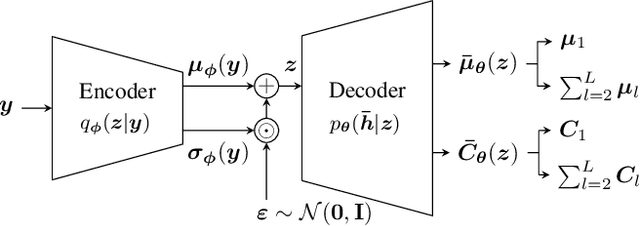
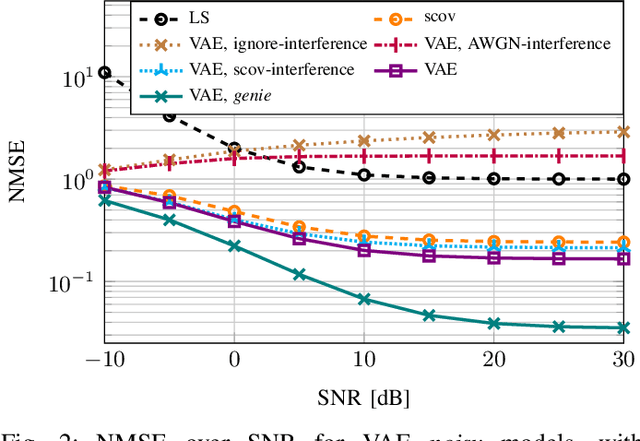
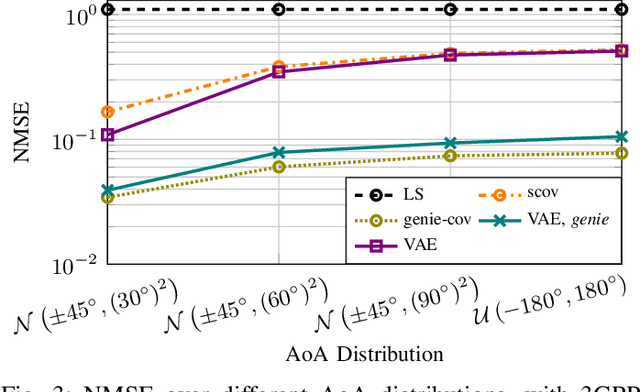
Pilot contamination (PC) is a well-known problem that affects massive multiple-input multiple-output (MIMO) systems. When frequency and pilots are reused between different cells, PC constitutes one of the main bottlenecks of the system's performance. In this paper, we propose a method based on the variational autoencoder (VAE), capable of reducing the impact of PC-related interference during channel estimation (CE). We obtain the first and second-order statistics of the conditionally Gaussian (CG) channels for both the user equipments (UEs) in a cell of interest and those in interfering cells, and we then use these moments to compute conditional linear minimum mean square error estimates. We show that the proposed estimator is capable of exploiting the interferers' additional statistical knowledge, outperforming other classical approaches. Moreover, we highlight how the achievable performance is tied to the chosen setup, making the setup selection crucial in the study of multi-cell CE.