 Add to Chrome
 Add to Firefox
 Add to Edge
Defective Task Descriptions in LLM-Based Code Generation: Detection and Analysis
Apr 27, 2026
Large language models are widely used for code generation, yet they rely on an implicit assumption that the task descriptions are sufficiently detailed and well-formed. However, in practice, users may provide defective descriptions, which can have a strong effect on code correctness. To address this issue, we develop SpecValidator, a lightweight classifier based on a small model that has been parameter-efficiently finetuned, to automatically detect task description defects. We evaluate SpecValidator on three types of defects, Lexical Vagueness, Under-Specification and Syntax-Formatting on 3 benchmarks with task descriptions of varying structure and complexity. Our results show that SpecValidator achieves defect detection of F1 = 0.804 and MCC = 0.745, significantly outperforming GPT-5-mini (F1 = 0.469 and MCC = 0.281) and Claude Sonnet 4 (F1 = 0.518 and MCC = 0.359). Perhaps more importantly, our analysis indicates that SpecValidator can generalize to unseen issues and detect unknown Under-Specification defects in the original (real) descriptions of the benchmarks used. Our results also show that the robustness of LLMs in task description defects depends primarily on the type of defect and the characteristics of the task description, rather than the capacity of the model, with Under-Specification defects being the most severe. We further found that benchmarks with richer contextual grounding, such as LiveCodeBench, exhibit substantially greater resilience, highlighting the importance of structured task descriptions for reliable LLM-based code generation.

When Prompts Go Wrong: Evaluating Code Model Robustness to Ambiguous, Contradictory, and Incomplete Task Descriptions
Jul 27, 2025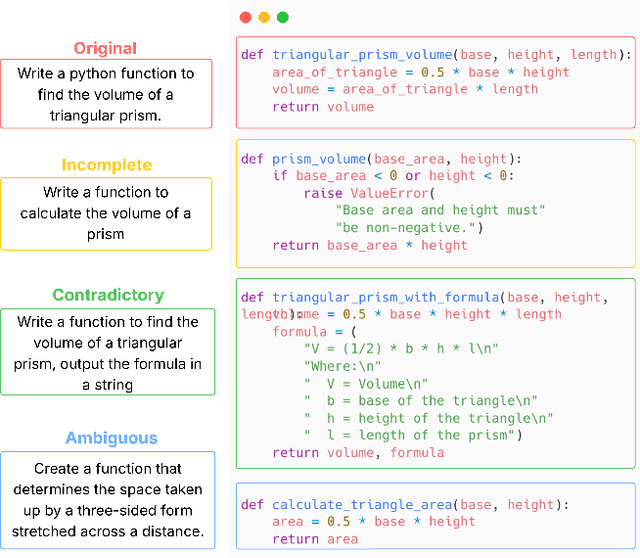
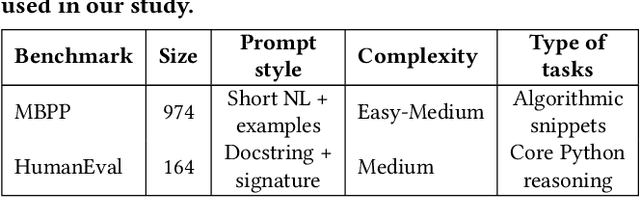
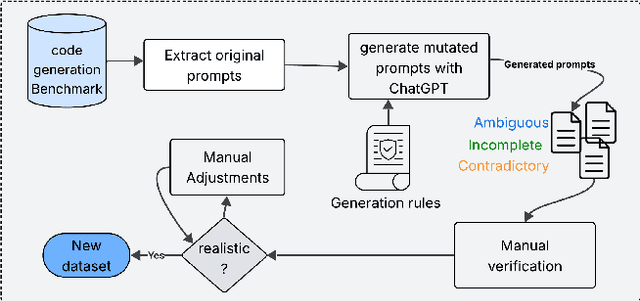
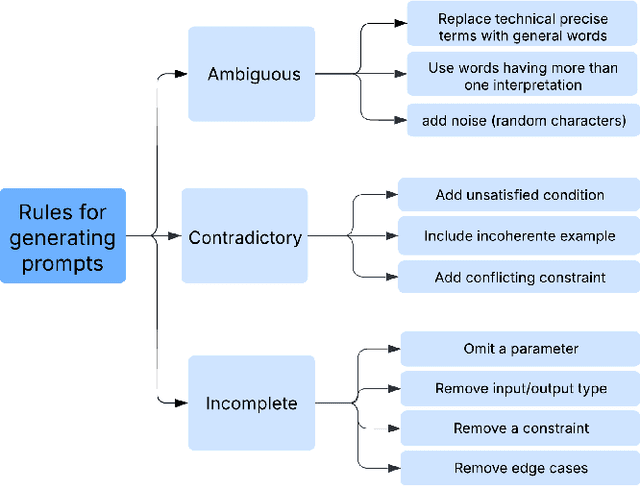
Large Language Models (LLMs) have demonstrated impressive performance in code generation tasks under idealized conditions, where task descriptions are clear and precise. However, in practice, task descriptions frequently exhibit ambiguity, incompleteness, or internal contradictions. In this paper, we present the first empirical study examining the robustness of state-of-the-art code generation models when faced with such unclear task descriptions. We extend the HumanEval and MBPP benchmarks by systematically introducing realistic task descriptions flaws through guided mutation strategies, producing a dataset that mirrors the messiness of informal developer instructions. We evaluate multiple LLMs of varying sizes and architectures, analyzing their functional correctness and failure modes across task descriptions categories. Our findings reveal that even minor imperfections in task description phrasing can cause significant performance degradation, with contradictory task descriptions resulting in numerous logical errors. Moreover, while larger models tend to be more resilient than smaller variants, they are not immune to the challenges posed by unclear requirements. We further analyze semantic error patterns and identify correlations between description clarity, model behavior, and error types. Our results underscore the critical need for developing LLMs that are not only powerful but also robust to the imperfections inherent in natural user tasks, highlighting important considerations for improving model training strategies, designing more realistic evaluation benchmarks, and ensuring reliable deployment in practical software development environments.