 Add to Chrome
 Add to Firefox
 Add to Edge
Toward CT-Equivalent Image Quality in Low-Dose Radiotherapy Planning: Conditional Diffusion-Based CBCT-to-CT Synthesis and the Impact of CBCT Input Representation
Aug 09, 2026
During standard radiotherapy planning, repeated CT acquisitions are often required for patient registration, verification, and adaptive planning, resulting in increased cumulative X-ray dose. To mitigate this, low-dose cone-beam CT (CBCT) is routinely acquired during treatment delivery. However, CBCT image quality remains insufficient for accurate dose calculation and adaptive radiotherapy planning due to increased scatter, noise, beam hardening, and reconstruction related artifacts. This study develops a supervised deep learning based CBCT to CT synthesis framework using a conditional denoising diffusion probabilistic model (DDPM), where the generation of a CT-based planning for accurate positioning and dose calculation is obtained using generative models with low dose CBCT imaging. Beyond demonstrating CBCT to CT synthesis, the primary objective is to investigate how the representation of CBCT input data, either standard clinical DICOM CBCT images or filtered back-projection (FDK) reconstructions from raw projection data, affects the performance of diffusion based CT synthesis. The overarching aim is to assess whether physics aware CBCT representations better support CT-equivalent image quality while maintaining reduced imaging dose in radiotherapy workflows.

Dual-Domain Equivariant Generative Adversarial Network for Multimodal CT-PET Synthesis
Jun 11, 2026We present a Dual-Domain Equivariant Generative Adversarial Network (DDE-GAN) for multimodal CT-PET image synthesis. Traditional GAN-based approaches often operate solely in the spatial domain and ignore geometric consistency, resulting in limited structural fidelity. DDE-GAN addresses these challenges by jointly learning from both spatial and frequency (Fourier) domains, capturing complementary anatomical and spectral information. Furthermore, rotational equivariance embedded in the physics of the CT and PET measurements are integrated into the loss of both the generator and discriminator to ensure consistent responses under rotations, improving anatomical accuracy. A hierarchical dual-domain training strategy enforces intra- and inter-domain consistency through multi-stage loss functions. Evaluated on the HECKTOR 2022 CT-PET dataset, DDE-GAN achieves superior synthesis quality over baseline models for CT-PET image synthesis. The results demonstrate that combining dual-domain learning with geometric equivariance substantially enhances multimodal image synthesis accuracy and robustness, enabling practical applications in PET completion and data augmentation.
EPC-3D-Diff: Equivariant Physics Consistent Conditional 3D Latent Diffusion for CBCT to CT Synthesis
May 19, 2026Cone-beam CT (CBCT) is routinely acquired during radiotherapy for patient setup, but its quantitative reliability is degraded by scatter, noise, and reconstruction artifacts, limiting Hounsfield Unit (HU) accuracy. We propose EPC-3D-Diff, a novel conditional 3D latent diffusion framework for volumetric CBCT to CT synthesis that introduces a projection domain equivariance loss derived from acquisition physics. Unlike common image domain equivariance, we exploit the fact that an in plane rotation of the volume corresponds to an angular shift in its projections. During training, we enforce this relationship by forward projecting rotated synthesized CT volumes and matching them to appropriately angle shifted projections of the paired target CT, yielding a physics consistent equivariance constraint integrated into the diffusion objective. To capture full 3D context efficiently, conditional diffusion is performed in a compact latent space learnt by a lightweight 3D autoencoder, preserving axial depth while downsampling in plane resolution for stable training. We validate on a paired head CBCT/CT phantom dataset, including repeat scans, and paired clinical data using patient wise splits, and perform single and mixed domain training, ablations, and comparisons with diffusion and CycleGAN. EPC-3D-Diff generalizes well and achieved substantial improvements, +7.4 dB (phantom) and +1.8 dB (clinical data) in PSNR compared to state of the art methods, alongside improved SSIM and HU accuracy, within tissue boundaries. Overall, EPC-3D-Diff improves robustness and physics consistency, supporting HU aware synthesis for downstream radiotherapy workflows.
EqDiff-CT: Equivariant Conditional Diffusion model for CT Image Synthesis from CBCT
Sep 26, 2025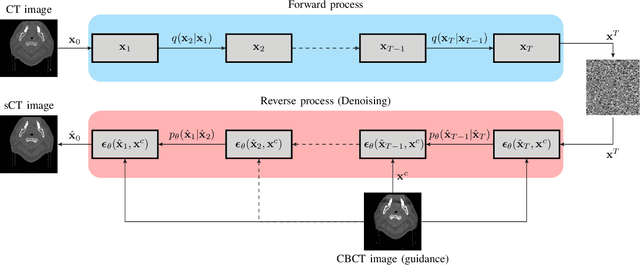
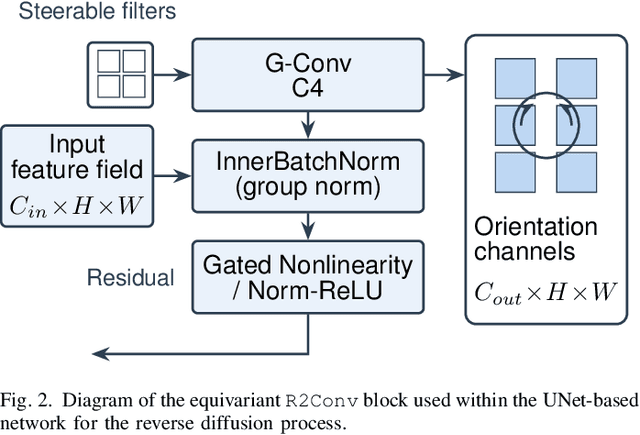
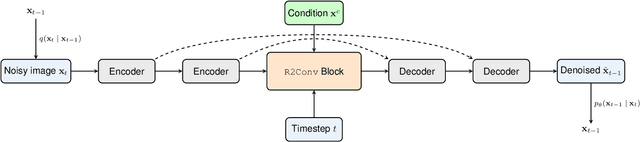
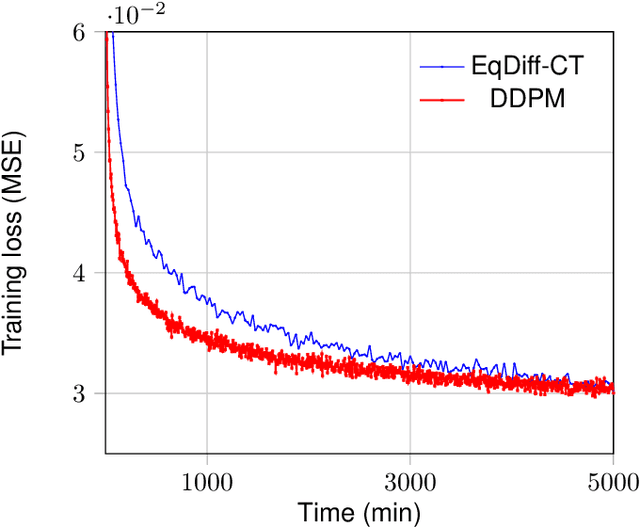
Cone-beam computed tomography (CBCT) is widely used for image-guided radiotherapy (IGRT). It provides real time visualization at low cost and dose. However, photon scattering and beam hindrance cause artifacts in CBCT. These include inaccurate Hounsfield Units (HU), reducing reliability for dose calculation, and adaptive planning. By contrast, computed tomography (CT) offers better image quality and accurate HU calibration but is usually acquired offline and fails to capture intra-treatment anatomical changes. Thus, accurate CBCT-to-CT synthesis is needed to close the imaging-quality gap in adaptive radiotherapy workflows. To cater to this, we propose a novel diffusion-based conditional generative model, coined EqDiff-CT, to synthesize high-quality CT images from CBCT. EqDiff-CT employs a denoising diffusion probabilistic model (DDPM) to iteratively inject noise and learn latent representations that enable reconstruction of anatomically consistent CT images. A group-equivariant conditional U-Net backbone, implemented with e2cnn steerable layers, enforces rotational equivariance (cyclic C4 symmetry), helping preserve fine structural details while minimizing noise and artifacts. The system was trained and validated on the SynthRAD2025 dataset, comprising CBCT-CT scans across multiple head-and-neck anatomical sites, and we compared it with advanced methods such as CycleGAN and DDPM. EqDiff-CT provided substantial gains in structural fidelity, HU accuracy and quantitative metrics. Visual findings further confirm the improved recovery, sharper soft tissue boundaries, and realistic bone reconstructions. The findings suggest that the diffusion model has offered a robust and generalizable framework for CBCT improvements. The proposed solution helps in improving the image quality as well as the clinical confidence in the CBCT-guided treatment planning and dose calculations.