 Add to Chrome
 Add to Firefox
 Add to Edge
Learning Energy-Efficient Modular Arrays under Hardware Non-linearities
May 21, 2026
This paper investigates the joint optimization of power allocation and antenna activation in sparse extremely large aperture array systems operating under power amplifier non-linearities. We first derive an analytical expression for the achievable spectral efficiency (SE) of point-to-point MIMO channels affected by non-linear distortions using the Bussgang decomposition. To address the combinatorial and non-convex nature of the energy-efficiency (EE) maximization problem, we employ an unsupervised deep neural network (DNN) that learns the non-linear mapping between the channel state information and the optimal EE operating point. The DNN jointly predicts distortion-aware power allocation, total transmit power scaling, and modular sub-array activation based on singular-value and geometric channel features. Numerical results demonstrate that the proposed DNN-based arrays achieve significant EE gains over the conventional sparse arrays.

Performance Evaluation of Movable Antenna Arrays in Wideband Multi-User MIMO Systems
Mar 23, 2026Future wireless networks are expected to support increasingly high data rates and user densities, motivating advanced multi-antenna architectures capable of adapting to dynamic propagation environments. Movable antenna (MA) arrays have recently emerged as an extension of massive MIMO, enabling physical repositioning of antenna elements to better exploit spatial diversity and mitigate inter-user interference. While prior studies report promising gains under idealized assumptions, their performance under realistic wideband multi-user operation remains insufficiently understood. This paper presents a comprehensive evaluation of MA-enabled systems in practical uplink and downlink scenarios. A wideband OFDM system model is developed, and novel closed-form sum-rate expressions are derived for both uplink and downlink under linear and nonlinear processing. Hardware impairments are incorporated via an EVM-based model, from which a distortion-aware UL/DL duality is established and the resulting high-SNR sum rate ceiling is analytically characterized. In addition, the interactions between antenna position optimization, receiver processing, and user loading are examined, and performance is evaluated under both time-division duplexing (TDD) and frequency-division duplexing (FDD). The results show that movable antennas can provide noticeable gains in low-impairment regimes with strong multi-user interference, but these benefits are highly scenario-dependent and diminish under hardware-impairment-limited conditions or in rich-scattering environments. These findings highlight the importance of carefully assessing deployment conditions when considering antenna mobility as an alternative to conventional fixed array configurations.
Quantized Precoding for Maximizing Sum Rate in MU-MIMO Systems with Constrained Fronthaul
Feb 27, 2026This paper studies a downlink multi-user multiple-input multiple-output (MU-MIMO) system, where the precoding matrix is computed at a baseband unit (BBU) and then transmitted to the remote antenna array over a limited-capacity digital fronthaul. The limited bit resolution of the fronthaul introduces quantization effects that are explicitly modeled. We propose a novel sum rate maximization framework that directly incorporates the quantizer's constraints into the precoding design. The resulting maximization problem, a non-convex mixed-integer program, is addressed using a new iterative algorithm inspired by the weighted minimum mean square error (WMMSE) methodology. The precoding optimization subproblem is reformulated as an integer least-squares problem and solved using a novel sphere decoding (SD) algorithm. Additionally, a low-complexity expectation propagation (EP)-based method is introduced to enable the practical implementation of quantized precoding in MU-massive MIMO (MU-mMIMO) systems. Furthermore, numerical evaluations demonstrate that the proposed precoding schemes outperform conventional approaches that optimize infinite-resolution precoding followed by element-wise quantization. We also propose a heuristic quantization-aware precoding method with comparable complexity to the baseline but superior performance. In particular, the EP-based approach offers near-optimal performance with substantial complexity reduction, making it well-suited for real-time MU-mMIMO applications.
Maximum A Posteriori Probability Channel Tracking with an Intelligent Transmitting Surface
Jan 27, 2026This paper considers an intelligent transmitting surface (ITS) integrated into a base station and develops a low-overhead maximum a posteriori (MAP) probability channel tracking method for the dominant line-of-sight link between the ITS and the user equipment. We cast the per-block channel as a three-parameter model consisting of the channel amplitude, channel phase, and angle-of-arrival at the ITS. We exploit temporal correlation by updating the priors using the estimates from the previous block. Using only two pilots per coherence block alongside a targeted beam alignment strategy, the proposed method achieves precise channel tracking and attains spectral efficiency close to that achievable under perfect channel knowledge.
From Antenna Abundance to Antenna Intelligence in 6G Gigantic MIMO Systems
Jan 13, 2026Current cellular systems achieve high spectral efficiency through Massive MIMO, which leverages an abundance of antennas to create favorable propagation conditions for multiuser spatial multiplexing. Looking towards future networks, the extrapolation of this paradigm leads to systems with many hundreds of antennas per base station, raising concerns regarding hardware complexity, cost, and power consumption. This article suggests more intelligent array designs that reduce the need for excessive antenna numbers. We revisit classical uniform array design principles and explain how their uniform spatial sampling leads to unnecessary redundancies in practical deployment scenarios. By exploiting non-uniform sparse arrays with site-specific antenna placements -- based on either pre-optimized irregular arrays or real-time movable antennas -- we demonstrate how superior multiuser MIMO performance can be achieved with far fewer antennas. These principles are inspired by previous works on wireless localization. We explain and demonstrate numerically how these concepts can be adapted for communications to improve the average sum rate and similar metrics. The results suggest a paradigm shift for future antenna array design, where antenna intelligence replaces sheer antenna count. This opens new opportunities for efficient, adaptable, and sustainable Gigantic MIMO systems.
Near-Field Beamfocusing, Localization, and Channel Estimation with Modular Linear Arrays
May 12, 2025This paper investigates how near-field beamfocusing can be achieved using a modular linear array (MLA), composed of multiple widely spaced uniform linear arrays (ULAs). The MLA architecture extends the aperture length of a standard ULA without adding additional antennas, thereby enabling near-field beamfocusing without increasing processing complexity. Unlike conventional far-field beamforming, near-field beamfocusing enables simultaneous data transmission to multiple users at different distances in the same angular interval, offering significant multiplexing gains. We present a detailed mathematical analysis of the beamwidth and beamdepth achievable with the MLA and show that by appropriately selecting the number of antennas in each constituent ULA, ideal near-field beamfocusing can be realized. In addition, we propose a computationally efficient localization method that fuses estimates from each ULA, enabling efficient parametric channel estimation. Simulation results confirm the accuracy of the analytical expressions and that MLAs achieve near-field beamfocusing with a limited number of antennas, making them a promising solution for next-generation wireless systems.
Optimizing Movable Antennas in Wideband Multi-User MIMO With Hardware Impairments
Apr 17, 2025Movable antennas represent an emerging field in telecommunication research and a potential approach to achieving higher data rates in multiple-input multiple-output (MIMO) communications when the total number of antennas is limited. Most solutions and analyses to date have been limited to \emph{narrowband} setups. This work complements the prior studies by quantifying the benefit of using movable antennas in \emph{wideband} MIMO communication systems. First, we derive a novel uplink wideband system model that also accounts for distortion from transceiver hardware impairments. We then formulate and solve an optimization task to maximize the average sum rate by adjusting the antenna positions using particle swarm optimization. Finally, the performance with movable antennas is compared with fixed uniform arrays and the derived theoretical upper bound. The numerical study concludes that the data rate improvement from movable antennas over other arrays heavily depends on the level of hardware impairments, the richness of the multi-path environments, and the number of subcarriers. The present study provides vital insights into the most suitable use cases for movable antennas in future wideband systems.
Limited-Resolution Hybrid Analog-Digital Precoding Design Using MIMO Detection Methods
Mar 16, 2025While fully digital precoding achieves superior performance in massive multiple-input multiple-output (MIMO) systems, it comes with significant drawbacks in terms of computational complexity and power consumption, particularly when operating at millimeter-wave frequencies and beyond. Hybrid analog-digital architectures address this by reducing radio frequency (RF) chains while maintaining performance in sparse multipath environments. However, most hybrid precoder designs assume ideal, infinite-resolution analog phase shifters, which cannot be implemented in actual systems. Another practical constraint is the limited fronthaul capacity between the baseband processor and array, implying that each entry of the digital precoder must be picked from a finite set of quantization labels. This paper proposes novel designs for the limited-resolution analog and digital precoders by exploiting two well-known MIMO symbol detection algorithms, namely sphere decoding (SD) and expectation propagation (EP). The goal is to minimize the Euclidean distance between the optimal fully digital precoder and the hybrid precoder to minimize the degradation caused by the finite resolution of the analog and digital precoders. Taking an alternative optimization approach, we first apply the SD method to find the precoders in each iteration optimally. Then, we apply the lower-complexity EP method which finds a near-optimal solution at a reduced computational cost. The effectiveness of the proposed designs is validated via numerical simulations, where we show that the proposed symbol detection-based precoder designs significantly outperform the nearest point mapping scheme which is commonly used for finding a sub-optimal solution to discrete optimization problems.
Pre-Optimized Irregular Arrays versus Moveable Antennas in Multi-User MIMO Systems
Feb 06, 2025
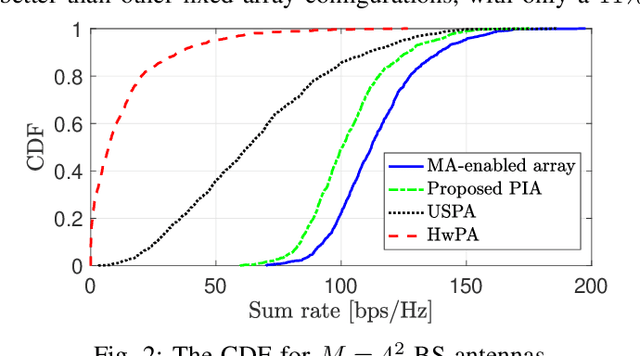


Massive multiple-input multiple-output (MIMO) systems exploit the spatial diversity achieved with an array of many antennas to perform spatial multiplexing of many users. Similar performance can be achieved using fewer antennas if movable antenna (MA) elements are used instead. MA-enabled arrays can dynamically change the antenna locations, mechanically or electrically, to achieve maximum spatial diversity for the current propagation conditions. However, optimizing the antenna locations for each channel realization is computationally excessive, requires channel knowledge for all conceivable locations, and requires rapid antenna movements, thus making real-time implementation cumbersome. To overcome these challenges, we propose a pre-optimized irregular array (PIA) concept, where the antenna locations at the base station are optimized a priori for a given coverage area. The objective is to maximize the average sum rate and we take a particle swarm optimization approach to solve it. Simulation results show that PIA achieves performance comparable to MA-enabled arrays while outperforming traditional uniform arrays. Hence, PIA offers a fixed yet efficient array deployment approach without the complexities associated with MA-enabled arrays.
A Novel Hybrid Precoder With Low-Resolution Phase Shifters and Fronthaul Capacity Limitation
Jan 18, 2025In massive MIMO systems, fully digital precoding offers high performance but has significant implementation complexity and energy consumption, particularly at millimeter frequencies and beyond. Hybrid analog-digital architectures provide a practical alternative by reducing the number of radio frequency (RF) chains while retaining performance in spatially sparse multipath scenarios. However, most hybrid precoder designs assume ideal, infinite-resolution analog phase shifters, which are impractical in real-world scenarios. Another practical constraint is the limited fronthaul capacity between the baseband processor and array, implying that each entry of the digital precoder must be picked from a finite set of quantization labels. To minimize the sum rate degradation caused by quantized analog and digital precoders, we propose novel designs inspired by the sphere decoding (SD) algorithm. We demonstrate numerically that our proposed designs outperform traditional methods, ensuring minimal sum rate loss in hybrid precoding systems with low-resolution phase shifters and limited fronthaul capacity.