 Add to Chrome
 Add to Firefox
 Add to Edge
Manifold Aware Denoising Score Matching (MAD)
Mar 02, 2026
A major focus in designing methods for learning distributions defined on manifolds is to alleviate the need to implicitly learn the manifold so that learning can concentrate on the data distribution within the manifold. However, accomplishing this often leads to compute-intensive solutions. In this work, we propose a simple modification to denoising score-matching in the ambient space to implicitly account for the manifold, thereby reducing the burden of learning the manifold while maintaining computational efficiency. Specifically, we propose a simple decomposition of the score function into a known component $s^{base}$ and a remainder component $s-s^{base}$ (the learning target), with the former implicitly including information on where the data manifold resides. We derive known components $s^{base}$ in analytical form for several important cases, including distributions over rotation matrices and discrete distributions, and use them to demonstrate the utility of this approach in those cases.

Generative Topological Networks
Jun 21, 2024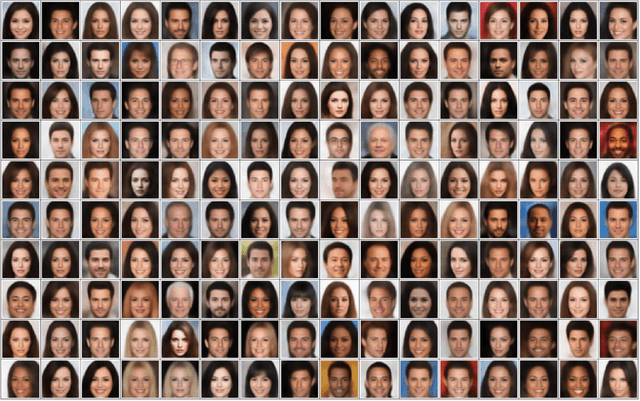


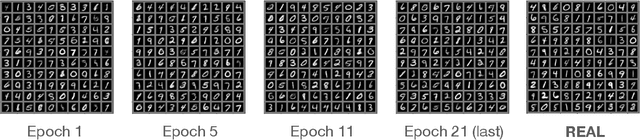
Generative models have seen significant advancements in recent years, yet often remain challenging and costly to train and use. We introduce Generative Topological Networks (GTNs) -- a new class of generative models that addresses these shortcomings. GTNs are trained deterministically using a simple supervised learning approach grounded in topology theory. GTNs are fast to train, and require only a single forward pass in a standard feedforward neural network to generate samples. We demonstrate the strengths of GTNs in several datasets, including MNIST, celebA and the Hands and Palm Images dataset. Finally, the theory behind GTNs offers insights into how to train generative models for improved performance.