 Add to Chrome
 Add to Firefox
 Add to Edge
Manifold Aware Denoising Score Matching (MAD)
Mar 02, 2026
A major focus in designing methods for learning distributions defined on manifolds is to alleviate the need to implicitly learn the manifold so that learning can concentrate on the data distribution within the manifold. However, accomplishing this often leads to compute-intensive solutions. In this work, we propose a simple modification to denoising score-matching in the ambient space to implicitly account for the manifold, thereby reducing the burden of learning the manifold while maintaining computational efficiency. Specifically, we propose a simple decomposition of the score function into a known component $s^{base}$ and a remainder component $s-s^{base}$ (the learning target), with the former implicitly including information on where the data manifold resides. We derive known components $s^{base}$ in analytical form for several important cases, including distributions over rotation matrices and discrete distributions, and use them to demonstrate the utility of this approach in those cases.

Efficient Stochastic Optimisation via Sequential Monte Carlo
Jan 29, 2026The problem of optimising functions with intractable gradients frequently arise in machine learning and statistics, ranging from maximum marginal likelihood estimation procedures to fine-tuning of generative models. Stochastic approximation methods for this class of problems typically require inner sampling loops to obtain (biased) stochastic gradient estimates, which rapidly becomes computationally expensive. In this work, we develop sequential Monte Carlo (SMC) samplers for optimisation of functions with intractable gradients. Our approach replaces expensive inner sampling methods with efficient SMC approximations, which can result in significant computational gains. We establish convergence results for the basic recursions defined by our methodology which SMC samplers approximate. We demonstrate the effectiveness of our approach on the reward-tuning of energy-based models within various settings.
Learning Latent Variable Models via Jarzynski-adjusted Langevin Algorithm
May 23, 2025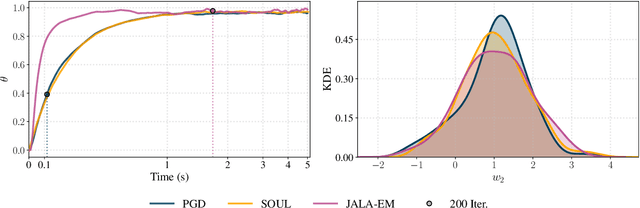
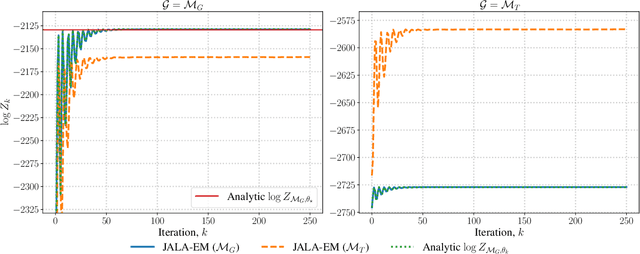
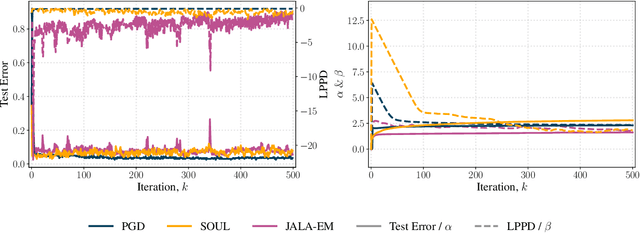
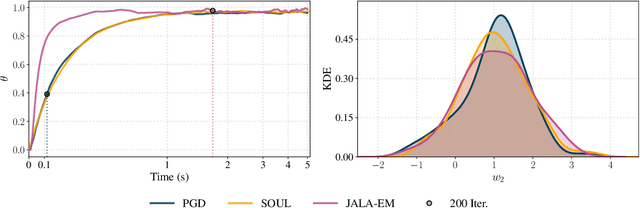
We utilise a sampler originating from nonequilibrium statistical mechanics, termed here Jarzynski-adjusted Langevin algorithm (JALA), to build statistical estimation methods in latent variable models. We achieve this by leveraging Jarzynski's equality and developing algorithms based on a weighted version of the unadjusted Langevin algorithm (ULA) with recursively updated weights. Adapting this for latent variable models, we develop a sequential Monte Carlo (SMC) method that provides the maximum marginal likelihood estimate of the parameters, termed JALA-EM. Under suitable regularity assumptions on the marginal likelihood, we provide a nonasymptotic analysis of the JALA-EM scheme implemented with stochastic gradient descent and show that it provably converges to the maximum marginal likelihood estimate. We demonstrate the performance of JALA-EM on a variety of latent variable models and show that it performs comparably to existing methods in terms of accuracy and computational efficiency. Importantly, the ability to recursively estimate marginal likelihoods - an uncommon feature among scalable methods - makes our approach particularly suited for model selection, which we validate through dedicated experiments.