 Add to Chrome
 Add to Firefox
 Add to Edge
Evolution Fine-Tuning: Learning to Discover Across 371 Optimization Tasks
Jun 27, 2026
Would experience designing faster GPU kernels also help close in on a long-standing open mathematical conjecture? Large Language Models (LLMs) integrated into evolutionary search have recently produced state-of-the-art solutions on optimization tasks, including open mathematical conjectures, GPU kernel design, scientific law discovery, and combinatorial puzzles. To achieve this, prior work applied search scaffolds to one target task at a time, so every new problem is approached from scratch and the experience accumulated during search is discarded once the model finishes its attempt. This leaves the capability of iteratively evolving a solution (e.g., knowing which part to mutate and how, deciding when to backtrack) entirely in the scaffold rather than in the model itself. Whether the model itself could acquire this capability and reuse it across different tasks has been largely unexamined. To address this, we introduce Evolution Fine-Tuning (EFT), a mid-training paradigm that teaches LLMs to evolve solutions across tasks by converting evolutionary search trajectories into supervision. We construct Finch Collection, a 156K-trajectory dataset spanning 10 domains and 371 optimization tasks, and fine-tune open-source LLMs from 2B to 9B parameters. Empirically, EFT confers cross-task generalization: across 22 held-out tasks, our models surpass their base counterparts by 10.22% on average. Furthermore, when paired with test-time RL, our model matches state-of-the-art performance on two circle-packing tasks and outperforms its base-model counterpart on the Erdős minimum-overlap problem. EFT thus serves as a "practice phase" for general-purpose discovery agents that do not solve new problems from scratch.

Detecting Offensive Memes with Social Biases in Singapore Context Using Multimodal Large Language Models
Feb 25, 2025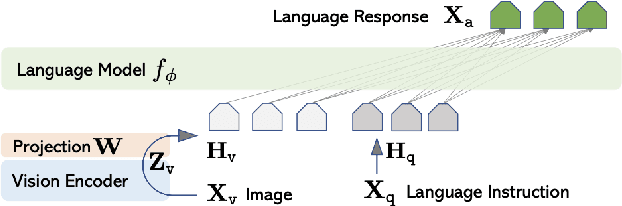
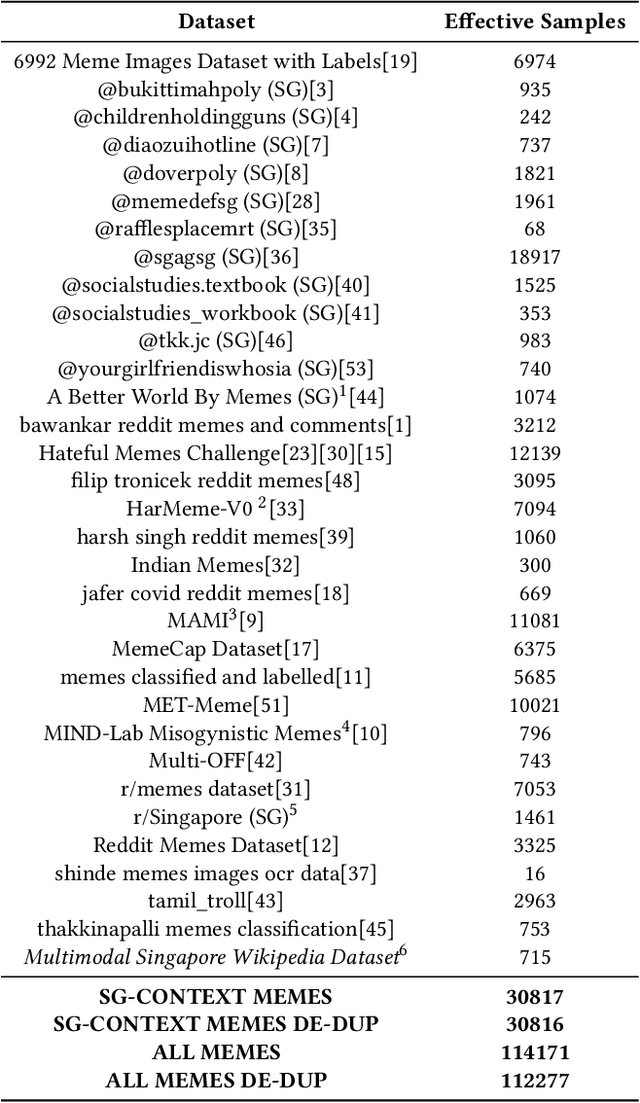

Traditional online content moderation systems struggle to classify modern multimodal means of communication, such as memes, a highly nuanced and information-dense medium. This task is especially hard in a culturally diverse society like Singapore, where low-resource languages are used and extensive knowledge on local context is needed to interpret online content. We curate a large collection of 112K memes labeled by GPT-4V for fine-tuning a VLM to classify offensive memes in Singapore context. We show the effectiveness of fine-tuned VLMs on our dataset, and propose a pipeline containing OCR, translation and a 7-billion parameter-class VLM. Our solutions reach 80.62% accuracy and 0.8192 AUROC on a held-out test set, and can greatly aid human in moderating online contents. The dataset, code, and model weights will be open-sourced at https://github.com/aliencaocao/vlm-for-memes-aisg.