 Add to Chrome
 Add to Firefox
 Add to Edge
Dataset Safety in Autonomous Driving: Requirements, Risks, and Assurance
Nov 11, 2025
Dataset integrity is fundamental to the safety and reliability of AI systems, especially in autonomous driving. This paper presents a structured framework for developing safe datasets aligned with ISO/PAS 8800 guidelines. Using AI-based perception systems as the primary use case, it introduces the AI Data Flywheel and the dataset lifecycle, covering data collection, annotation, curation, and maintenance. The framework incorporates rigorous safety analyses to identify hazards and mitigate risks caused by dataset insufficiencies. It also defines processes for establishing dataset safety requirements and proposes verification and validation strategies to ensure compliance with safety standards. In addition to outlining best practices, the paper reviews recent research and emerging trends in dataset safety and autonomous vehicle development, providing insights into current challenges and future directions. By integrating these perspectives, the paper aims to advance robust, safety-assured AI systems for autonomous driving applications.

Safety Verification for Evasive Collision Avoidance in Autonomous Vehicles with Enhanced Resolutions
Nov 05, 2024This paper presents a comprehensive hazard analysis, risk assessment, and loss evaluation for an Evasive Minimum Risk Maneuvering (EMRM) system designed for autonomous vehicles. The EMRM system is engineered to enhance collision avoidance and mitigate loss severity by drawing inspiration from professional drivers who perform aggressive maneuvers while maintaining stability for effective risk mitigation. Recent advancements in autonomous vehicle technology demonstrate a growing capability for high-performance maneuvers. This paper discusses a comprehensive safety verification process and establishes a clear safety goal to enhance testing validation. The study systematically identifies potential hazards and assesses their risks to overall safety and the protection of vulnerable road users. A novel loss evaluation approach is introduced, focusing on the impact of mitigation maneuvers on loss severity. Additionally, the proposed mitigation integrity level can be used to verify the minimum-risk maneuver feature. This paper applies a verification method to evasive maneuvering, contributing to the development of more reliable active safety features in autonomous driving systems.
Inherent Diverse Redundant Safety Mechanisms for AI-based Software Elements in Automotive Applications
Feb 29, 2024
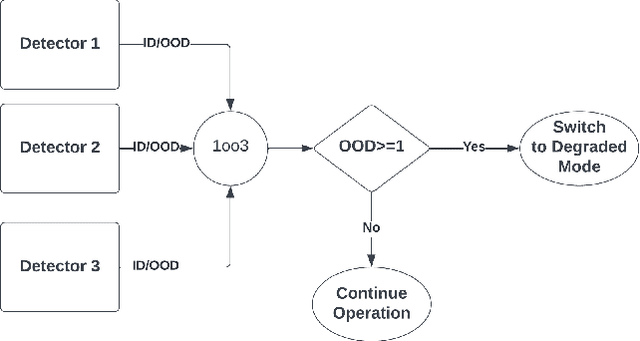
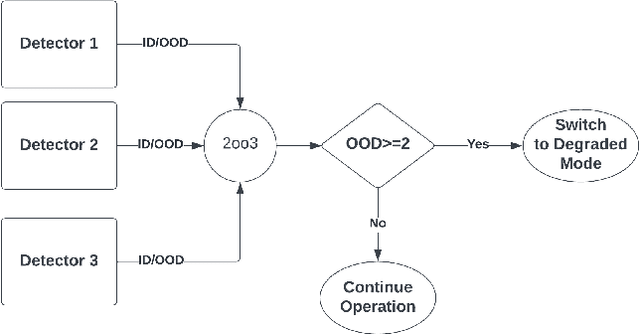

This paper explores the role and challenges of Artificial Intelligence (AI) algorithms, specifically AI-based software elements, in autonomous driving systems. These AI systems are fundamental in executing real-time critical functions in complex and high-dimensional environments. They handle vital tasks like multi-modal perception, cognition, and decision-making tasks such as motion planning, lane keeping, and emergency braking. A primary concern relates to the ability (and necessity) of AI models to generalize beyond their initial training data. This generalization issue becomes evident in real-time scenarios, where models frequently encounter inputs not represented in their training or validation data. In such cases, AI systems must still function effectively despite facing distributional or domain shifts. This paper investigates the risk associated with overconfident AI models in safety-critical applications like autonomous driving. To mitigate these risks, methods for training AI models that help maintain performance without overconfidence are proposed. This involves implementing certainty reporting architectures and ensuring diverse training data. While various distribution-based methods exist to provide safety mechanisms for AI models, there is a noted lack of systematic assessment of these methods, especially in the context of safety-critical automotive applications. Many methods in the literature do not adapt well to the quick response times required in safety-critical edge applications. This paper reviews these methods, discusses their suitability for safety-critical applications, and highlights their strengths and limitations. The paper also proposes potential improvements to enhance the safety and reliability of AI algorithms in autonomous vehicles in the context of rapid and accurate decision-making processes.