 Add to Chrome
 Add to Firefox
 Add to Edge
Low-Cost Neural Radiance Fields
May 10, 2026
Neural Radiance Fields (NeRF) achieve high-quality novel-view synthesis, but their long training times and reliance on dense input views limit accessibility. We present a comparative study of three accelerated NeRF variants - DS-NeRF, TensoRF, and HashNeRF and explore extensions targeted at the low-compute, low-data regime. First, we add a depth-supervision loss derived from COLMAP keypoints to TensoRF (TensoRF-DS) and evaluate it on the LLFF dataset under reduced view counts. Second, we ablate the feature-decoding MLP of TensoRF and study the effect of input downsampling on PSNR and runtime on the synthetic Lego scene. Third, we propose four architectural variants of the HashNeRF color and density networks, including residual and convolutional designs, and report PSNR/training-time tradeoffs under matched iteration budgets. Under iso-time evaluation, none of our extensions conclusively outperform the published baselines, but the experiments characterize which extensions transfer to constrained settings and surface design questions for future work.

Exploring Self-Reinforcement for Improving Learnersourced Multiple-Choice Question Explanations with Large Language Models
Sep 19, 2023
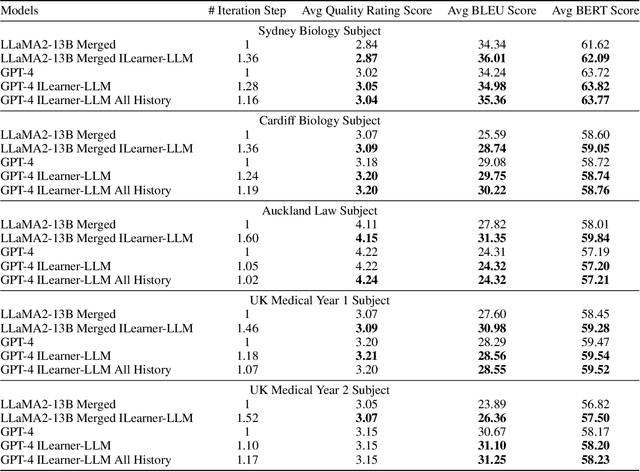
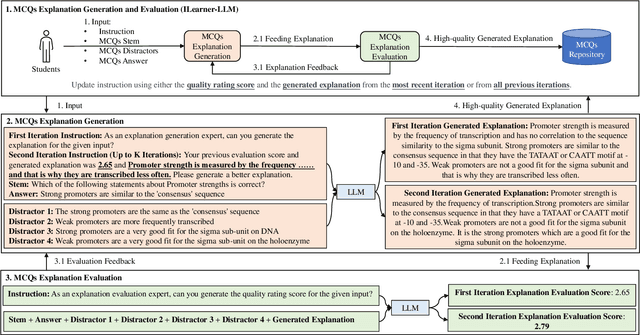
Learnersourcing involves students generating and sharing learning resources with their peers. When learnersourcing multiple-choice questions, creating explanations for the generated questions is a crucial step as it facilitates a deeper understanding of the related concepts. However, it is often difficult for students to craft effective explanations due to limited subject understanding and a tendency to merely restate the question stem, distractors, and correct answer. To help scaffold this task, in this work we propose a self-reinforcement large-language-model framework, with the goal of generating and evaluating explanations automatically. Comprising three modules, the framework generates student-aligned explanations, evaluates these explanations to ensure their quality and iteratively enhances the explanations. If an explanation's evaluation score falls below a defined threshold, the framework iteratively refines and reassesses the explanation. Importantly, our framework emulates the manner in which students compose explanations at the relevant grade level. For evaluation, we had a human subject-matter expert compare the explanations generated by students with the explanations created by the open-source large language model Vicuna-13B, a version of Vicuna-13B that had been fine-tuned using our method, and by GPT-4. We observed that, when compared to other large language models, GPT-4 exhibited a higher level of creativity in generating explanations. We also found that explanations generated by GPT-4 were ranked higher by the human expert than both those created by the other models and the original student-created explanations. Our findings represent a significant advancement in enriching the learnersourcing experience for students and enhancing the capabilities of large language models in educational applications.