 Add to Chrome
 Add to Firefox
 Add to Edge
Environmental resilience via morphological diversity within machines
Aug 03, 2026
Organisms contain diverse, sensorimotor parts across size scales and rapidly adapt to new environments, while machines contain only inert materials at smaller scales and struggle with surprise. We hypothesize that this agents-within-agents quality of organisms may aid their resilience: increasing experiences with internal physical adversity may pre-train organisms and machines to handle external adversity, such as encounters with new environments. Not only has this hypothesis not yet been articulated, mechanisms enabling this phenomenon have yet to be proposed. Here we show a mechanism by which this can occur: we found that physical connectors, in learning to restore behavior to previously independent, morphologically diverse agents they disrupted by tethering them together, trigger and tame sufficiently diverse disruptions that later encounters with new environments trigger disruptions that fall within this manageable range, enabling the collective to continue behaving properly without any additional learning or adaptation. Further, we found that building collectives from more agents, or more diverse agents, further increases the collective's resilience to new environments. This suggests that not just taming but intentionally creating internal physical adversity may indeed prepare organisms for external adversity, and could do so for machines, if they were built from smaller machines.

Outlier Detection using Self-Organizing Maps for Automated Blood Cell Analysis
Aug 18, 2022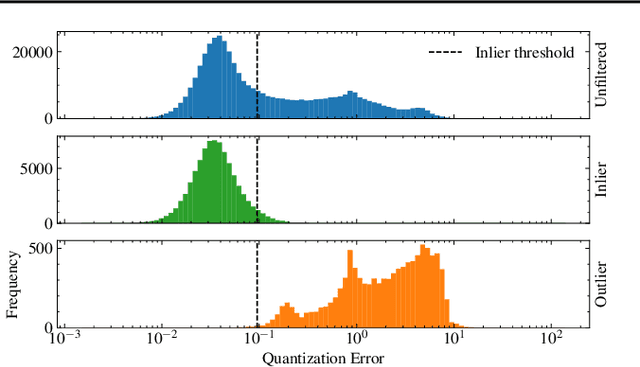
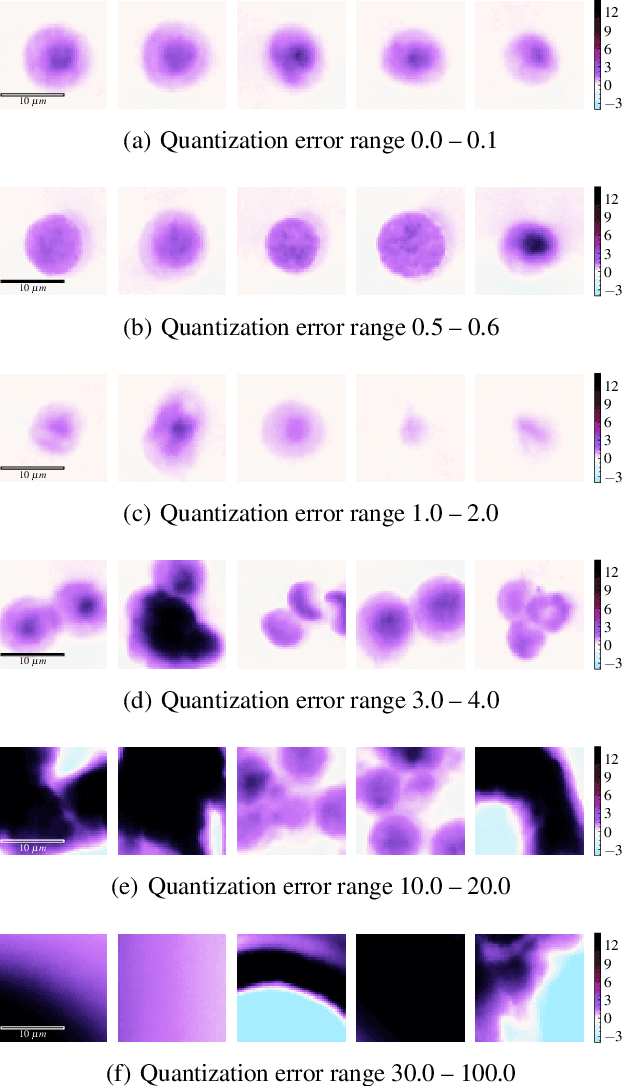
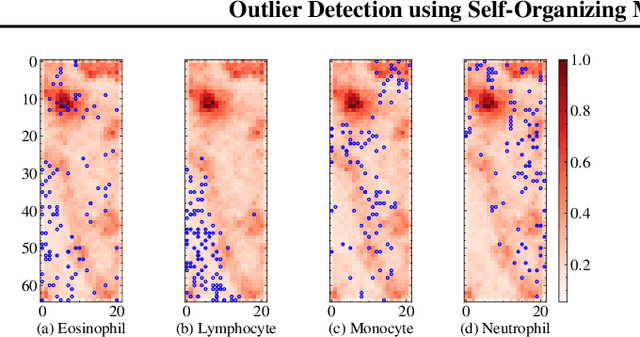
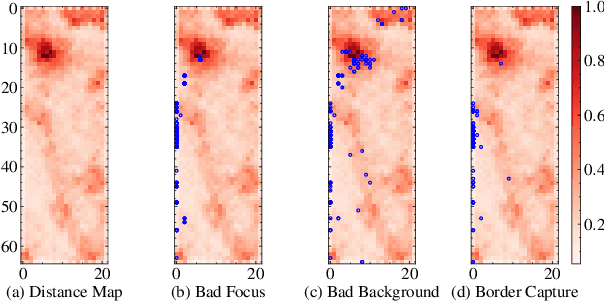
The quality of datasets plays a crucial role in the successful training and deployment of deep learning models. Especially in the medical field, where system performance may impact the health of patients, clean datasets are a safety requirement for reliable predictions. Therefore, outlier detection is an essential process when building autonomous clinical decision systems. In this work, we assess the suitability of Self-Organizing Maps for outlier detection specifically on a medical dataset containing quantitative phase images of white blood cells. We detect and evaluate outliers based on quantization errors and distance maps. Our findings confirm the suitability of Self-Organizing Maps for unsupervised Out-Of-Distribution detection on the dataset at hand. Self-Organizing Maps perform on par with a manually specified filter based on expert domain knowledge. Additionally, they show promise as a tool in the exploration and cleaning of medical datasets. As a direction for future research, we suggest a combination of Self-Organizing Maps and feature extraction based on deep learning.