 Add to Chrome
 Add to Firefox
 Add to Edge
GENESIS: Harnessing AI Agents for Autonomous 6G RAN Synthesis, Research, and Testing
May 26, 2026
Cellular research and development (R&D) is throttled by six structural processes that each consume months of manual engineering work per iteration: (i) synthesizing new features from standards or research papers into production code; (ii) conformance and interoperability testing; (iii) hardening against field anomalies and diverse deployment environments; (iv) data-driven optimization of network functionalities; (v) discovering and prototyping novel waveforms, functionalities, and capabilities for future standards; and (vi) securing the stack against vulnerabilities. Although Large Language Models (LLMs) have compressed comparable R&D work in general software engineering from days to minutes, their known pitfalls worsen on Radio Access Network (RAN) use cases: they hallucinate Application Programming Interfaces (APIs) and mis-read specifications, which kills interoperability of RAN components at the first mistake, and they heavily rely on simulations for designing algorithms, which is notorious for breaking when transferred to real hardware. To address these challenges, we present GENESIS, an agentic Artificial Intelligence (AI) framework that converts intents (e.g., a specification clause, a telemetry anomaly, or a research hypothesis) into solutions validated with over-the-air experiments, fed back into a persistent knowledge base. GENESIS is built on three composable primitives (agents, skills, hooks) and a knowledge layer (SYNAPSE) that doubles as the source of ground truth and the recipient of every artifact the framework produces, making capabilities compound across runs.

AI-assisted Agile Propagation Modeling for Real-time Digital Twin Wireless Networks
Oct 29, 2024Accurate channel modeling in real-time faces remarkable challenge due to the complexities of traditional methods such as ray tracing and field measurements. AI-based techniques have emerged to address these limitations, offering rapid, precise predictions of channel properties through ground truth data. This paper introduces an innovative approach to real-time, high-fidelity propagation modeling through advanced deep learning. Our model integrates 3D geographical data and rough propagation estimates to generate precise path gain predictions. By positioning the transmitter centrally, we simplify the model and enhance its computational efficiency, making it amenable to larger scenarios. Our approach achieves a normalized Root Mean Squared Error of less than 0.035 dB over a 37,210 square meter area, processing in just 46 ms on a GPU and 183 ms on a CPU. This performance significantly surpasses traditional high-fidelity ray tracing methods, which require approximately three orders of magnitude more time. Additionally, the model's adaptability to real-world data highlights its potential to revolutionize wireless network design and optimization, through enabling real-time creation of adaptive digital twins of real-world wireless scenarios in dynamic environments.
A Multi-Modal Non-Invasive Deep Learning Framework for Progressive Prediction of Seizures
Oct 26, 2024
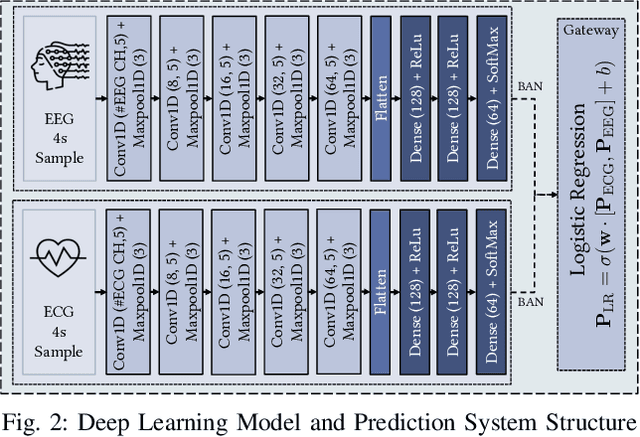


This paper introduces an innovative framework designed for progressive (granular in time to onset) prediction of seizures through the utilization of a Deep Learning (DL) methodology based on non-invasive multi-modal sensor networks. Epilepsy, a debilitating neurological condition, affects an estimated 65 million individuals globally, with a substantial proportion facing drug-resistant epilepsy despite pharmacological interventions. To address this challenge, we advocate for predictive systems that provide timely alerts to individuals at risk, enabling them to take precautionary actions. Our framework employs advanced DL techniques and uses personalized data from a network of non-invasive electroencephalogram (EEG) and electrocardiogram (ECG) sensors, thereby enhancing prediction accuracy. The algorithms are optimized for real-time processing on edge devices, mitigating privacy concerns and minimizing data transmission overhead inherent in cloud-based solutions, ultimately preserving battery energy. Additionally, our system predicts the countdown time to seizures (with 15-minute intervals up to an hour prior to the onset), offering critical lead time for preventive actions. Our multi-modal model achieves 95% sensitivity, 98% specificity, and 97% accuracy, averaged among 29 patients.
SeizNet: An AI-enabled Implantable Sensor Network System for Seizure Prediction
Jan 12, 2024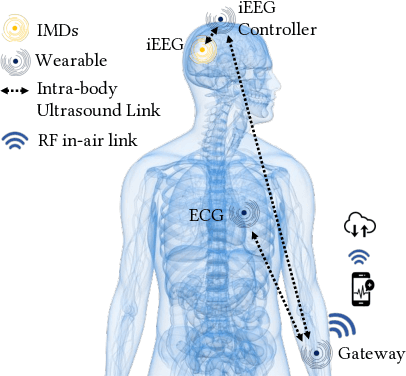
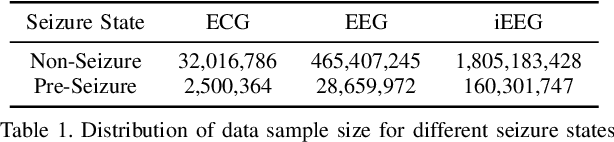
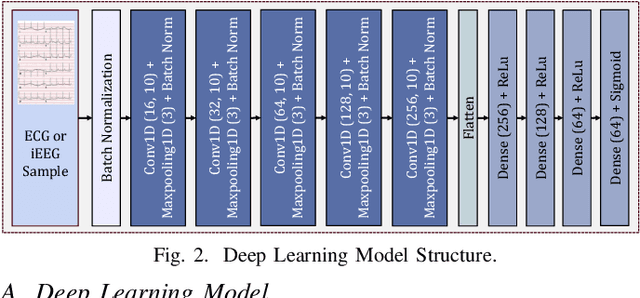
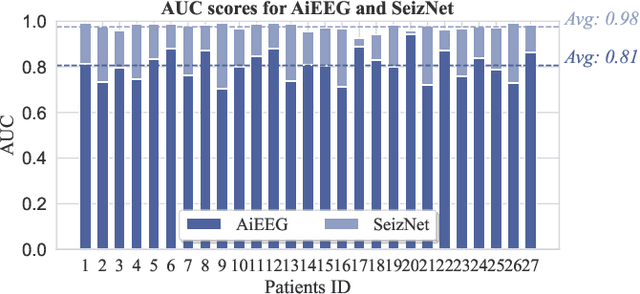
In this paper, we introduce SeizNet, a closed-loop system for predicting epileptic seizures through the use of Deep Learning (DL) method and implantable sensor networks. While pharmacological treatment is effective for some epilepsy patients (with ~65M people affected worldwide), one out of three suffer from drug-resistant epilepsy. To alleviate the impact of seizure, predictive systems have been developed that can notify such patients of an impending seizure, allowing them to take precautionary measures. SeizNet leverages DL techniques and combines data from multiple recordings, specifically intracranial electroencephalogram (iEEG) and electrocardiogram (ECG) sensors, that can significantly improve the specificity of seizure prediction while preserving very high levels of sensitivity. SeizNet DL algorithms are designed for efficient real-time execution at the edge, minimizing data privacy concerns, data transmission overhead, and power inefficiencies associated with cloud-based solutions. Our results indicate that SeizNet outperforms traditional single-modality and non-personalized prediction systems in all metrics, achieving up to 99% accuracy in predicting seizure, offering a promising new avenue in refractory epilepsy treatment.