 Add to Chrome
 Add to Firefox
 Add to Edge
Distribution-Specific Curvature Control with Finite-Sample Guarantees for Open-Weight Safety
Jul 24, 2026
A short fine-tuning run can undo the safety guards of an open-weight model---retraining a refusal-trained assistant to aid weapons development or produce hate speech. Preventing such harmful fine-tuning while retaining benign adaptability remains difficult: the only prior method with an explicit curvature certificate, spectral deformation, inflates curvature globally and thereby obstructs benign adaptation along with harmful adaptation. We propose HarmAlign, which applies function-preserving spectral deformation along a estimated contrastive activation subspace. We derive finite-sample bounds for the estimated subspace energy and the resulting local harmful-distribution curvature lower bound. A stability--progress dichotomy for constant-step gradient descent turns the certified curvature into conditional convergence-rate control. Empirically, within a fixed-architecture, finite-budget first-order threat model, HarmAlign blocks direct fine-tuning and three data- or objective-adaptive attacks across a hazardous-knowledge relearning setting and a harmful-assistance fine-tuning setting, while the protected benign tasks remain trainable. The block persists across the tested first-order optimizer variants over every attack checkpoint, and under out-of-distribution harmful fine-tuning, and it extends to important cases in our threat model: accidental safety degradation and emergent misalignment.

SoftAdaClip: A Smooth Clipping Strategy for Fair and Private Model Training
Oct 01, 2025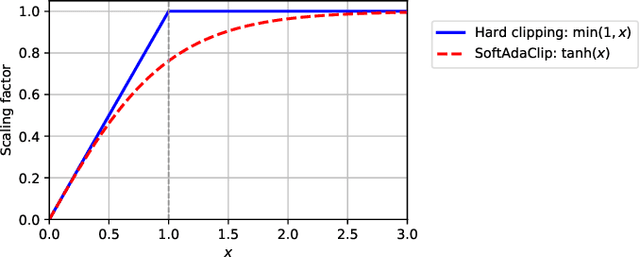
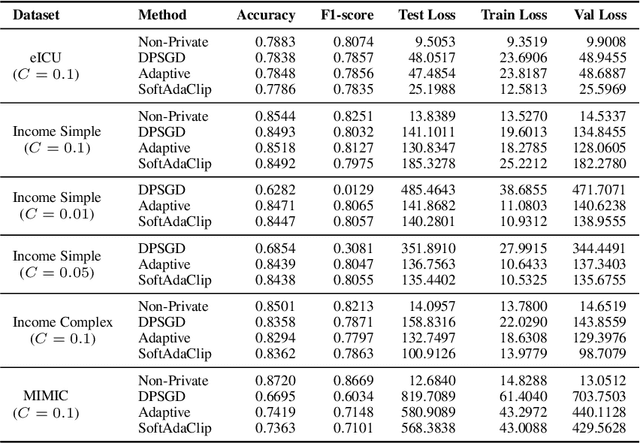
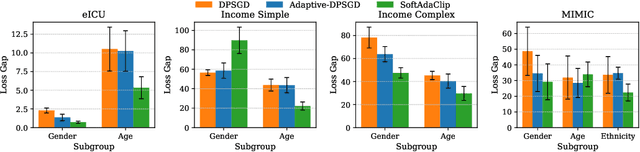
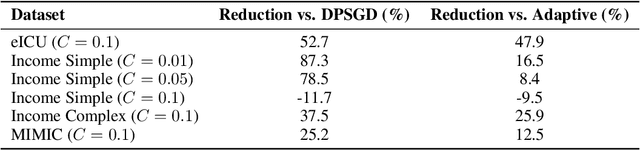
Differential privacy (DP) provides strong protection for sensitive data, but often reduces model performance and fairness, especially for underrepresented groups. One major reason is gradient clipping in DP-SGD, which can disproportionately suppress learning signals for minority subpopulations. Although adaptive clipping can enhance utility, it still relies on uniform hard clipping, which may restrict fairness. To address this, we introduce SoftAdaClip, a differentially private training method that replaces hard clipping with a smooth, tanh-based transformation to preserve relative gradient magnitudes while bounding sensitivity. We evaluate SoftAdaClip on various datasets, including MIMIC-III (clinical text), GOSSIS-eICU (structured healthcare), and Adult Income (tabular data). Our results show that SoftAdaClip reduces subgroup disparities by up to 87% compared to DP-SGD and up to 48% compared to Adaptive-DPSGD, and these reductions in subgroup disparities are statistically significant. These findings underscore the importance of integrating smooth transformations with adaptive mechanisms to achieve fair and private model training.
Can large language models be privacy preserving and fair medical coders?
Dec 07, 2024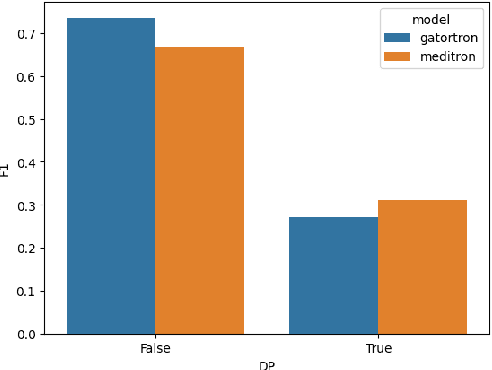
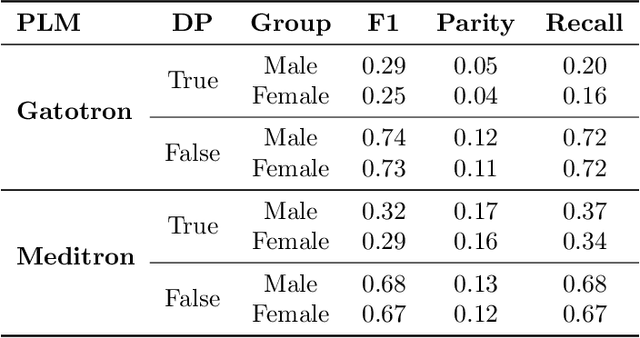
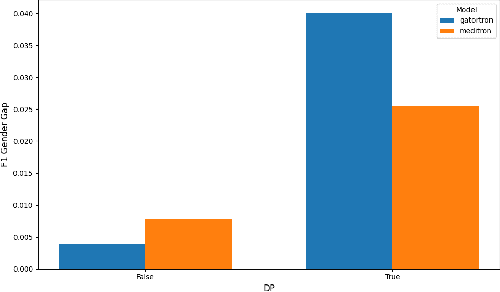
Protecting patient data privacy is a critical concern when deploying machine learning algorithms in healthcare. Differential privacy (DP) is a common method for preserving privacy in such settings and, in this work, we examine two key trade-offs in applying DP to the NLP task of medical coding (ICD classification). Regarding the privacy-utility trade-off, we observe a significant performance drop in the privacy preserving models, with more than a 40% reduction in micro F1 scores on the top 50 labels in the MIMIC-III dataset. From the perspective of the privacy-fairness trade-off, we also observe an increase of over 3% in the recall gap between male and female patients in the DP models. Further understanding these trade-offs will help towards the challenges of real-world deployment.