 Add to Chrome
 Add to Firefox
 Add to Edge
A Metamorphic Testing Approach to Diagnosing Memorization in LLM-Based Program Repair
Apr 23, 2026
LLM-based automated program repair (APR) techniques have shown promising results in reducing debugging costs. However, prior results can be affected by data leakage: large language models (LLMs) may memorize bug fixes when evaluation benchmarks overlap with their pretraining data, leading to inflated performance estimates. In this paper, we investigate whether we can better reveal data leakage by combining metamorphic testing (MT) with negative log-likelihood (NLL), which has been used in prior work as a proxy for memorization. We construct variant benchmarks by applying semantics-preserving transformations to two widely used datasets, Defects4J and GitBug-Java. Using these benchmarks, we evaluate the repair success rates of seven LLMs on both original and transformed versions, and analyze the relationship between performance degradation and NLL. Our results show that all evaluated state-of-the-art LLMs exhibit substantial drops in patch generation success rates on transformed benchmarks, ranging from -4.1% for GPT-4o to -15.98% for Llama-3.1. Furthermore, we find that this degradation strongly correlates with NLL on the original benchmarks, suggesting that models perform better on instances they are more likely to have memorized. These findings show that combining MT with NLL provides stronger and more reliable evidence of data leakage, while metamorphic testing alone can help mitigate its effects in LLM-based APR evaluations.

Metamorphic Testing of Deep Code Models: A Systematic Literature Review
Jul 30, 2025Large language models and deep learning models designed for code intelligence have revolutionized the software engineering field due to their ability to perform various code-related tasks. These models can process source code and software artifacts with high accuracy in tasks such as code completion, defect detection, and code summarization; therefore, they can potentially become an integral part of modern software engineering practices. Despite these capabilities, robustness remains a critical quality attribute for deep-code models as they may produce different results under varied and adversarial conditions (e.g., variable renaming). Metamorphic testing has become a widely used approach to evaluate models' robustness by applying semantic-preserving transformations to input programs and analyzing the stability of model outputs. While prior research has explored testing deep learning models, this systematic literature review focuses specifically on metamorphic testing for deep code models. By studying 45 primary papers, we analyze the transformations, techniques, and evaluation methods used to assess robustness. Our review summarizes the current landscape, identifying frequently evaluated models, programming tasks, datasets, target languages, and evaluation metrics, and highlights key challenges and future directions for advancing the field.
Towards a Safety Case for Hardware Fault Tolerance in Convolutional Neural Networks Using Activation Range Supervision
Aug 16, 2021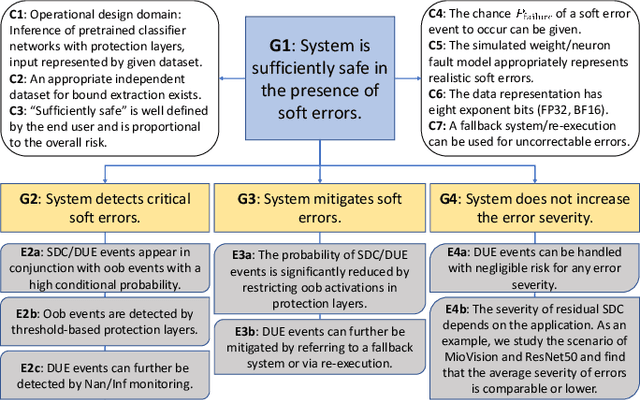
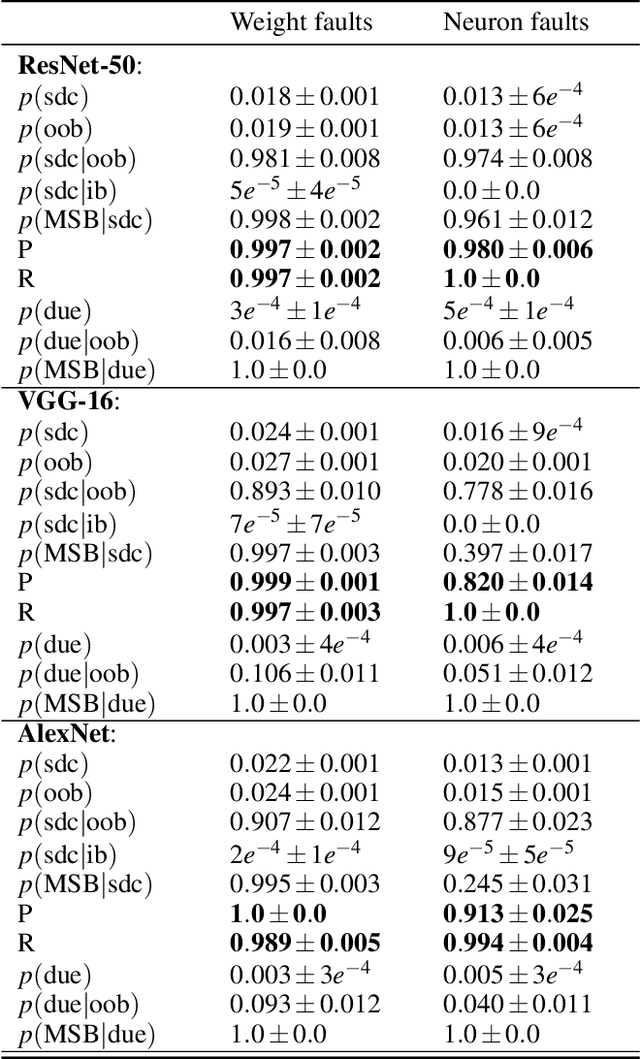
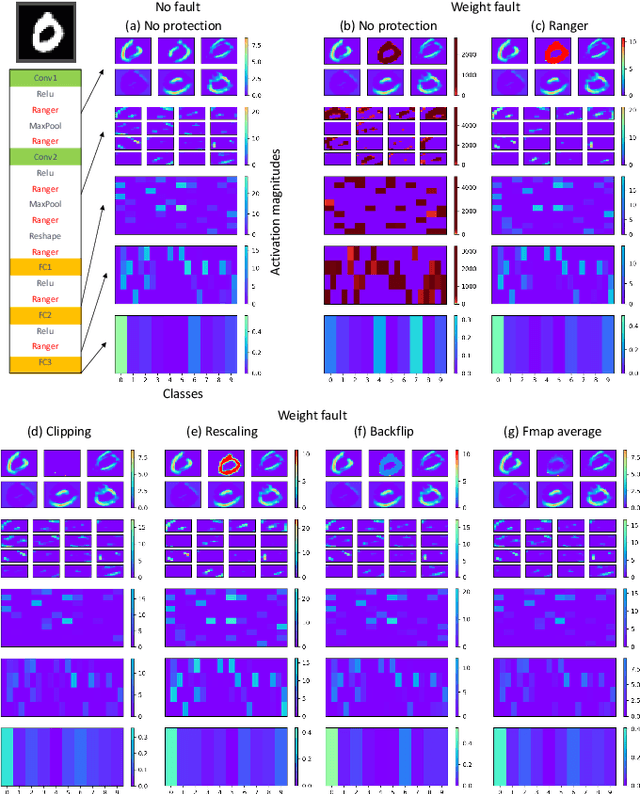
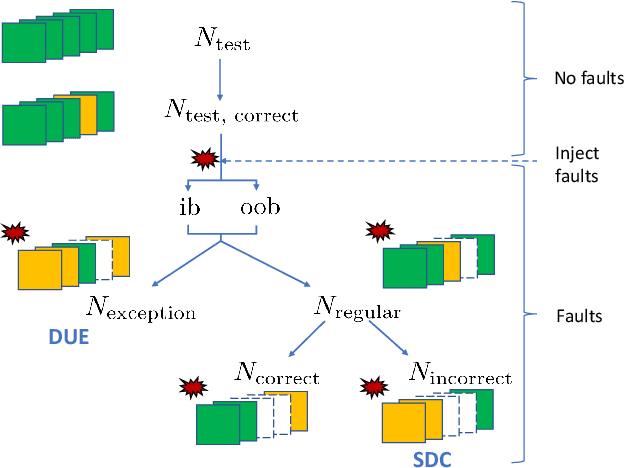
Convolutional neural networks (CNNs) have become an established part of numerous safety-critical computer vision applications, including human robot interactions and automated driving. Real-world implementations will need to guarantee their robustness against hardware soft errors corrupting the underlying platform memory. Based on the previously observed efficacy of activation clipping techniques, we build a prototypical safety case for classifier CNNs by demonstrating that range supervision represents a highly reliable fault detector and mitigator with respect to relevant bit flips, adopting an eight-exponent floating point data representation. We further explore novel, non-uniform range restriction methods that effectively suppress the probability of silent data corruptions and uncorrectable errors. As a safety-relevant end-to-end use case, we showcase the benefit of our approach in a vehicle classification scenario, using ResNet-50 and the traffic camera data set MIOVision. The quantitative evidence provided in this work can be leveraged to inspire further and possibly more complex CNN safety arguments.