 Add to Chrome
 Add to Firefox
 Add to Edge
User-Assisted Collaborative Distributed Inference for Efficient QoS-Aware Autoscaling
Aug 12, 2026
Growing demand for artificial intelligence (AI) inference services requires scalable infrastructure, yet centralized serving costs rise with demand. We propose a collaborative distributed inference system combining dedicated infrastructure with resources contributed by service users. Dedicated resources provide baseline capacity for maintaining quality of service (QoS), while volunteered resources absorb increasing demand without proportional growth in centralized infrastructure. To capture stochastic and dynamic interactions among users, resources, tasks, and policies, we develop a high-dimensional generative Markov model with structured temporal factorization. The model supports simulation and provides a foundation for task scheduling and QoS-aware resource allocation optimization. We evaluate the system across user populations, resource capacities, and centralized and distributed scheduling policies. Simulations show that distributed scheduling becomes increasingly advantageous as the user population grows, improving request completion and P99 latency while substantially reducing dedicated resource consumption. These results demonstrate the feasibility of user-assisted collaborative inference for infrastructure-efficient autoscaling.

Brief Announcement: Generative Markov Model for Distributed Computing Systems
Jun 02, 2026Emerging distributed computing paradigms, such as the computing continuum, are inherently heterogeneous, stochastic, and complex. Efficiently and effectively utilizing all available resources across the continuum demands a unified formal model of the system. To address this gap, we propose a general framework for modeling distributed computing systems as a generative Markov model, factorized over a structured system state. In our model, the state decomposes into high-dimensional variables, each further factorized over its elements, reflecting the sparse dependency structure inherent to distributed systems. This yields a tractable model enabling simulation, inference, and policy learning over otherwise intractable system states, bridging distributed computing with Markov chain theory and reinforcement learning (RL). We demonstrate our framework through a case study of collaborative AI inference, in which a dedicated server combines resources with those volunteered by service users. Our results show that centralized scheduling becomes a bottleneck at scale, while distributing computation across user devices reduces both latency and server resource consumption. These findings highlight the value of adaptive decision-making in distributed computing systems and demonstrate the framework's utility for modeling, simulation, and optimization.
An Uncertainty-Aware Resilience Micro-Agent for Causal Observability in the Computing Continuum
May 11, 2026Grey failures in the computing continuum produce ambiguous overlapping symptoms that existing approaches fail to diagnose reliably, either due to a lack of causal awareness or acting under high epistemic uncertainty, risking destructive interventions. This paper presents an uncertainty-aware resilience micro-agent for causal observability (AURORA), a lightweight framework for diagnosing and mitigating grey failures in edge-tier environments. The framework employs parallel micro-agents that integrate the free-energy principle, causal do-calculus, and localized causal state-graphs to support counterfactual root-cause analysis within each fault's Markov blanket. Restricting inference to causally relevant variables reduces computational overhead while preserving diagnostic fidelity. AURORA further introduces a dual-gated execution mechanism that authorizes remediation only when causal confidence is high and predicted epistemic uncertainty is bounded; otherwise, it abstains from local intervention and escalates the diagnostic payload to the fog tier. Our experiments demonstrate that AURORA outperforms baselines, achieving a 0% destructive action rate, while maintaining 62.0% repair accuracy and a 3ms mean time to repair.
Adaptive DNN Partitioning and Offloading in Heterogeneous Edge-Cloud Continuum
May 10, 2026In recent years, the use of artificial intelligence on resource-constrained IoT devices has grown significantly. However, existing approaches to DNN partitioning and offloading across the edge-cloud continuum typically rely on static methods that ignore runtime dynamics. Furthermore, they are often evaluated in simulated environments rather than on real hardware. To address this gap, we propose a framework that dynamically splits neural network layers across the heterogeneous continuum. The framework profiles the model at startup, measures network link conditions between nodes, and periodically re-evaluates the partition to adapt to environmental changes. We created a physical testbed comprising a Raspberry Pi edge device, a laptop fog, and a high-performance desktop PC as the cloud. We evaluated the framework over three widely adopted convolutional neural networks: VGG16, AlexNet, and MobileNetV2. Our results show that the framework achieves reductions in energy and end-to-end latency of 27.09--35.82% and 6.34--22.92%, respectively, compared to a static partitioning baseline. These findings confirm the superiority of adaptive to static partitioning.
NeSy-Edge: Neuro-Symbolic Trustworthy Self-Healing in the Computing Continuum
Mar 22, 2026The computational demands of modern AI services are increasingly shifting execution beyond centralized clouds toward a computing continuum spanning edge and end devices. However, the scale, heterogeneity, and cross-layer dependencies of these environments make resilience difficult to maintain. Existing fault-management methods are often too static, fragmented, or heavy to support timely self-healing, especially under noisy logs and edge resource constraints. To address these limitations, this paper presents NeSy-Edge, a neuro-symbolic framework for trustworthy self-healing in the computing continuum. The framework follows an edge-first design, where a resource-constrained edge node performs local perception and reasoning, while a cloud model is invoked only at the final diagnosis stage. Specifically, NeSy-Edge converts raw runtime logs into structured event representations, builds a prior-constrained sparse symbolic causal graph, and integrates causal evidence with historical troubleshooting knowledge for root-cause analysis and recovery recommendation. We evaluate our work on representative Loghub datasets under multiple levels of semantic noise, considering parsing quality, causal reasoning, end-to-end diagnosis, and edge-side resource usage. The results show that NeSy-Edge remains robust even at the highest noise level, achieving up to 75% root-cause analysis accuracy and 65% end-to-end accuracy while operating within about 1500 MB of local memory.
Resilient by Design -- Active Inference for Distributed Continuum Intelligence
Nov 18, 2025Failures are the norm in highly complex and heterogeneous devices spanning the distributed computing continuum (DCC), from resource-constrained IoT and edge nodes to high-performance computing systems. Ensuring reliability and global consistency across these layers remains a major challenge, especially for AI-driven workloads requiring real-time, adaptive coordination. This work-in-progress paper introduces a Probabilistic Active Inference Resilience Agent (PAIR-Agent) to achieve resilience in DCC systems. PAIR-Agent performs three core operations: (i) constructing a causal fault graph from device logs, (ii) identifying faults while managing certainties and uncertainties using Markov blankets and the free energy principle, and (iii) autonomously healing issues through active inference. Through continuous monitoring and adaptive reconfiguration, the agent maintains service continuity and stability under diverse failure conditions. Theoretical validations confirm the reliability and effectiveness of the proposed framework.
Benchmarking Dynamic SLO Compliance in Distributed Computing Continuum Systems
Mar 05, 2025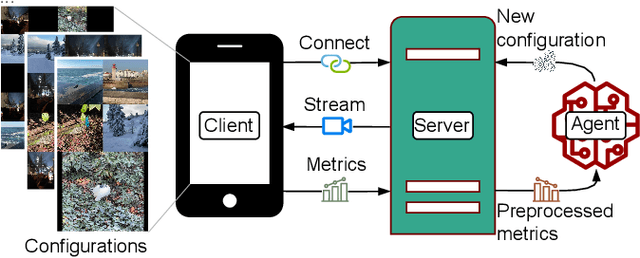
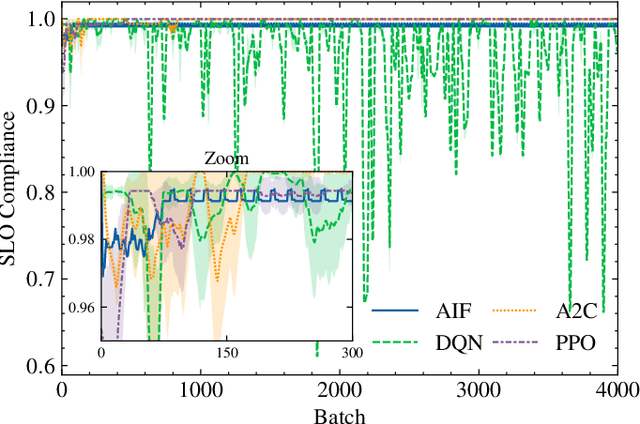
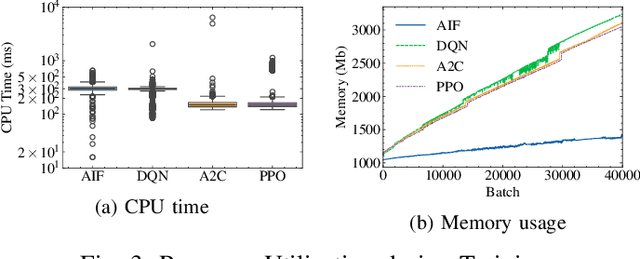
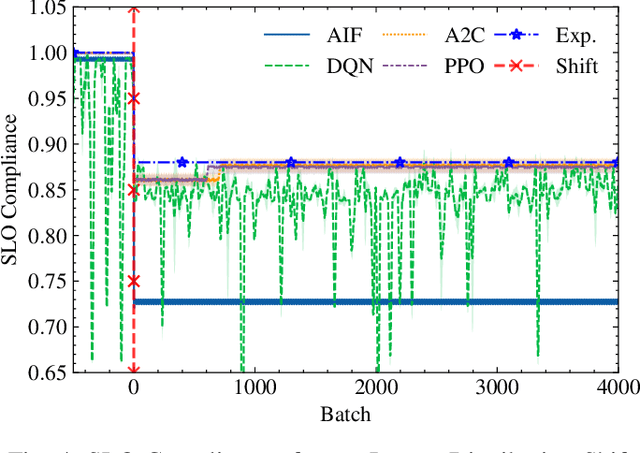
Ensuring Service Level Objectives (SLOs) in large-scale architectures, such as Distributed Computing Continuum Systems (DCCS), is challenging due to their heterogeneous nature and varying service requirements across different devices and applications. Additionally, unpredictable workloads and resource limitations lead to fluctuating performance and violated SLOs. To improve SLO compliance in DCCS, one possibility is to apply machine learning; however, the design choices are often left to the developer. To that extent, we provide a benchmark of Active Inference -- an emerging method from neuroscience -- against three established reinforcement learning algorithms (Deep Q-Network, Advantage Actor-Critic, and Proximal Policy Optimization). We consider a realistic DCCS use case: an edge device running a video conferencing application alongside a WebSocket server streaming videos. Using one of the respective algorithms, we continuously monitor key performance metrics, such as latency and bandwidth usage, to dynamically adjust parameters -- including the number of streams, frame rate, and resolution -- to optimize service quality and user experience. To test algorithms' adaptability to constant system changes, we simulate dynamically changing SLOs and both instant and gradual data-shift scenarios, such as network bandwidth limitations and fluctuating device thermal states. Although the evaluated algorithms all showed advantages and limitations, our findings demonstrate that Active Inference is a promising approach for ensuring SLO compliance in DCCS, offering lower memory usage, stable CPU utilization, and fast convergence.
Automatic Fused Multimodal Deep Learning for Plant Identification
Jun 03, 2024Plant classification is vital for ecological conservation and agricultural productivity, enhancing our understanding of plant growth dynamics and aiding species preservation. The advent of deep learning (DL) techniques has revolutionized this field by enabling autonomous feature extraction, significantly reducing the dependence on manual expertise. However, conventional DL models often rely solely on single data sources, failing to capture the full biological diversity of plant species comprehensively. Recent research has turned to multimodal learning to overcome this limitation by integrating multiple data types, which enriches the representation of plant characteristics. This shift introduces the challenge of determining the optimal point for modality fusion. In this paper, we introduce a pioneering multimodal DL-based approach for plant classification with automatic modality fusion. Utilizing the multimodal fusion architecture search, our method integrates images from multiple plant organs-flowers, leaves, fruits, and stems-into a cohesive model. Our method achieves 83.48% accuracy on 956 classes of the PlantCLEF2015 dataset, surpassing state-of-the-art methods. It outperforms late fusion by 11.07% and is more robust to missing modalities. We validate our model against established benchmarks using standard performance metrics and McNemar's test, further underscoring its superiority.