 Add to Chrome
 Add to Firefox
 Add to Edge
Revisiting [CLS] and Patch Token Interaction in Vision Transformers
Feb 09, 2026
Vision Transformers have emerged as powerful, scalable and versatile representation learners. To capture both global and local features, a learnable [CLS] class token is typically prepended to the input sequence of patch tokens. Despite their distinct nature, both token types are processed identically throughout the model. In this work, we investigate the friction between global and local feature learning under different pre-training strategies by analyzing the interactions between class and patch tokens. Our analysis reveals that standard normalization layers introduce an implicit differentiation between these token types. Building on this insight, we propose specialized processing paths that selectively disentangle the computational flow of class and patch tokens, particularly within normalization layers and early query-key-value projections. This targeted specialization leads to significantly improved patch representation quality for dense prediction tasks. Our experiments demonstrate segmentation performance gains of over 2 mIoU points on standard benchmarks, while maintaining strong classification accuracy. The proposed modifications introduce only an 8% increase in parameters, with no additional computational overhead. Through comprehensive ablations, we provide insights into which architectural components benefit most from specialization and how our approach generalizes across model scales and learning frameworks.

Boosting Asynchronous Decentralized Learning with Model Fragmentation
Oct 16, 2024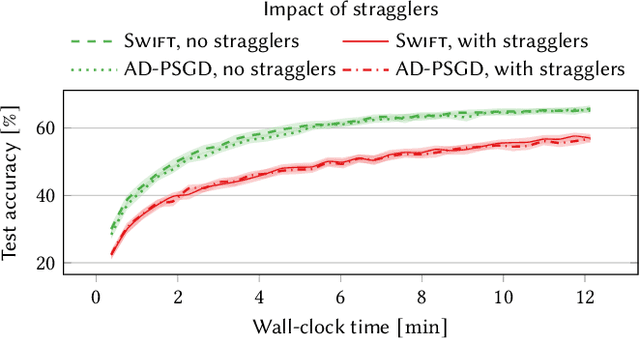

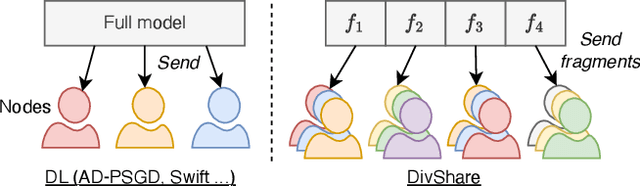
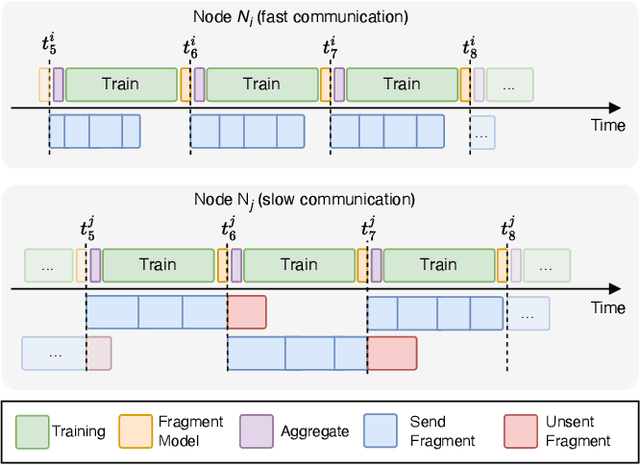
Decentralized learning (DL) is an emerging technique that allows nodes on the web to collaboratively train machine learning models without sharing raw data. Dealing with stragglers, i.e., nodes with slower compute or communication than others, is a key challenge in DL. We present DivShare, a novel asynchronous DL algorithm that achieves fast model convergence in the presence of communication stragglers. DivShare achieves this by having nodes fragment their models into parameter subsets and send, in parallel to computation, each subset to a random sample of other nodes instead of sequentially exchanging full models. The transfer of smaller fragments allows more efficient usage of the collective bandwidth and enables nodes with slow network links to quickly contribute with at least some of their model parameters. By theoretically proving the convergence of DivShare, we provide, to the best of our knowledge, the first formal proof of convergence for a DL algorithm that accounts for the effects of asynchronous communication with delays. We experimentally evaluate DivShare against two state-of-the-art DL baselines, AD-PSGD and Swift, and with two standard datasets, CIFAR-10 and MovieLens. We find that DivShare with communication stragglers lowers time-to-accuracy by up to 3.9x compared to AD-PSGD on the CIFAR-10 dataset. Compared to baselines, DivShare also achieves up to 19.4% better accuracy and 9.5% lower test loss on the CIFAR-10 and MovieLens datasets, respectively.