 Add to Chrome
 Add to Firefox
 Add to Edge
Emerging Cross-lingual Structure in Pretrained Language Models
Nov 10, 2019
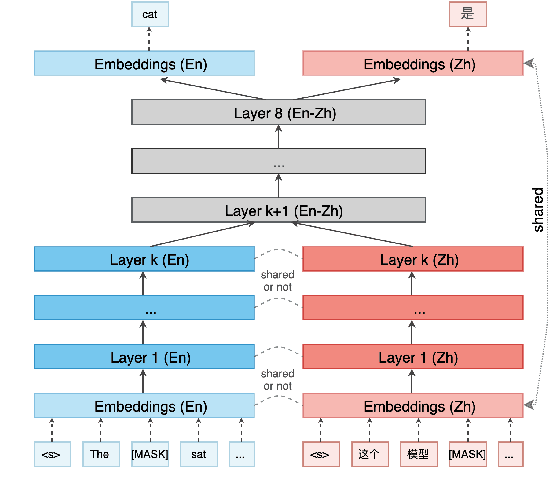
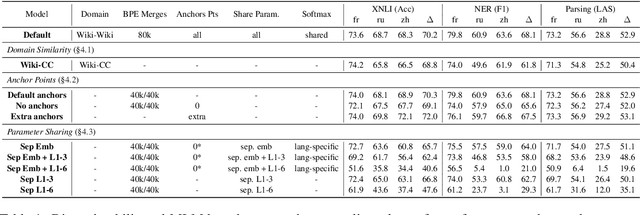
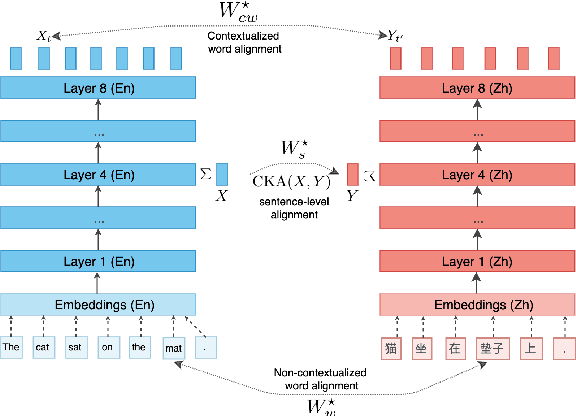
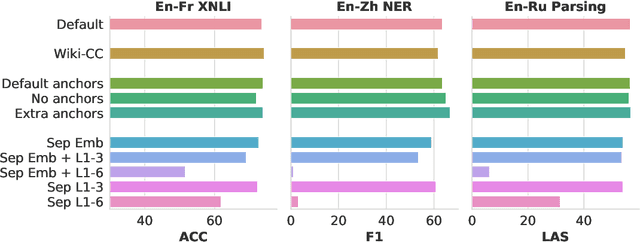
We study the problem of multilingual masked language modeling, i.e. the training of a single model on concatenated text from multiple languages, and present a detailed study of several factors that influence why these models are so effective for cross-lingual transfer. We show, contrary to what was previously hypothesized, that transfer is possible even when there is no shared vocabulary across the monolingual corpora and also when the text comes from very different domains. The only requirement is that there are some shared parameters in the top layers of the multi-lingual encoder. To better understand this result, we also show that representations from independently trained models in different languages can be aligned post-hoc quite effectively, strongly suggesting that, much like for non-contextual word embeddings, there are universal latent symmetries in the learned embedding spaces. For multilingual masked language modeling, these symmetries seem to be automatically discovered and aligned during the joint training process.

Unsupervised Cross-lingual Representation Learning at Scale
Nov 05, 2019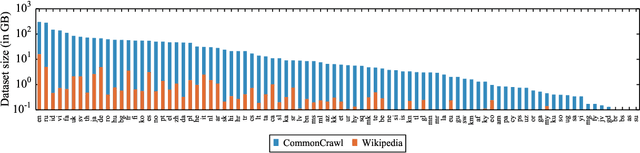
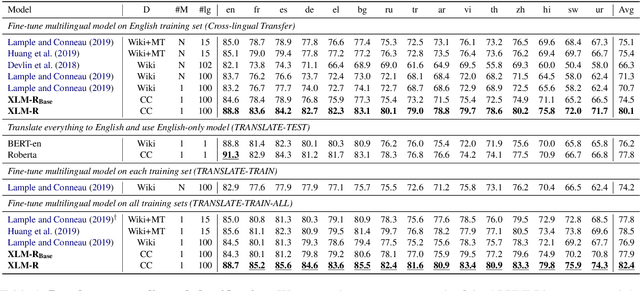
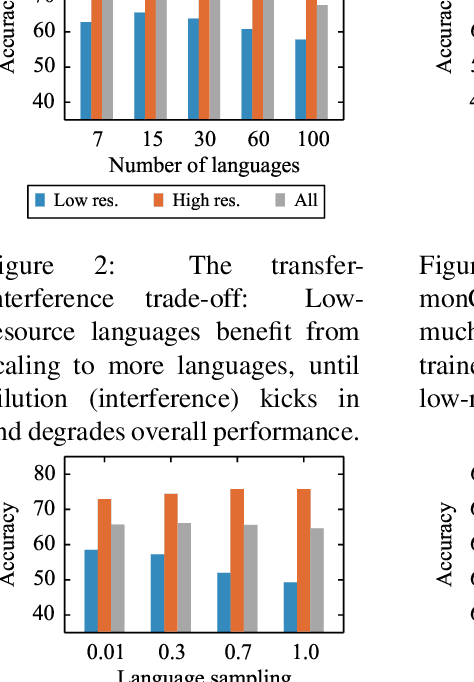
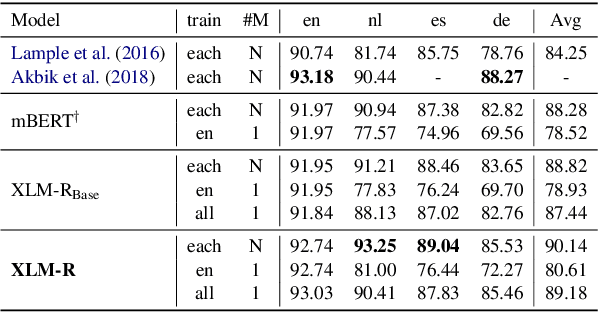
This paper shows that pretraining multilingual language models at scale leads to significant performance gains for a wide range of cross-lingual transfer tasks. We train a Transformer-based masked language model on one hundred languages, using more than two terabytes of filtered CommonCrawl data. Our model, dubbed XLM-R, significantly outperforms multilingual BERT (mBERT) on a variety of cross-lingual benchmarks, including +13.8% average accuracy on XNLI, +12.3% average F1 score on MLQA, and +2.1% average F1 score on NER. XLM-R performs particularly well on low-resource languages, improving 11.8% in XNLI accuracy for Swahili and 9.2% for Urdu over the previous XLM model. We also present a detailed empirical evaluation of the key factors that are required to achieve these gains, including the trade-offs between (1) positive transfer and capacity dilution and (2) the performance of high and low resource languages at scale. Finally, we show, for the first time, the possibility of multilingual modeling without sacrificing per-language performance; XLM-Ris very competitive with strong monolingual models on the GLUE and XNLI benchmarks. We will make XLM-R code, data, and models publicly available.
Cross-lingual Language Model Pretraining
Jan 22, 2019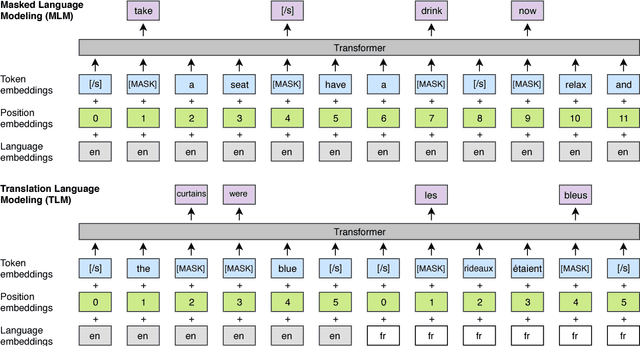
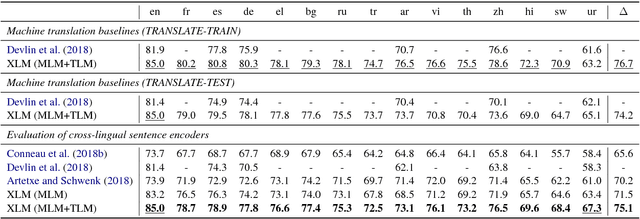
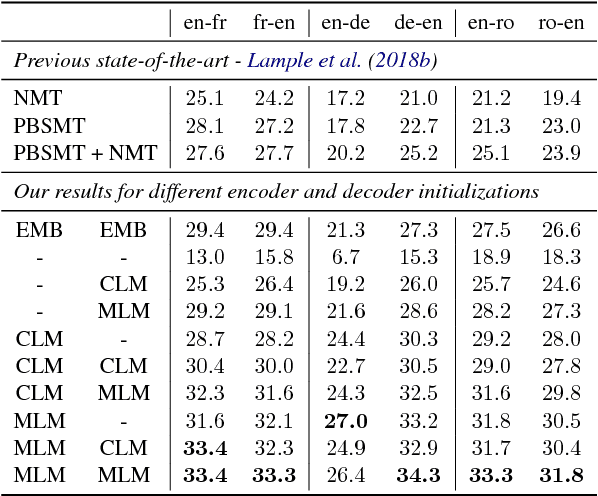
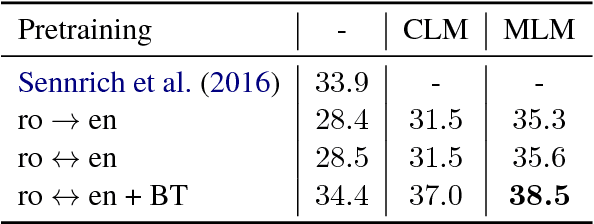
Recent studies have demonstrated the efficiency of generative pretraining for English natural language understanding. In this work, we extend this approach to multiple languages and show the effectiveness of cross-lingual pretraining. We propose two methods to learn cross-lingual language models (XLMs): one unsupervised that only relies on monolingual data, and one supervised that leverages parallel data with a new cross-lingual language model objective. We obtain state-of-the-art results on cross-lingual classification, unsupervised and supervised machine translation. On XNLI, our approach pushes the state of the art by an absolute gain of 4.9% accuracy. On unsupervised machine translation, we obtain 34.3 BLEU on WMT'16 German-English, improving the previous state of the art by more than 9 BLEU. On supervised machine translation, we obtain a new state of the art of 38.5 BLEU on WMT'16 Romanian-English, outperforming the previous best approach by more than 4 BLEU. Our code and pretrained models will be made publicly available.
XNLI: Evaluating Cross-lingual Sentence Representations
Sep 13, 2018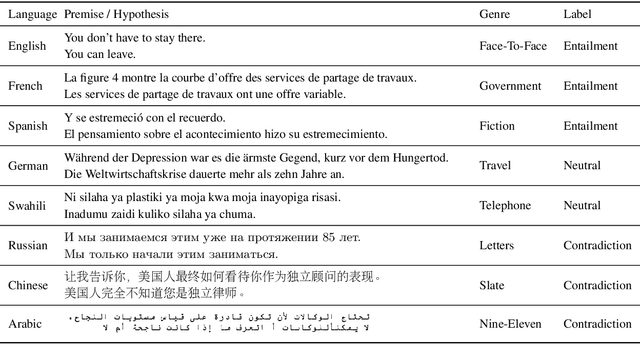
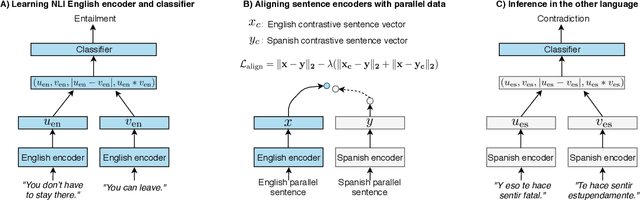

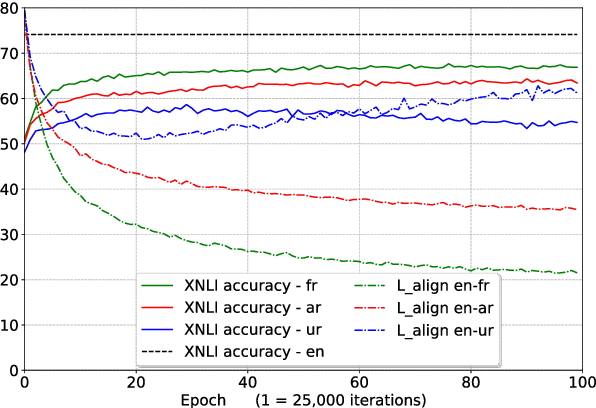
State-of-the-art natural language processing systems rely on supervision in the form of annotated data to learn competent models. These models are generally trained on data in a single language (usually English), and cannot be directly used beyond that language. Since collecting data in every language is not realistic, there has been a growing interest in cross-lingual language understanding (XLU) and low-resource cross-language transfer. In this work, we construct an evaluation set for XLU by extending the development and test sets of the Multi-Genre Natural Language Inference Corpus (MultiNLI) to 15 languages, including low-resource languages such as Swahili and Urdu. We hope that our dataset, dubbed XNLI, will catalyze research in cross-lingual sentence understanding by providing an informative standard evaluation task. In addition, we provide several baselines for multilingual sentence understanding, including two based on machine translation systems, and two that use parallel data to train aligned multilingual bag-of-words and LSTM encoders. We find that XNLI represents a practical and challenging evaluation suite, and that directly translating the test data yields the best performance among available baselines.
Phrase-Based & Neural Unsupervised Machine Translation
Aug 13, 2018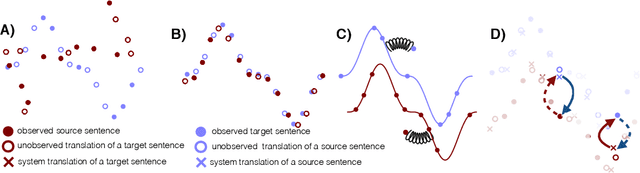
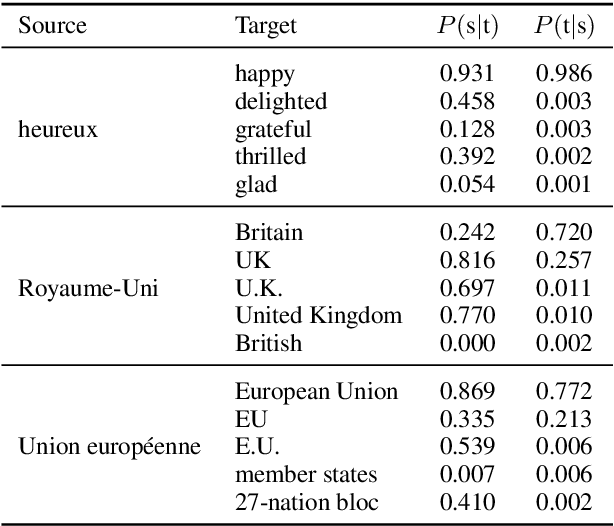
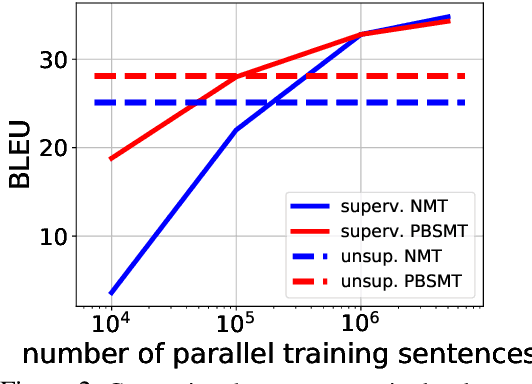
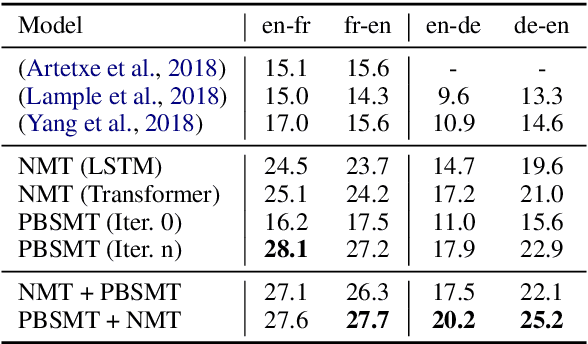
Machine translation systems achieve near human-level performance on some languages, yet their effectiveness strongly relies on the availability of large amounts of parallel sentences, which hinders their applicability to the majority of language pairs. This work investigates how to learn to translate when having access to only large monolingual corpora in each language. We propose two model variants, a neural and a phrase-based model. Both versions leverage a careful initialization of the parameters, the denoising effect of language models and automatic generation of parallel data by iterative back-translation. These models are significantly better than methods from the literature, while being simpler and having fewer hyper-parameters. On the widely used WMT'14 English-French and WMT'16 German-English benchmarks, our models respectively obtain 28.1 and 25.2 BLEU points without using a single parallel sentence, outperforming the state of the art by more than 11 BLEU points. On low-resource languages like English-Urdu and English-Romanian, our methods achieve even better results than semi-supervised and supervised approaches leveraging the paucity of available bitexts. Our code for NMT and PBSMT is publicly available.
What you can cram into a single vector: Probing sentence embeddings for linguistic properties
Jul 08, 2018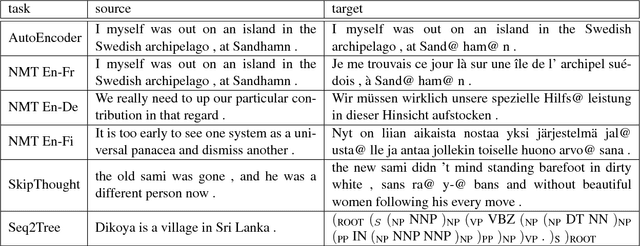
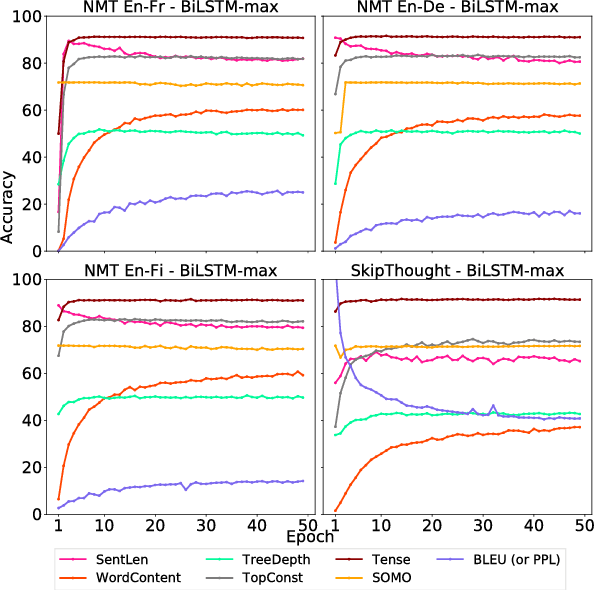
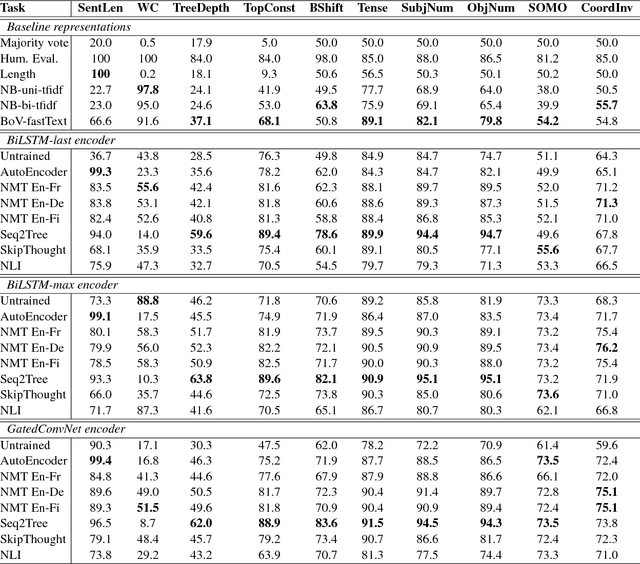
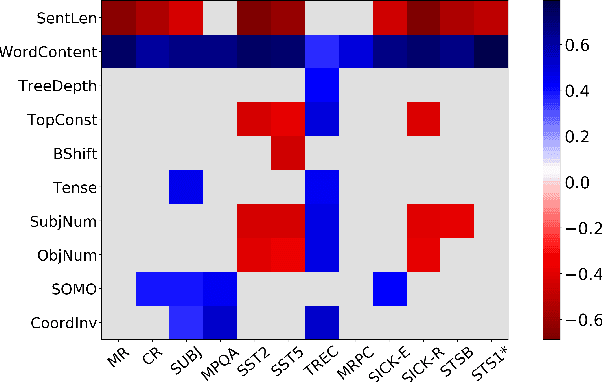
Although much effort has recently been devoted to training high-quality sentence embeddings, we still have a poor understanding of what they are capturing. "Downstream" tasks, often based on sentence classification, are commonly used to evaluate the quality of sentence representations. The complexity of the tasks makes it however difficult to infer what kind of information is present in the representations. We introduce here 10 probing tasks designed to capture simple linguistic features of sentences, and we use them to study embeddings generated by three different encoders trained in eight distinct ways, uncovering intriguing properties of both encoders and training methods.
Supervised Learning of Universal Sentence Representations from Natural Language Inference Data
Jul 08, 2018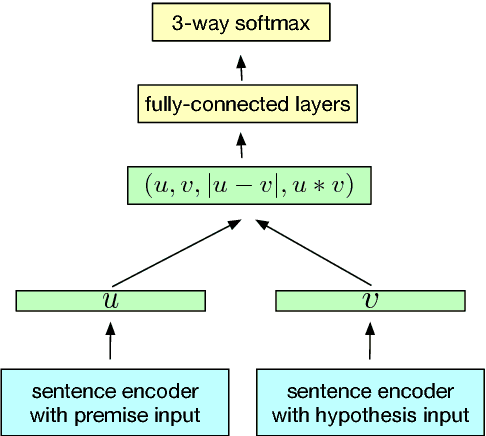

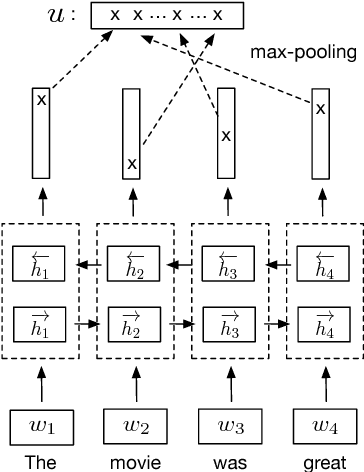
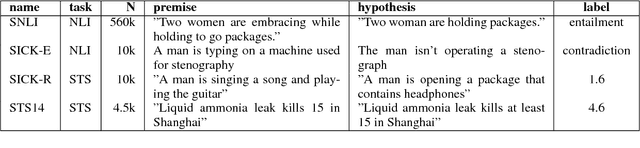
Many modern NLP systems rely on word embeddings, previously trained in an unsupervised manner on large corpora, as base features. Efforts to obtain embeddings for larger chunks of text, such as sentences, have however not been so successful. Several attempts at learning unsupervised representations of sentences have not reached satisfactory enough performance to be widely adopted. In this paper, we show how universal sentence representations trained using the supervised data of the Stanford Natural Language Inference datasets can consistently outperform unsupervised methods like SkipThought vectors on a wide range of transfer tasks. Much like how computer vision uses ImageNet to obtain features, which can then be transferred to other tasks, our work tends to indicate the suitability of natural language inference for transfer learning to other NLP tasks. Our encoder is publicly available.
Learning Visually Grounded Sentence Representations
Jun 04, 2018
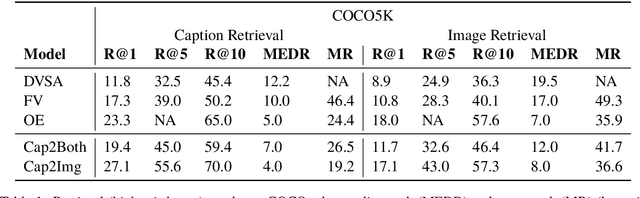
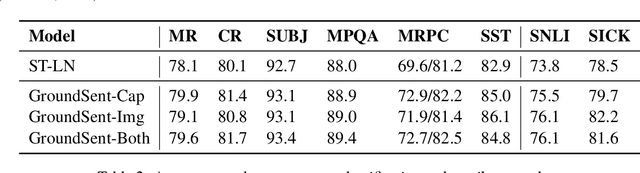
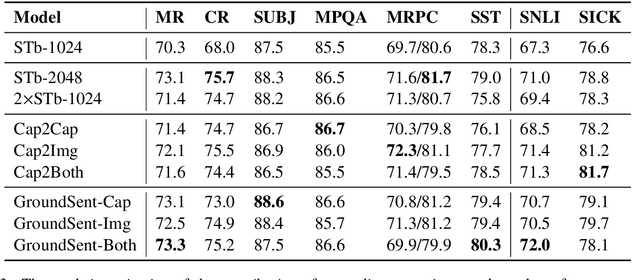
We introduce a variety of models, trained on a supervised image captioning corpus to predict the image features for a given caption, to perform sentence representation grounding. We train a grounded sentence encoder that achieves good performance on COCO caption and image retrieval and subsequently show that this encoder can successfully be transferred to various NLP tasks, with improved performance over text-only models. Lastly, we analyze the contribution of grounding, and show that word embeddings learned by this system outperform non-grounded ones.
Unsupervised Machine Translation Using Monolingual Corpora Only
Apr 13, 2018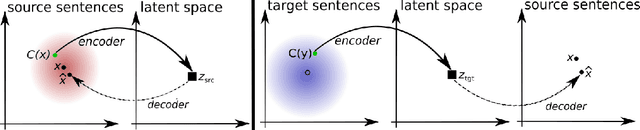

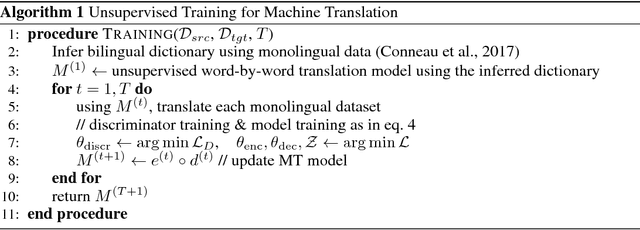
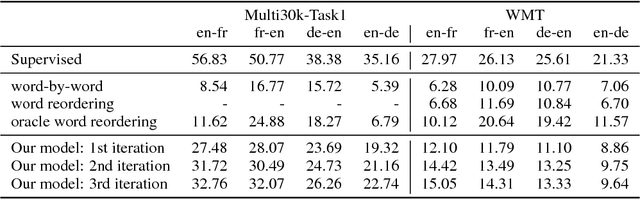
Machine translation has recently achieved impressive performance thanks to recent advances in deep learning and the availability of large-scale parallel corpora. There have been numerous attempts to extend these successes to low-resource language pairs, yet requiring tens of thousands of parallel sentences. In this work, we take this research direction to the extreme and investigate whether it is possible to learn to translate even without any parallel data. We propose a model that takes sentences from monolingual corpora in two different languages and maps them into the same latent space. By learning to reconstruct in both languages from this shared feature space, the model effectively learns to translate without using any labeled data. We demonstrate our model on two widely used datasets and two language pairs, reporting BLEU scores of 32.8 and 15.1 on the Multi30k and WMT English-French datasets, without using even a single parallel sentence at training time.
SentEval: An Evaluation Toolkit for Universal Sentence Representations
Mar 14, 2018
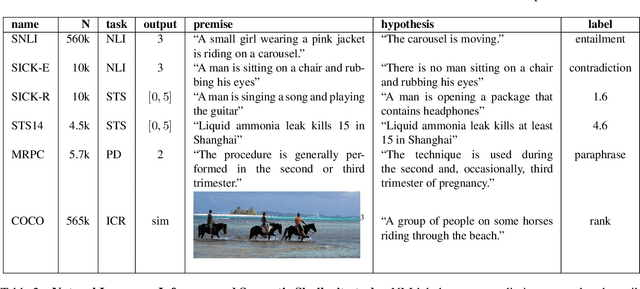
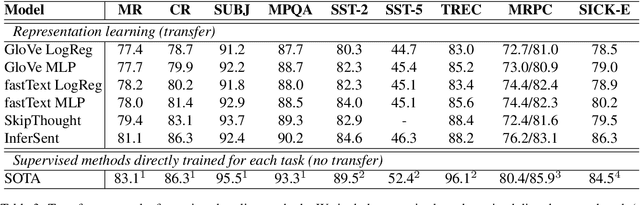
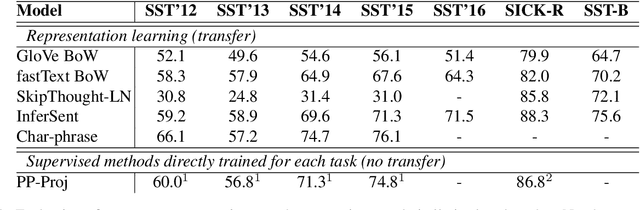
We introduce SentEval, a toolkit for evaluating the quality of universal sentence representations. SentEval encompasses a variety of tasks, including binary and multi-class classification, natural language inference and sentence similarity. The set of tasks was selected based on what appears to be the community consensus regarding the appropriate evaluations for universal sentence representations. The toolkit comes with scripts to download and preprocess datasets, and an easy interface to evaluate sentence encoders. The aim is to provide a fairer, less cumbersome and more centralized way for evaluating sentence representations.