 Add to Chrome
 Add to Firefox
 Add to Edge
Pattern-and-root inflectional morphology: the Arabic broken plural
May 21, 2026
We present a substantially implemented model of description of the inflectional morphology of Arabic nouns, with special attention to the management of dictionaries and other language resources by Arabic-speaking linguists. The breakthrough lies in the reversal of the traditional root-and-pattern Semitic model into pattern-and-root, giving precedence to patterns over roots. Our model includes broken plurals (BPs), i.e. plurals formed by modifying the stem. It is based on the traditional notions of root and pattern of Semitic morphology. However, as compared to traditional Arabic morphology, it keeps the formal description of inflection separate from that of derivation and semantics. As traditional Arabic dictionaries, the updatable dictionary is structured in lexical entries for lemmas, and the reference spelling is fully diacritized. In our model, morphological analysis of Arabic text is performed directly with a dictionary of words and without morphophonological rules. Our taxonomy for noun inflection is simple, orderly and detailed. We simplify the taxonomy of singular patterns by specifying vowel quantity as v or vv, and ignoring vowel quality. Root alternations and orthographical variations are encoded independently from patterns and in a factual way, without deep roots or morphophonological or orthographical rules. Nouns with a triliteral BP are classified according to 22 patterns subdivided into 90 classes, and nouns with a quadriliteral BP according to 3 patterns subdivided into 70 classes. These 160 classes become 300 inflectional classes when we take into account inflectional variations that affect only the singular. We provide a straightforward encoding scheme that we applied to 3 200 entries of BP nouns.

Restoring Arabic vowels through omission-tolerant dictionary lookup
May 10, 2019
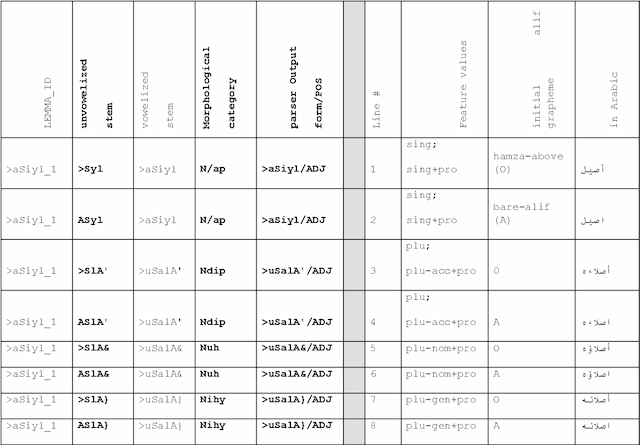
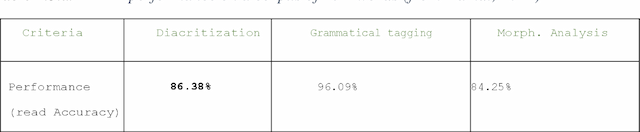
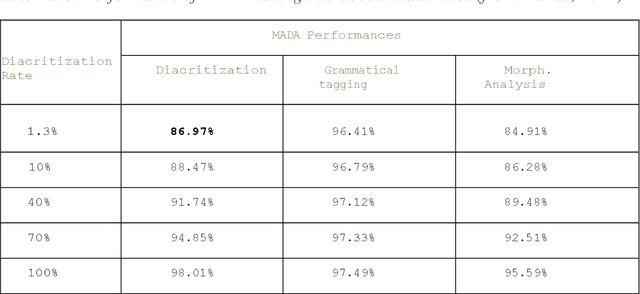
Vowels in Arabic are optional orthographic symbols written as diacritics above or below letters. In Arabic texts, typically more than 97 percent of written words do not explicitly show any of the vowels they contain; that is to say, depending on the author, genre and field, less than 3 percent of words include any explicit vowel. Although numerous studies have been published on the issue of restoring the omitted vowels in speech technologies, little attention has been given to this problem in papers dedicated to written Arabic technologies.f In this research, we present Arabic-Unitex, an Arabic Language Resource, with emphasis on vowel representation and encoding. Specifically, we present two dozens of rules formalizing a detailed description of vowel omission in written text. They are typographical rules integrated into large-coverage resources for morphological annotation. For restoring vowels, our resources are capable of identifying words in which the vowels are not shown, as well as words in which the vowels are partially or fully included. By taking into account these rules, our resources are able to compute and restore for each word form a list of compatible fully vowelized candidates through omission-tolerant dictionary lookup. Our program performs the analysis of 5000 words/second for running text (20 pages/second). Based on these comprehensive linguistic resources, we created a spell checker that detects any invalid/misplaced vowel in a fully or partially vowelized form. Finally, our resources provide a lexical coverage of more than 99 percent of the words used in popular newspapers, and restore vowels in words (out of context) simply and efficiently.