 Add to Chrome
 Add to Firefox
 Add to Edge
LogicGaze: Benchmarking Causal Consistency in Visual Narratives via Counterfactual Verification
Jan 30, 2026
While sequential reasoning enhances the capability of Vision-Language Models (VLMs) to execute complex multimodal tasks, their reliability in grounding these reasoning chains within actual visual evidence remains insufficiently explored. We introduce LogicGaze, a novel benchmark framework designed to rigorously interrogate whether VLMs can validate sequential causal chains against visual inputs, specifically targeting the pervasive issue of hallucination. Curated from 40,000 video segments from ShareGPT4Video and a subset of Flickr30k imagery, LogicGaze integrates causal sequences with visually contradictory yet linguistically plausible perturbations, compelling models to verify the authenticity of each reasoning step. Our tripartite evaluation protocol - Causal Validation, Grounded Narrative Synthesis, and Perturbation Rejection - exposes significant vulnerabilities in state-of-the-art VLMs such as Qwen2.5-VL-72B. LogicGaze advocates for robust, trustworthy multimodal reasoning, with all resources publicly available in an anonymized repository.

Bridging the Semantic Chasm: Synergistic Conceptual Anchoring for Generalized Few-Shot and Zero-Shot OOD Perception
Jan 30, 2026This manuscript presents a pioneering Synergistic Neural Agents Network (SynerNet) framework designed to mitigate the phenomenon of cross-modal alignment degeneration in Vision-Language Models (VLMs) when encountering Out-of-Distribution (OOD) concepts. Specifically, four specialized computational units - visual perception, linguistic context, nominal embedding, and global coordination - collaboratively rectify modality disparities via a structured message-propagation protocol. The principal contributions encompass a multi-agent latent space nomenclature acquisition framework, a semantic context-interchange algorithm for enhanced few-shot adaptation, and an adaptive dynamic equilibrium mechanism. Empirical evaluations conducted on the VISTA-Beyond benchmark demonstrate that SynerNet yields substantial performance augmentations in both few-shot and zero-shot scenarios, exhibiting precision improvements ranging from 1.2% to 5.4% across a diverse array of domains.
SA-DiffuSeq: Addressing Computational and Scalability Challenges in Long-Document Generation with Sparse Attention
Dec 23, 2025Diffusion based approaches to long form text generation suffer from prohibitive computational cost and memory overhead as sequence length increases. We introduce SA-DiffuSeq, a diffusion framework that integrates sparse attention to fundamentally improve scalability for long document modeling. By selectively allocating attention within the diffusion process, SA-DiffuSeq significantly reduces computational complexity while maintaining semantic coherence and generation quality. A key component of our method is a soft absorbing state tailored to sparse attention dynamics, which stabilizes diffusion trajectories and accelerates sequence reconstruction. This design improves sampling efficiency and enhances precision in long range dependency modeling. Extensive experiments demonstrate that SA-DiffuSeq consistently surpasses state of the art diffusion baselines in both training efficiency and sampling speed, with especially strong gains on extended sequences. These properties make SA-DiffuSeq well suited for demanding long form applications such as scientific writing, large scale code generation, and multi turn long context dialogue. Overall, our results indicate that incorporating structured sparsity into diffusion models is a promising direction for efficient and expressive long text generation.
MoE-DiffuSeq: Enhancing Long-Document Diffusion Models with Sparse Attention and Mixture of Experts
Dec 23, 2025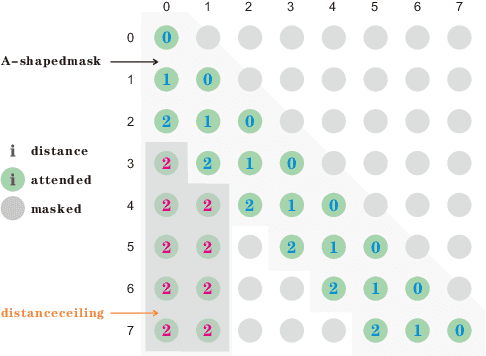
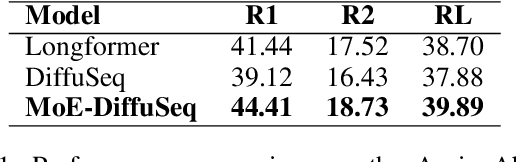

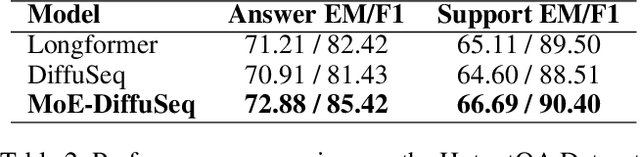
We present MoE-DiffuSeq, a mixture of experts based framework for enhancing diffusion models in long document generation. Existing diffusion based text generation models, such as DiffuSeq, suffer from high computational cost and memory overhead when applied to extended sequences. To address these challenges, MoE-DiffuSeq integrates sparse attention with a mixture of experts architecture, enabling efficient and scalable long sequence modeling. Our approach introduces a customized sparse attention mechanism designed to reduce computational complexity while preserving text quality and coherence. In addition, we incorporate a soft absorbing state within the diffusion process to accelerate sequence reconstruction and improve generation precision. Extensive experiments demonstrate that MoE-DiffuSeq significantly improves training efficiency and sampling speed compared to existing diffusion models. These advantages are particularly effective for long document scenarios, including scientific article generation, code repository modeling, and long form dialogue generation. Benchmark results further show that MoE-DiffuSeq improves efficiency, speed, accuracy, and expressiveness, advancing the practical applicability of diffusion models for high quality long form text generation.