 Add to Chrome
 Add to Firefox
 Add to Edge
From Driving Videos to Simulatable Scenarios
Jun 20, 2026
Autonomous vehicles (AVs) face driving scenarios ranging from routine traffic to rare events. To assess safety it is crucial to reproduce these scenarios in a controllable, repeatable, and scalable manner, with simulation playing a key role. This paper introduces D-V2S, a novel framework that automatically generates simulatable driving scenarios from driving videos. D-V2S operates in two stages: a Driving Record Analyzer (DRA) uses a vision language model (VLM) with our designed prompt to produce natural-language descriptions from input videos, capturing road layouts and dynamic traffic interactions; subsequently, a Scenario Generator (SG) uses a large language model (LLM) and our conditioning context to translate these descriptions into executable scenarios. Using simulations, we show that D-V2S generates scenarios where 90% of the relevant semantic elements of the videos are present. We also provide qualitative results demonstrating D-V2S's capability to transform real-world driving videos into simulatable scenarios. Moreover, we provide both semantic and human driven ablative analyses of D-V2S's modules. In particular, we show how the VLM choice matters for DRA, and how our SG achieves a 75% preference rate over other state-of-the-art methods.

Guiding Attention in End-to-End Driving Models
Apr 30, 2024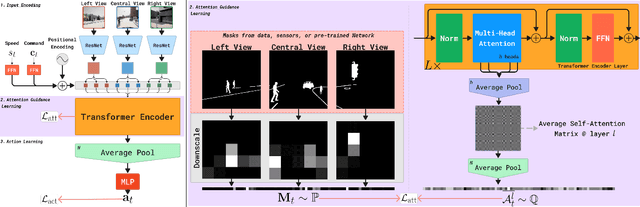
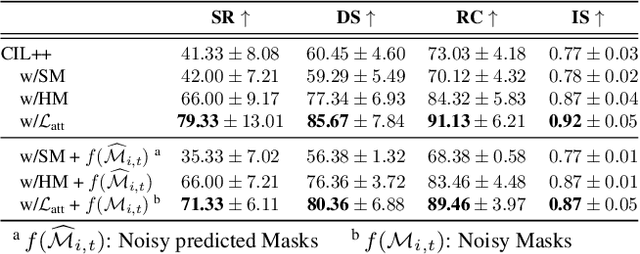
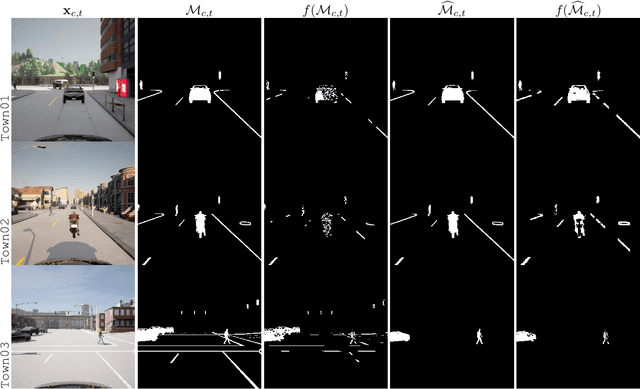

Vision-based end-to-end driving models trained by imitation learning can lead to affordable solutions for autonomous driving. However, training these well-performing models usually requires a huge amount of data, while still lacking explicit and intuitive activation maps to reveal the inner workings of these models while driving. In this paper, we study how to guide the attention of these models to improve their driving quality and obtain more intuitive activation maps by adding a loss term during training using salient semantic maps. In contrast to previous work, our method does not require these salient semantic maps to be available during testing time, as well as removing the need to modify the model's architecture to which it is applied. We perform tests using perfect and noisy salient semantic maps with encouraging results in both, the latter of which is inspired by possible errors encountered with real data. Using CIL++ as a representative state-of-the-art model and the CARLA simulator with its standard benchmarks, we conduct experiments that show the effectiveness of our method in training better autonomous driving models, especially when data and computational resources are scarce.