 Add to Chrome
 Add to Firefox
 Add to Edge
Robustifying pathology foundation models via fine-tuning
Jul 24, 2026
Pathology foundation models (FMs) produce powerful tile-level representations which remain sensitive to scanner and staining variability, undermining deployment across laboratories. We develop a novel fine-tuning recipe that improves the robustness of pathology FMs to acquisition factors. Applied to ten different FMs, our fine-tuning strategy consistently improves robustness for every model as well as downstream performance, with no observed trade-off. On average, it raises the PathoROB robustness index by 23% (from 0.72 to 0.87) and increases the overall cross-benchmark performance by 43% on Patho-Bench, HEST and THUNDER combined, with individual gains reaching up to 72% in robustness (Phikon-v2) and 76% in performance (Midnight-12k). We publicly release the fine-tuned versions of Phikon-v2 (Phaet) and Midnight-12k (Mascaret) at https://huggingface.co/wearewaiv/models.

CytoSyn: a Foundation Diffusion Model for Histopathology -- Tech Report
Mar 18, 2026Computational pathology has made significant progress in recent years, fueling advances in both fundamental disease understanding and clinically ready tools. This evolution is driven by the availability of large amounts of digitized slides and specialized deep learning methods and models. Multiple self-supervised foundation feature extractors have been developed, enabling downstream predictive applications from cell segmentation to tumor sub-typing and survival analysis. In contrast, generative foundation models designed specifically for histopathology remain scarce. Such models could address tasks that are beyond the capabilities of feature extractors, such as virtual staining. In this paper, we introduce CytoSyn, a state-of-the-art foundation latent diffusion model that enables the guided generation of highly realistic and diverse histopathology H&E-stained images, as shown in an extensive benchmark. We explored methodological improvements, training set scaling, sampling strategies and slide-level overfitting, culminating in the improved CytoSyn-v2, and compared our work to PixCell, a state-of-the-art model, in an in-depth manner. This comparison highlighted the strong sensitivity of both diffusion models and performance metrics to preprocessing-specific details such as JPEG compression. Our model has been trained on a dataset obtained from more than 10,000 TCGA diagnostic whole-slide images of 32 different cancer types. Despite being trained only on oncology slides, it maintains state-of-the-art performance generating inflammatory bowel disease images. To support the research community, we publicly release CytoSyn's weights, its training and validation datasets, and a sample of synthetic images in this repository: https://huggingface.co/Owkin-Bioptimus/CytoSyn.
Distilling foundation models for robust and efficient models in digital pathology
Jan 27, 2025In recent years, the advent of foundation models (FM) for digital pathology has relied heavily on scaling the pre-training datasets and the model size, yielding large and powerful models. While it resulted in improving the performance on diverse downstream tasks, it also introduced increased computational cost and inference time. In this work, we explore the distillation of a large foundation model into a smaller one, reducing the number of parameters by several orders of magnitude. Leveraging distillation techniques, our distilled model, H0-mini, achieves nearly comparable performance to large FMs at a significantly reduced inference cost. It is evaluated on several public benchmarks, achieving 3rd place on the HEST benchmark and 5th place on the EVA benchmark. Additionally, a robustness analysis conducted on the PLISM dataset demonstrates that our distilled model reaches excellent robustness to variations in staining and scanning conditions, significantly outperforming other state-of-the art models. This opens new perspectives to design lightweight and robust models for digital pathology, without compromising on performance.
Phikon-v2, A large and public feature extractor for biomarker prediction
Sep 13, 2024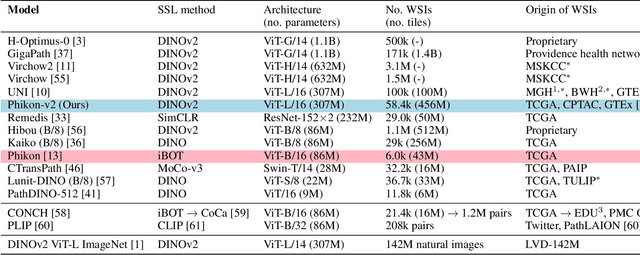
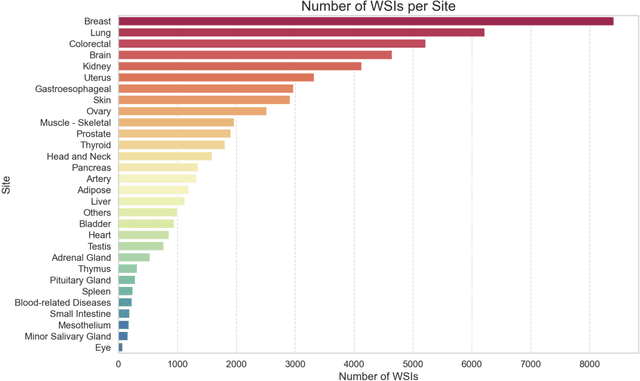
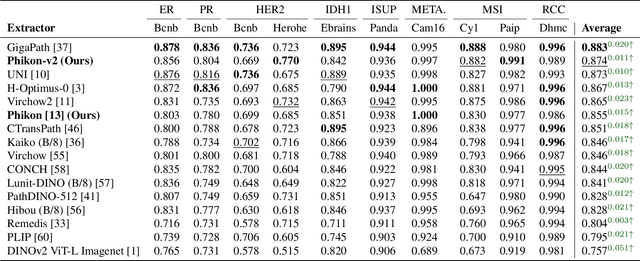
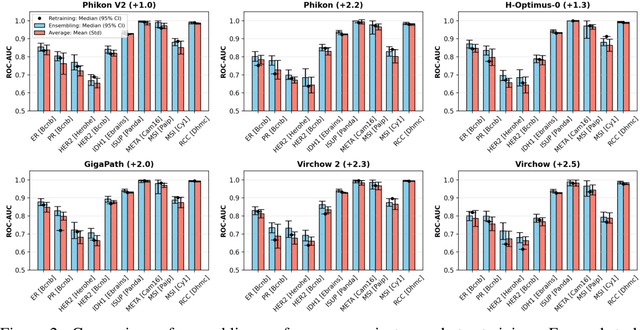
Gathering histopathology slides from over 100 publicly available cohorts, we compile a diverse dataset of 460 million pathology tiles covering more than 30 cancer sites. Using this dataset, we train a large self-supervised vision transformer using DINOv2 and publicly release one iteration of this model for further experimentation, coined Phikon-v2. While trained on publicly available histology slides, Phikon-v2 surpasses our previously released model (Phikon) and performs on par with other histopathology foundation models (FM) trained on proprietary data. Our benchmarks include eight slide-level tasks with results reported on external validation cohorts avoiding any data contamination between pre-training and evaluation datasets. Our downstream training procedure follows a simple yet robust ensembling strategy yielding a +1.75 AUC increase across tasks and models compared to one-shot retraining (p<0.001). We compare Phikon (ViT-B) and Phikon-v2 (ViT-L) against 14 different histology feature extractors, making our evaluation the most comprehensive to date. Our result support evidences that DINOv2 handles joint model and data scaling better than iBOT. Also, we show that recent scaling efforts are overall beneficial to downstream performance in the context of biomarker prediction with GigaPath and H-Optimus-0 (two ViT-g with 1.1B parameters each) standing out. However, the statistical margins between the latest top-performing FMs remain mostly non-significant; some even underperform on specific indications or tasks such as MSI prediction - deposed by a 13x smaller model developed internally. While latest foundation models may exhibit limitations for clinical deployment, they nonetheless offer excellent grounds for the development of more specialized and cost-efficient histology encoders fueling AI-guided diagnostic tools.