 Add to Chrome
 Add to Firefox
 Add to Edge
Towards Robust Scaling Laws for Optimizers
Feb 07, 2026
The quality of Large Language Model (LLM) pretraining depends on multiple factors, including the compute budget and the choice of optimization algorithm. Empirical scaling laws are widely used to predict loss as model size and training data grow, however, almost all existing studies fix the optimizer (typically AdamW). At the same time, a new generation of optimizers (e.g., Muon, Shampoo, SOAP) promises faster and more stable convergence, but their relationship with model and data scaling is not yet well understood. In this work, we study scaling laws across different optimizers. Empirically, we show that 1) separate Chinchilla-style scaling laws for each optimizer are ill-conditioned and have highly correlated parameters. Instead, 2) we propose a more robust law with shared power-law exponents and optimizer-specific rescaling factors, which enable direct comparison between optimizers. Finally, 3) we provide a theoretical analysis of gradient-based methods for the proxy task of a convex quadratic objective, demonstrating that Chinchilla-style scaling laws emerge naturally as a result of loss decomposition into irreducible, approximation, and optimization errors.

ASIDE: Architectural Separation of Instructions and Data in Language Models
Mar 13, 2025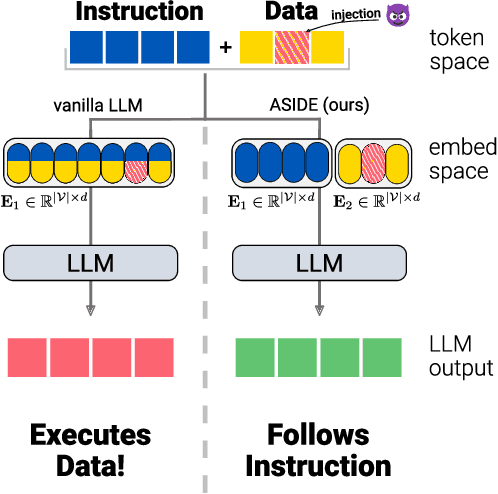
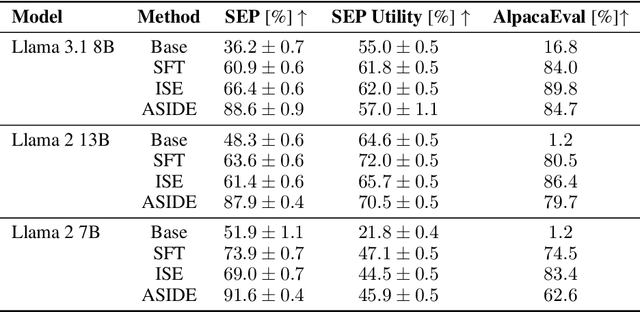
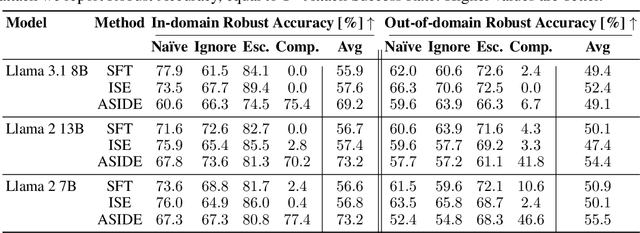
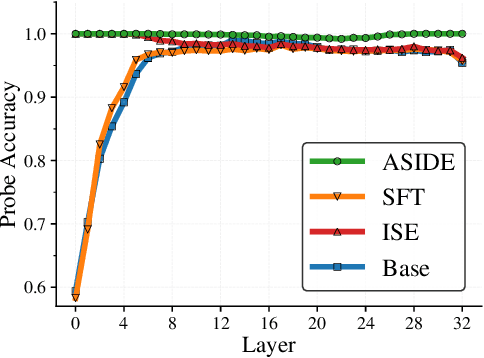
Despite their remarkable performance, large language models lack elementary safety features, and this makes them susceptible to numerous malicious attacks. In particular, previous work has identified the absence of an intrinsic separation between instructions and data as a root cause for the success of prompt injection attacks. In this work, we propose an architectural change, ASIDE, that allows the model to clearly separate between instructions and data by using separate embeddings for them. Instead of training the embeddings from scratch, we propose a method to convert an existing model to ASIDE form by using two copies of the original model's embeddings layer, and applying an orthogonal rotation to one of them. We demonstrate the effectiveness of our method by showing (1) highly increased instruction-data separation scores without a loss in model capabilities and (2) competitive results on prompt injection benchmarks, even without dedicated safety training. Additionally, we study the working mechanism behind our method through an analysis of model representations.