 Add to Chrome
 Add to Firefox
 Add to Edge
Systematic Evaluation of TabPFN-TS for Zero-Shot Probabilistic Heat Load Forecasting in District Heating Networks
Aug 20, 2026
District heating energy hubs require reliable heat load forecasts for efficient operational scheduling. Conventional forecasting workflows train system-specific models on historical data, which can become burdensome when networks change through new consumers, retrofits, or changing operating regimes. Zero-shot time-series foundation models and in-context forecasting offer a promising alternative: they can adapt at inference time from recent observations rather than by repeated retraining. This study systematically evaluates TabPFN-TS against time-series foundation models and trained machine-learning baselines for probabilistic heat load forecasting in district heating networks. Unlike foundation models pretrained on large collections of real time series, TabPFN-TS relies on synthetic pretraining data, which avoids direct pretraining-test overlap but raises the question of whether the learned prior captures district heating dynamics. We analyze covariate choice, context length, temporal resolution, and prediction horizon on representative operating weeks, validate the selected configuration over a full year, and test transferability on a second network. The results identify hourly 24-hour forecasting with a 12-week rolling context and ambient temperature as a parsimonious high-performing configuration; longer context windows do not improve accuracy. TabPFN-TS remains close to Chronos-2 in deterministic accuracy, reaching CVRMSE values of 13.06% versus 12.48% on the main dataset, and lies within the critical-difference threshold in the daily-rank comparison. Although Chronos-2 achieves the lowest aggregate full-year error, TabPFN-TS shows better empirical calibration. Finally, the diagnostic findings motivate a Multi-Resolution Residual-Correction Forecaster that combines a low-frequency Base Forecaster with a short-horizon Residual Forecaster to improve longer-horizon planning accuracy.

Hybrid Neural Ordinary Differential Equations for Data-Efficient Polymerization Modeling with Incomplete Kinetics
Jun 01, 2026Accurate prediction of polymerization dynamics is essential for process design, control, and optimization. Yet, purely mechanistic models require labor-intensive parameterization of partially characterized kinetics, while purely data-driven models demand large, diverse datasets that are costly to obtain, particularly in early-design stages. We propose a hybrid Neural Ordinary Differential Equation (NODE) framework for data-efficient modeling of free-radical polymerization. Using batch polymerization of methyl methacrylate (MMA) as a case study, the mechanistic mass balances are retained explicitly, and only the partially-characterized effective radical concentration governing monomer consumption is learned from data through a neural network surrogate, while established reactions such as initiator decomposition, propagation, and termination remain physically modeled. The hybrid NODE is evaluated against a discrete-time feedforward neural network and a purely data-driven NODE under sparse data conditions, with models trained on as few as ten measurements under both regular and irregular sampling. The hybrid NODE consistently achieves lower prediction errors and more physically consistent extrapolations than both purely data-driven baselines. In a generalization scenario with noisy data and unseen operating conditions, the hybrid NODE achieves an RMSE of 0.013, compared to 0.31 for the data-driven NODE and 0.68 for the discrete-time model, demonstrating that learning only a closure term rather than the full dynamics is sufficient for reliable prediction under limited data availability.
Iterative Model-Learning Scheme via Gaussian Processes for Nonlinear Model Predictive Control of (Semi-)Batch Processes
Apr 24, 2026Batch processes are inherently transient and typically nonlinear, motivating nonlinear model predictive control (NMPC). However, adopting NMPC is hindered by the cost and unavailability of dynamic models. Thus, we propose to use Gaussian Processes (GP) in a model-learning NMPC scheme (GP-MLMPC) for batch processes. We initialize the GP-MLMPC using data from a single initial trajectory, e.g., from a PI controller. We iteratively apply the NMPC embedded with GPs to run batches and update the GP with new observations from each iteration, thereby achieving batch-wise improvements. Using uncertainty quantification from the GPs, we formulate chance constraints to enforce safe operation to the required confidence levels. We demonstrate our approach in \textit{silico} on a semi-batch polymerization reactor for tracking and economic objectives over durations of two hours, and the reactor temperature is constrained in a range of $\pm2^\circ C$ around its setpoint. After only four batch iterations, tracking error from the GP-MLMPC scheme converged to a reduction of $83\%$, compared to the initial trajectory. Furthermore, under an economic objective, the GP-MLMPC resulted in a 17-fold increase in final product mass by iteration 8, compared to the initial trajectory. In both cases, the resulting GP-MLMPC performance is on par with the full-model NMPC, which shows that the optimal controller can be learned by the approach. By collecting samples around the optimal trajectory, the GP-MLMPC remains sample-efficient across iterations and achieves quick convergence. Thus, the proposed GP-MLMPC scheme presents a promising data-efficient approach for the control of nonlinear batch processes without mechanistic knowledge.
Bayesian Optimization of Partially Known Systems using Hybrid Models
Mar 11, 2026Bayesian optimization (BO) has gained attention as an efficient algorithm for black-box optimization of expensive-to-evaluate systems, where the BO algorithm iteratively queries the system and suggests new trials based on a probabilistic model fitted to previous samples. Still, the standard BO loop may require a prohibitively large number of experiments to converge to the optimum, especially for high-dimensional and nonlinear systems. We present a hybrid model-based BO formulation that combines the iterative Bayesian learning of BO with partially known mechanistic physical models. Instead of learning a direct mapping from inputs to the objective, we write all known equations for a physics-based model and infer expressions for variables missing equations using a probabilistic model, in our case, a Gaussian process (GP). The final formulation then includes the GP as a constraint in the hybrid model, thereby allowing other physics-based nonlinear and implicit model constraints. This hybrid model formulation yields a constrained, nonlinear stochastic program, which we discretize using the sample-average approximation. In an in-silico optimization of a single-stage distillation, the hybrid BO model based on mass conservation laws yields significantly better designs than a standard BO loop. Furthermore, the hybrid model converges in as few as one iteration, depending on the initial samples, whereas, the standard BO does not converge within 25 for any of the seeds. Overall, the proposed hybrid BO scheme presents a promising optimization method for partially known systems, leveraging the strengths of both mechanistic modeling and data-driven optimization.
Differentiable Thermodynamic Phase-Equilibria for Machine Learning
Mar 11, 2026Accurate prediction of phase equilibria remains a central challenge in chemical engineering. Physics-consistent machine learning methods that incorporate thermodynamic structure into neural networks have recently shown strong performance for activity-coefficient modeling. However, extending such approaches to equilibrium data arising from an extremum principle, such as liquid-liquid equilibria, remains difficult. Here we present DISCOMAX, a differentiable algorithm for phase-equilibrium calculation that guarantees thermodynamic consistency at both training and inference, only subject to a user-specified discretization. The method is rooted in statistical thermodynamics, and works via a discrete enumeration with subsequent masked softmax aggregation of feasible states, and together with a straight-through gradient estimator to enable physics-consistent end-to-end learning of neural $g^{E}$-models. We evaluate the approach on binary liquid-liquid equilibrium data and demonstrate that it outperforms existing surrogate-based methods, while offering a general framework for learning from different kinds of equilibrium data.
Amortized Molecular Optimization via Group Relative Policy Optimization
Feb 12, 2026Molecular design encompasses tasks ranging from de-novo design to structural alteration of given molecules or fragments. For the latter, state-of-the-art methods predominantly function as "Instance Optimizers'', expending significant compute restarting the search for every input structure. While model-based approaches theoretically offer amortized efficiency by learning a policy transferable to unseen structures, existing methods struggle to generalize. We identify a key failure mode: the high variance arising from the heterogeneous difficulty of distinct starting structures. To address this, we introduce GRXForm, adapting a pre-trained Graph Transformer model that optimizes molecules via sequential atom-and-bond additions. We employ Group Relative Policy Optimization (GRPO) for goal-directed fine-tuning to mitigate variance by normalizing rewards relative to the starting structure. Empirically, GRXForm generalizes to out-of-distribution molecular scaffolds without inference-time oracle calls or refinement, achieving scores in multi-objective optimization competitive with leading instance optimizers.
Estimating Dense-Packed Zone Height in Liquid-Liquid Separation: A Physics-Informed Neural Network Approach
Jan 26, 2026Separating liquid-liquid dispersions in gravity settlers is critical in chemical, pharmaceutical, and recycling processes. The dense-packed zone height is an important performance and safety indicator but it is often expensive and impractical to measure due to optical limitations. We propose to estimate phase heights using only inexpensive volume flow measurements. To this end, a physics-informed neural network (PINN) is first pretrained on synthetic data and physics equations derived from a low-fidelity (approximate) mechanistic model to reduce the need for extensive experimental data. While the mechanistic model is used to generate synthetic training data, only volume balance equations are used in the PINN, since the integration of submodels describing droplet coalescence and sedimentation into the PINN would be computationally prohibitive. The pretrained PINN is then fine-tuned with scarce experimental data to capture the actual dynamics of the separator. We then employ the differentiable PINN as a predictive model in an Extended Kalman Filter inspired state estimation framework, enabling the phase heights to be tracked and updated from flow-rate measurements. We first test the two-stage trained PINN by forward simulation from a known initial state against the mechanistic model and a non-pretrained PINN. We then evaluate phase height estimation performance with the filter, comparing the two-stage trained PINN with a two-stage trained purely data-driven neural network. All model types are trained and evaluated using ensembles to account for model parameter uncertainty. In all evaluations, the two-stage trained PINN yields the most accurate phase-height estimates.
Data-Driven Conditional Flexibility Index
Jan 22, 2026With the increasing flexibilization of processes, determining robust scheduling decisions has become an important goal. Traditionally, the flexibility index has been used to identify safe operating schedules by approximating the admissible uncertainty region using simple admissible uncertainty sets, such as hypercubes. Presently, available contextual information, such as forecasts, has not been considered to define the admissible uncertainty set when determining the flexibility index. We propose the conditional flexibility index (CFI), which extends the traditional flexibility index in two ways: by learning the parametrized admissible uncertainty set from historical data and by using contextual information to make the admissible uncertainty set conditional. This is achieved using a normalizing flow that learns a bijective mapping from a Gaussian base distribution to the data distribution. The admissible latent uncertainty set is constructed as a hypersphere in the latent space and mapped to the data space. By incorporating contextual information, the CFI provides a more informative estimate of flexibility by defining admissible uncertainty sets in regions that are more likely to be relevant under given conditions. Using an illustrative example, we show that no general statement can be made about data-driven admissible uncertainty sets outperforming simple sets, or conditional sets outperforming unconditional ones. However, both data-driven and conditional admissible uncertainty sets ensure that only regions of the uncertain parameter space containing realizations are considered. We apply the CFI to a security-constrained unit commitment example and demonstrate that the CFI can improve scheduling quality by incorporating temporal information.
Nonlinear Model Order Reduction of Dynamical Systems in Process Engineering: Review and Comparison
Jun 15, 2025Computationally cheap yet accurate enough dynamical models are vital for real-time capable nonlinear optimization and model-based control. When given a computationally expensive high-order prediction model, a reduction to a lower-order simplified model can enable such real-time applications. Herein, we review state-of-the-art nonlinear model order reduction methods and provide a theoretical comparison of method properties. Additionally, we discuss both general-purpose methods and tailored approaches for (chemical) process systems and we identify similarities and differences between these methods. As manifold-Galerkin approaches currently do not account for inputs in the construction of the reduced state subspace, we extend these methods to dynamical systems with inputs. In a comparative case study, we apply eight established model order reduction methods to an air separation process model: POD-Galerkin, nonlinear-POD-Galerkin, manifold-Galerkin, dynamic mode decomposition, Koopman theory, manifold learning with latent predictor, compartment modeling, and model aggregation. Herein, we do not investigate hyperreduction (reduction of FLOPS). Based on our findings, we discuss strengths and weaknesses of the model order reduction methods.
Deterministic Global Optimization of the Acquisition Function in Bayesian Optimization: To Do or Not To Do?
Mar 05, 2025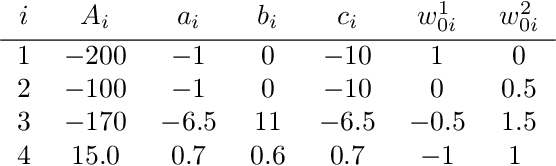
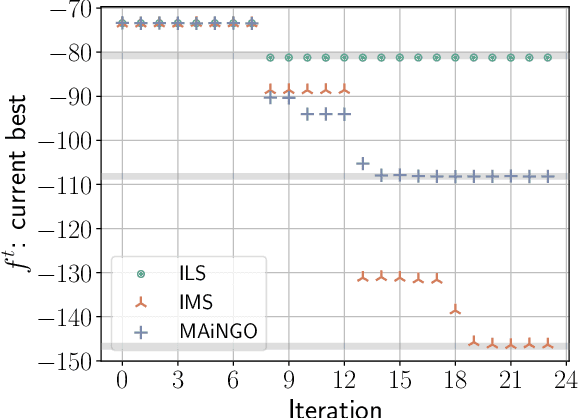
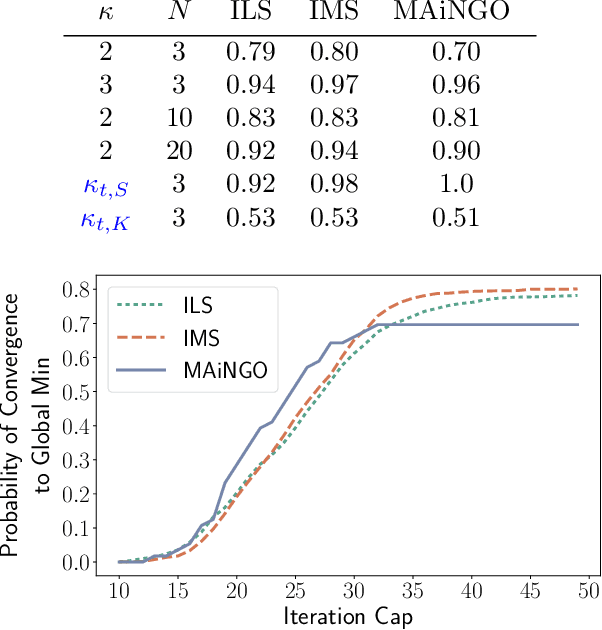
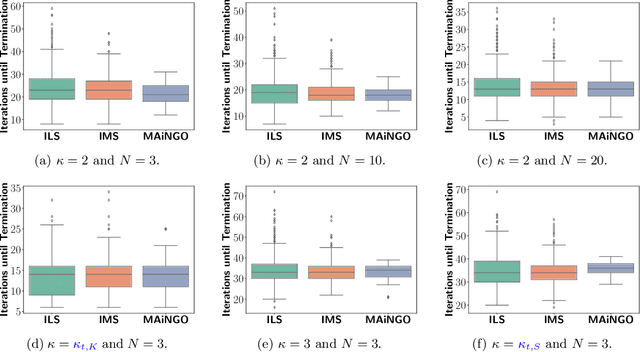
Bayesian Optimization (BO) with Gaussian Processes relies on optimizing an acquisition function to determine sampling. We investigate the advantages and disadvantages of using a deterministic global solver (MAiNGO) compared to conventional local and stochastic global solvers (L-BFGS-B and multi-start, respectively) for the optimization of the acquisition function. For CPU efficiency, we set a time limit for MAiNGO, taking the best point as optimal. We perform repeated numerical experiments, initially using the Muller-Brown potential as a benchmark function, utilizing the lower confidence bound acquisition function; we further validate our findings with three alternative benchmark functions. Statistical analysis reveals that when the acquisition function is more exploitative (as opposed to exploratory), BO with MAiNGO converges in fewer iterations than with the local solvers. However, when the dataset lacks diversity, or when the acquisition function is overly exploitative, BO with MAiNGO, compared to the local solvers, is more likely to converge to a local rather than a global ly near-optimal solution of the black-box function. L-BFGS-B and multi-start mitigate this risk in BO by introducing stochasticity in the selection of the next sampling point, which enhances the exploration of uncharted regions in the search space and reduces dependence on acquisition function hyperparameters. Ultimately, suboptimal optimization of poorly chosen acquisition functions may be preferable to their optimal solution. When the acquisition function is more exploratory, BO with MAiNGO, multi-start, and L-BFGS-B achieve comparable probabilities of convergence to a globally near-optimal solution (although BO with MAiNGO may require more iterations to converge under these conditions).