 Add to Chrome
 Add to Firefox
 Add to Edge
Granuscore: A Reference-Free Measure of Granularity for Text Analysis and Question Answering
May 26, 2026
Natural language conveys information at varying levels of granularity, from fine-grained references to broad descriptions. While granularity is fundamental to human communication, existing measures mostly capture surface detail or sentence specificity. We introduce Granuscore, a reference-free measure of granularity that leverages structural properties of a hierarchical embedding space. Granuscore reliably recovers hierarchical orderings on the Granola-EQ dataset and captures expected differences in granularity across discourse contexts. Across domains, we further show that Granuscore explains non-linear variation in sentence specificity beyond sentence length. Finally, we apply Granuscore to four question-answering benchmarks and analyze how granularity differs for questions, gold answers, and model outputs across response outcomes. The analysis reveals consistent differences in model behavior and provides a principled lens for characterizing the difficulty of QA datasets. Together, the results position Granuscore as a scalable, broadly applicable tool for analyzing granularity in text.

Adapter-based Approaches to Knowledge-enhanced Language Models -- A Survey
Nov 25, 2024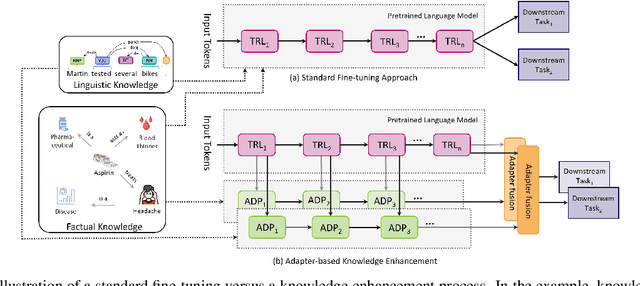
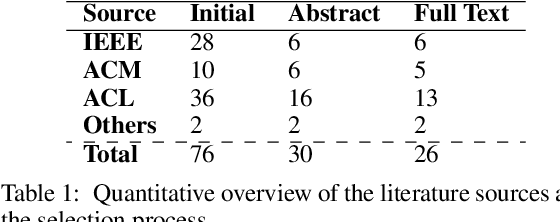
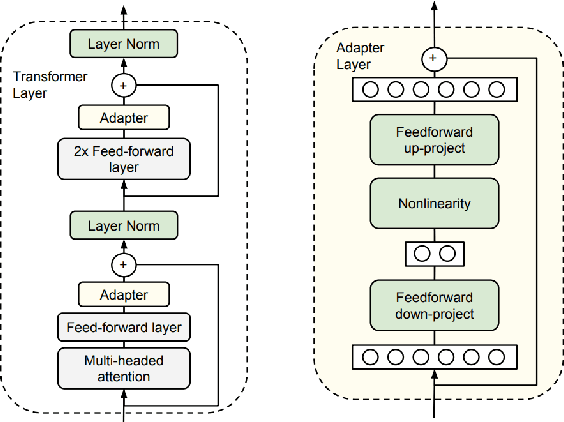
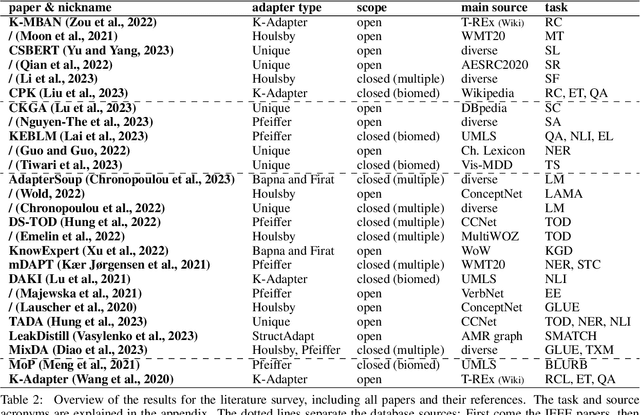
Knowledge-enhanced language models (KELMs) have emerged as promising tools to bridge the gap between large-scale language models and domain-specific knowledge. KELMs can achieve higher factual accuracy and mitigate hallucinations by leveraging knowledge graphs (KGs). They are frequently combined with adapter modules to reduce the computational load and risk of catastrophic forgetting. In this paper, we conduct a systematic literature review (SLR) on adapter-based approaches to KELMs. We provide a structured overview of existing methodologies in the field through quantitative and qualitative analysis and explore the strengths and potential shortcomings of individual approaches. We show that general knowledge and domain-specific approaches have been frequently explored along with various adapter architectures and downstream tasks. We particularly focused on the popular biomedical domain, where we provided an insightful performance comparison of existing KELMs. We outline the main trends and propose promising future directions.
* 12 pages, 4 figures. Published at KEOD24 via SciTePress
Diversifying Knowledge Enhancement of Biomedical Language Models using Adapter Modules and Knowledge Graphs
Dec 21, 2023
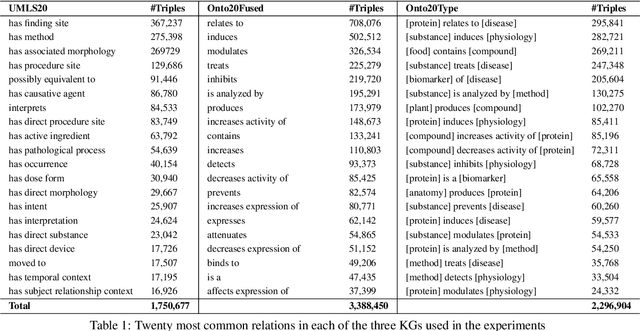
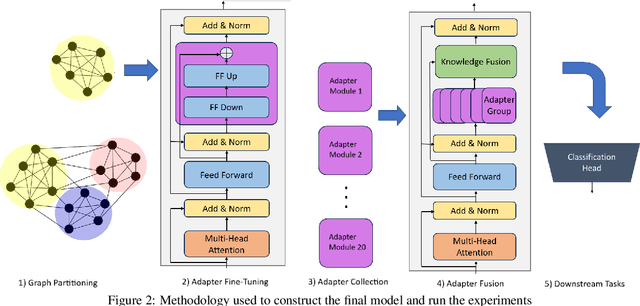
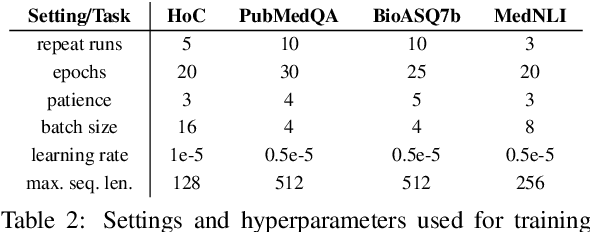
Recent advances in natural language processing (NLP) owe their success to pre-training language models on large amounts of unstructured data. Still, there is an increasing effort to combine the unstructured nature of LMs with structured knowledge and reasoning. Particularly in the rapidly evolving field of biomedical NLP, knowledge-enhanced language models (KELMs) have emerged as promising tools to bridge the gap between large language models and domain-specific knowledge, considering the available biomedical knowledge graphs (KGs) curated by experts over the decades. In this paper, we develop an approach that uses lightweight adapter modules to inject structured biomedical knowledge into pre-trained language models (PLMs). We use two large KGs, the biomedical knowledge system UMLS and the novel biochemical ontology OntoChem, with two prominent biomedical PLMs, PubMedBERT and BioLinkBERT. The approach includes partitioning knowledge graphs into smaller subgraphs, fine-tuning adapter modules for each subgraph, and combining the knowledge in a fusion layer. We test the performance on three downstream tasks: document classification,question answering, and natural language inference. We show that our methodology leads to performance improvements in several instances while keeping requirements in computing power low. Finally, we provide a detailed interpretation of the results and report valuable insights for future work.