 Add to Chrome
 Add to Firefox
 Add to Edge
Time-Inhomogeneous Preconditioned Langevin Dynamics
May 07, 2026
Langevin sampling from distributions of the form $p(x) \propto \exp(-Ψ(x))$ faces two major challenges: (global) mode coverage and (local) mode exploration. The first challenge is particularly relevant for multi-modal distributions with disjoint modes, whereas the second arises when the potential $Ψ$ exhibits diverse and ill-conditioned local mode geometry. To address these challenges, a common approach is to precondition Langevin dynamics with problem-specific information, such as the sample covariance or the local curvature of $Ψ$. However, existing preconditioner choices inherently involve a trade-off between global mode coverage and local mode exploration, and no prior method resolves both simultaneously. To overcome this limitation, we propose the TIPreL, which introduces a time- and position-dependent preconditioner. This design effectively addresses both challenges mentioned above within a single framework. We establish convergence of the resulting dynamics in the Wasserstein-2 distance both in continuous time and for a tamed Euler discretization. In particular, our analysis extends the existing state of the art by proving convergence under time- and space-dependent diffusion coefficients, and only locally Lipschitz drifts, which has not been covered by prior work. Finally, we experimentally compare TIPreL with competing preconditioning schemes on a two-dimensional, severely ill-posed example and on a Bayesian logistic regression task in higher dimensions, confirming the efficiency of the proposed method.

Diffusion at Absolute Zero: Langevin Sampling Using Successive Moreau Envelopes
Feb 03, 2025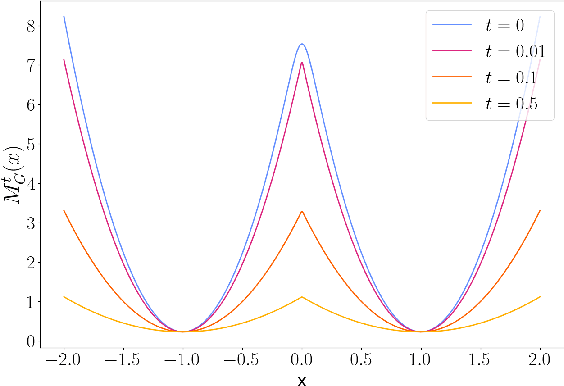
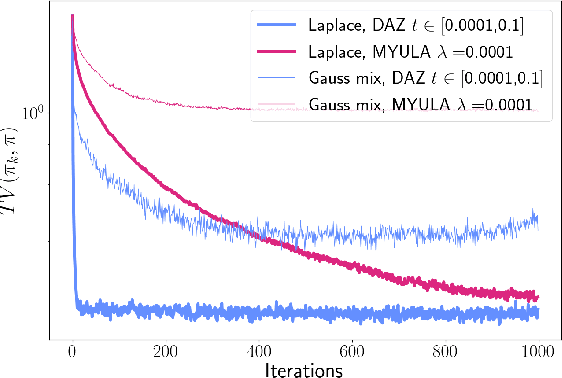

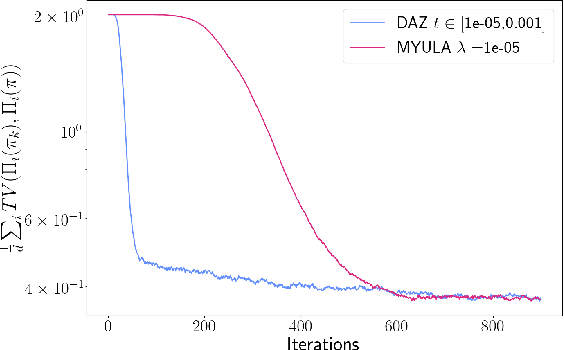
In this article we propose a novel method for sampling from Gibbs distributions of the form $\pi(x)\propto\exp(-U(x))$ with a potential $U(x)$. In particular, inspired by diffusion models we propose to consider a sequence $(\pi^{t_k})_k$ of approximations of the target density, for which $\pi^{t_k}\approx \pi$ for $k$ small and, on the other hand, $\pi^{t_k}$ exhibits favorable properties for sampling for $k$ large. This sequence is obtained by replacing parts of the potential $U$ by its Moreau envelopes. Sampling is performed in an Annealed Langevin type procedure, that is, sequentially sampling from $\pi^{t_k}$ for decreasing $k$, effectively guiding the samples from a simple starting density to the more complex target. In addition to a theoretical analysis we show experimental results supporting the efficacy of the method in terms of increased convergence speed and applicability to multi-modal densities $\pi$.
FlowSDF: Flow Matching for Medical Image Segmentation Using Distance Transforms
May 28, 2024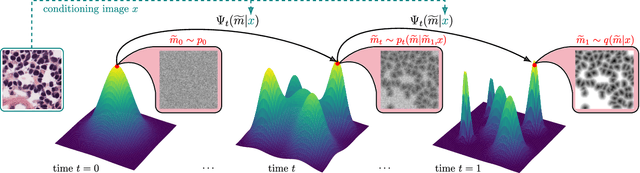
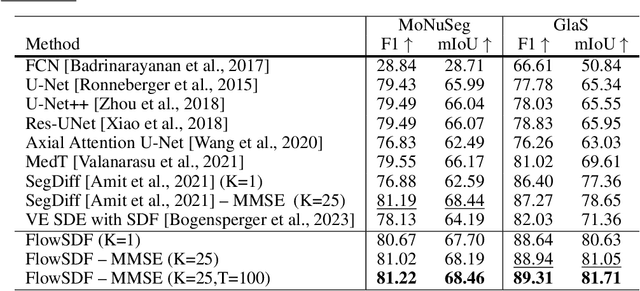
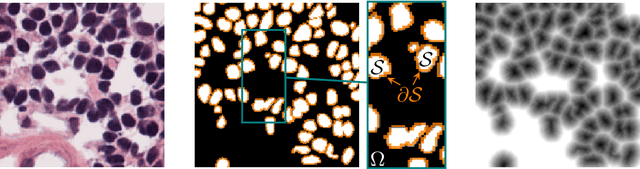

Medical image segmentation is a crucial task that relies on the ability to accurately identify and isolate regions of interest in medical images. Thereby, generative approaches allow to capture the statistical properties of segmentation masks that are dependent on the respective structures. In this work we propose FlowSDF, an image-guided conditional flow matching framework to represent the signed distance function (SDF) leading to an implicit distribution of segmentation masks. The advantage of leveraging the SDF is a more natural distortion when compared to that of binary masks. By learning a vector field that is directly related to the probability path of a conditional distribution of SDFs, we can accurately sample from the distribution of segmentation masks, allowing for the evaluation of statistical quantities. Thus, this probabilistic representation allows for the generation of uncertainty maps represented by the variance, which can aid in further analysis and enhance the predictive robustness. We qualitatively and quantitatively illustrate competitive performance of the proposed method on a public nuclei and gland segmentation data set, highlighting its utility in medical image segmentation applications.