 Add to Chrome
 Add to Firefox
 Add to Edge
Time-Inhomogeneous Preconditioned Langevin Dynamics
May 07, 2026
Langevin sampling from distributions of the form $p(x) \propto \exp(-Ψ(x))$ faces two major challenges: (global) mode coverage and (local) mode exploration. The first challenge is particularly relevant for multi-modal distributions with disjoint modes, whereas the second arises when the potential $Ψ$ exhibits diverse and ill-conditioned local mode geometry. To address these challenges, a common approach is to precondition Langevin dynamics with problem-specific information, such as the sample covariance or the local curvature of $Ψ$. However, existing preconditioner choices inherently involve a trade-off between global mode coverage and local mode exploration, and no prior method resolves both simultaneously. To overcome this limitation, we propose the TIPreL, which introduces a time- and position-dependent preconditioner. This design effectively addresses both challenges mentioned above within a single framework. We establish convergence of the resulting dynamics in the Wasserstein-2 distance both in continuous time and for a tamed Euler discretization. In particular, our analysis extends the existing state of the art by proving convergence under time- and space-dependent diffusion coefficients, and only locally Lipschitz drifts, which has not been covered by prior work. Finally, we experimentally compare TIPreL with competing preconditioning schemes on a two-dimensional, severely ill-posed example and on a Bayesian logistic regression task in higher dimensions, confirming the efficiency of the proposed method.

Product of Gaussian Mixture Diffusion Model for non-linear MRI Inversion
Jan 15, 2025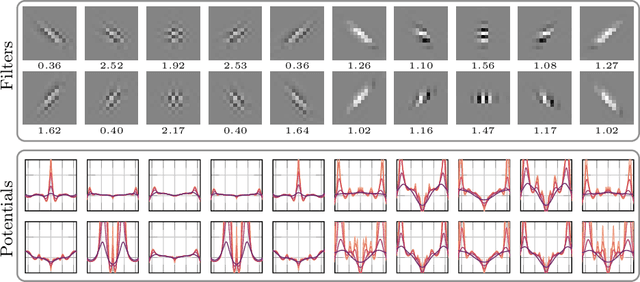
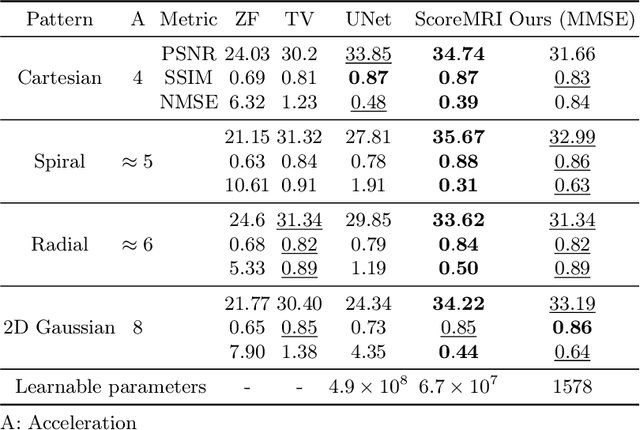
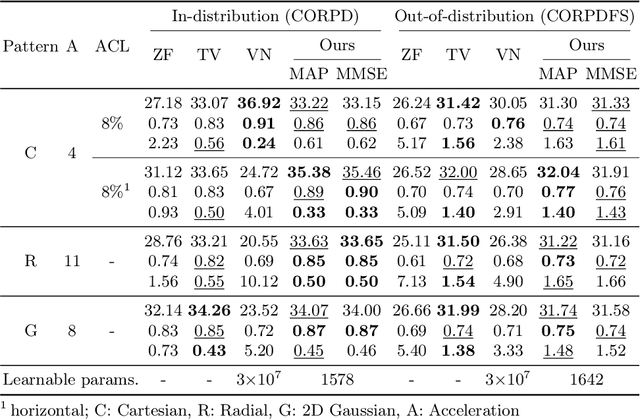
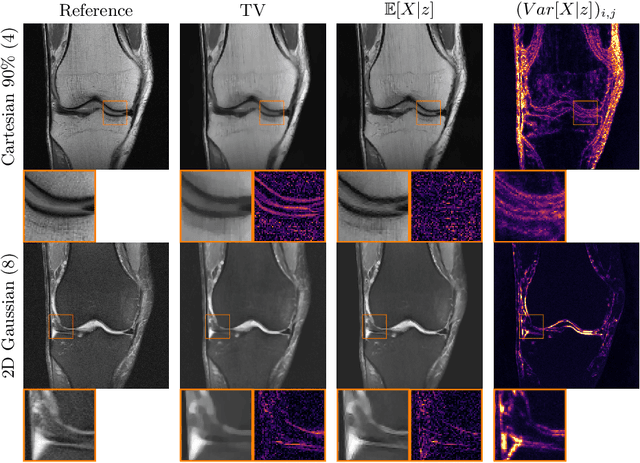
Diffusion models have recently shown remarkable results in magnetic resonance imaging reconstruction. However, the employed networks typically are black-box estimators of the (smoothed) prior score with tens of millions of parameters, restricting interpretability and increasing reconstruction time. Furthermore, parallel imaging reconstruction algorithms either rely on off-line coil sensitivity estimation, which is prone to misalignment and restricting sampling trajectories, or perform per-coil reconstruction, making the computational cost proportional to the number of coils. To overcome this, we jointly reconstruct the image and the coil sensitivities using the lightweight, parameter-efficient, and interpretable product of Gaussian mixture diffusion model as an image prior and a classical smoothness priors on the coil sensitivities. The proposed method delivers promising results while allowing for fast inference and demonstrating robustness to contrast out-of-distribution data and sampling trajectories, comparable to classical variational penalties such as total variation. Finally, the probabilistic formulation allows the calculation of the posterior expectation and pixel-wise variance.