 Add to Chrome
 Add to Firefox
 Add to Edge
PRISM: Efficient and Locally Optimal Probabilistic Planning with Reachability Guarantees
Jun 24, 2026
Belief-space planning under motion uncertainty and state and control constraints remains a fundamental challenge, largely due to the difficulty of establishing reachability guarantees in constrained belief spaces. Existing constrained belief-space planners rely on sampling to construct multi-query belief roadmaps and explicitly find feasible trajectories between sampled nodes to establish reachability. These methods often struggle to cover the belief space or use robust control techniques that improve coverage at the cost of indirect, high-cost trajectories; they also lack finite-time or finite-memory completeness guarantees. We propose PRISM, a multi-query motion planning algorithm for belief spaces with state and control constraints that targets both high coverage and low cost. We present a new result on controllability of the state covariance under constraints, which is used by PRISM to decompose belief-space planning into deterministic mean planning and covariance shrinking. PRISM further includes an online local optimization method that reduces the cost of feasible belief-space trajectories. Under mild assumptions on the start and goal distributions, we prove that PRISM guarantees full coverage (i.e. completeness) despite actuator and obstacle constraints. In challenging simulated scenarios, PRISM achieves substantially higher roadmap coverage than state-of-the-art belief-space planning methods while producing trajectories with lower mean cost and cost variance. For example, PRISM achieves 100% coverage in easy and medium-difficulty scenarios, and, in the hardest scenario, which violates PRISM's coverage assumptions, it still achieves 97-100% coverage, while all other methods achieve less than 45%.

Efficient Probabilistic Planning with Maximum-Coverage Distributionally Robust Backward Reachable Trees
Oct 06, 2025This paper presents a new multi-query motion planning algorithm for linear Gaussian systems with the goal of reaching a Euclidean ball with high probability. We develop a new formulation for ball-shaped ambiguity sets of Gaussian distributions and leverage it to develop a distributionally robust belief roadmap construction algorithm. This algorithm synthe- sizes robust controllers which are certified to be safe for maximal size ball-shaped ambiguity sets of Gaussian distributions. Our algorithm achieves better coverage than the maximal coverage algorithm for planning over Gaussian distributions [1], and we identify mild conditions under which our algorithm achieves strictly better coverage. For the special case of no process noise or state constraints, we formally prove that our algorithm achieves maximal coverage. In addition, we present a second multi-query motion planning algorithm for linear Gaussian systems with the goal of reaching a region parameterized by the Minkowski sum of an ellipsoid and a Euclidean ball with high probability. This algorithm plans over ellipsoidal sets of maximal size ball-shaped ambiguity sets of Gaussian distributions, and provably achieves equal or better coverage than the best-known algorithm for planning over ellipsoidal ambiguity sets of Gaussian distributions [2]. We demonstrate the efficacy of both methods in a wide range of conditions via extensive simulation experiments.
GRAND-SLAM: Local Optimization for Globally Consistent Large-Scale Multi-Agent Gaussian SLAM
Jun 23, 20253D Gaussian splatting has emerged as an expressive scene representation for RGB-D visual SLAM, but its application to large-scale, multi-agent outdoor environments remains unexplored. Multi-agent Gaussian SLAM is a promising approach to rapid exploration and reconstruction of environments, offering scalable environment representations, but existing approaches are limited to small-scale, indoor environments. To that end, we propose Gaussian Reconstruction via Multi-Agent Dense SLAM, or GRAND-SLAM, a collaborative Gaussian splatting SLAM method that integrates i) an implicit tracking module based on local optimization over submaps and ii) an approach to inter- and intra-robot loop closure integrated into a pose-graph optimization framework. Experiments show that GRAND-SLAM provides state-of-the-art tracking performance and 28% higher PSNR than existing methods on the Replica indoor dataset, as well as 91% lower multi-agent tracking error and improved rendering over existing multi-agent methods on the large-scale, outdoor Kimera-Multi dataset.
REVISE: Robust Probabilistic Motion Planning in a Gaussian Random Field
Nov 20, 2024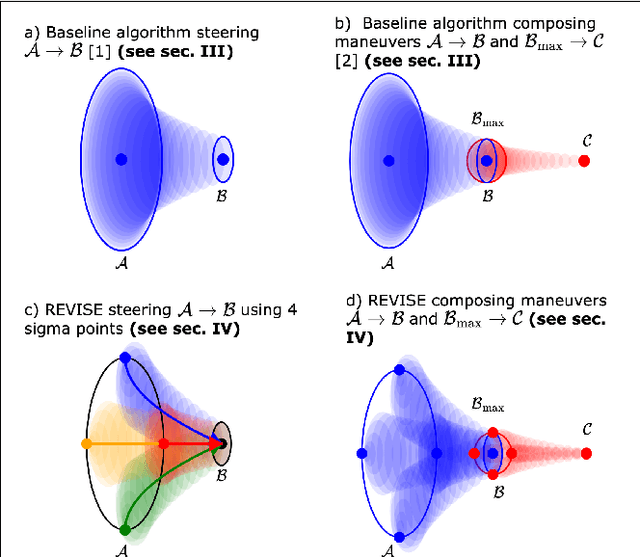
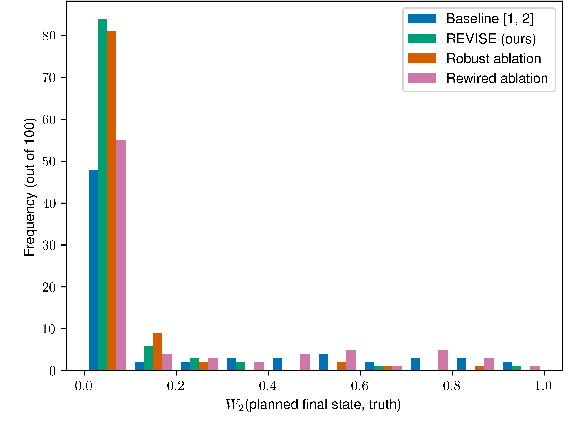
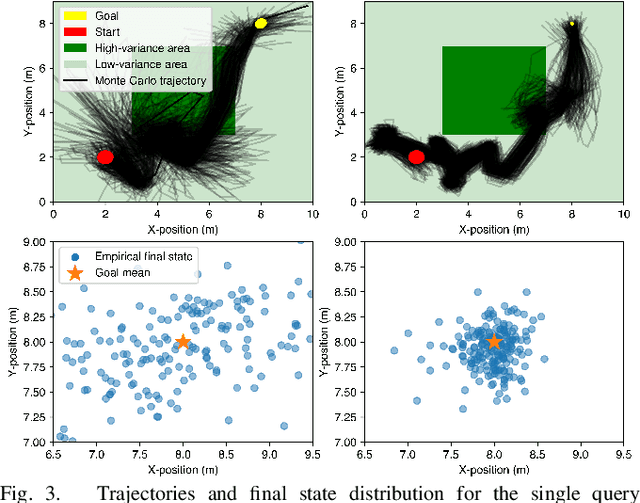

This paper presents Robust samplE-based coVarIance StEering (REVISE), a multi-query algorithm that generates robust belief roadmaps for dynamic systems navigating through spatially dependent disturbances modeled as a Gaussian random field. Our proposed method develops a novel robust sample-based covariance steering edge controller to safely steer a robot between state distributions, satisfying state constraints along the trajectory. Our proposed approach also incorporates an edge rewiring step into the belief roadmap construction process, which provably improves the coverage of the belief roadmap. When compared to state-of-the-art methods, REVISE improves median plan accuracy (as measured by Wasserstein distance between the actual and planned final state distribution) by 10x in multi-query planning and reduces median plan cost (as measured by the largest eigenvalue of the planned state covariance at the goal) by 2.5x in single-query planning for a 6DoF system. We will release our code at https://acl.mit.edu/REVISE/.