 Add to Chrome
 Add to Firefox
 Add to Edge
SinoDiff: Physics-Consistent Self-Supervised Diffusion for Unified Low-Dose to Standard-Dose PET Sinogram Recovery
Aug 11, 2026
Low-dose positron emission tomography (LD-PET) reduces radiation exposure but leads to poor image quality and hinders diagnostic confidence. Existing supervised LD to standard-dose (SD) PET recovery methods often fail to generalise across dose variations, while dose-agnostic supervised methods require paired LD-SD data. Current self-supervised methods, although more flexible, typically produce inferior results, including loss of anatomical details and oversmoothing pathological features. These pose major limitations for practical applications. To overcome these limitations, we propose SinoDiff, a novel self-supervised, physics-consistent diffusion framework for the recovery of PET sinograms across multiple predefined dose levels. Unlike the noise simulation in traditional diffusion methods, SinoDiff integrates the PET acquisition model into the forward diffusion process via Poisson thinning, enabling physically consistent sampling/modelling of dose-dependent count statistics. During the reverse diffusion process, SinoDiff estimates the incremental change in PET signals from predefined dose levels. Therefore, SinoDiff is a single, unified model that requires no retraining across multiple dose levels. To consider the characteristics of PET sinogram, we incorporate a frequency-domain convolution to capture long-range dependencies across projection angles and detector bins. Experiments on [18F]-FDG and [18F]-FDOPA datasets demonstrate that SinoDiff achieves competitive performance against supervised and self-supervised baselines across multiple dose levels.

Deep kernel representations of latent space features for low-dose PET-MR imaging robust to variable dose reduction
Sep 10, 2024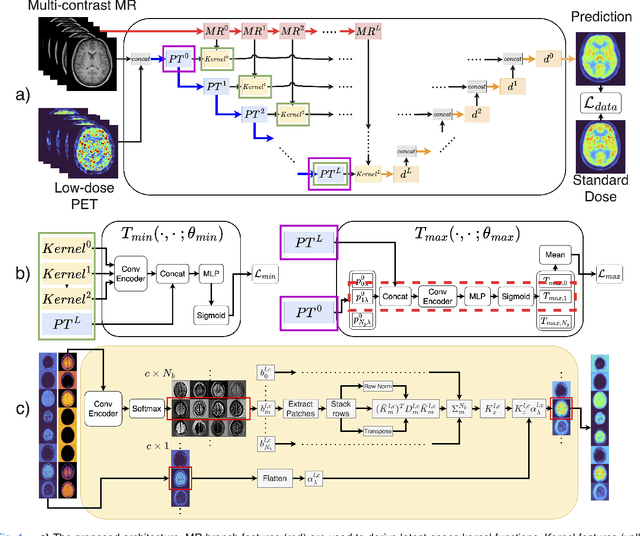
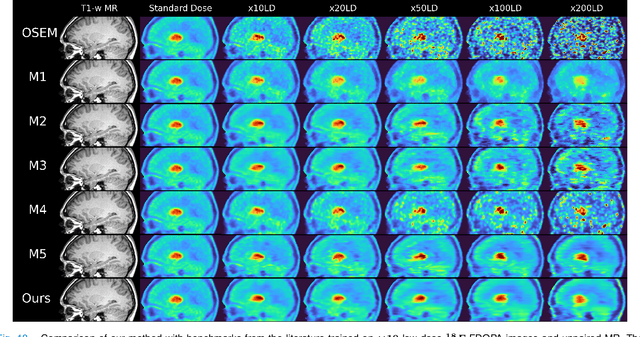
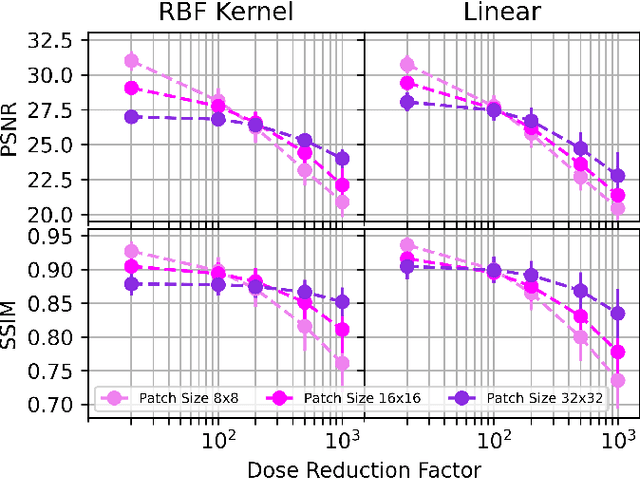
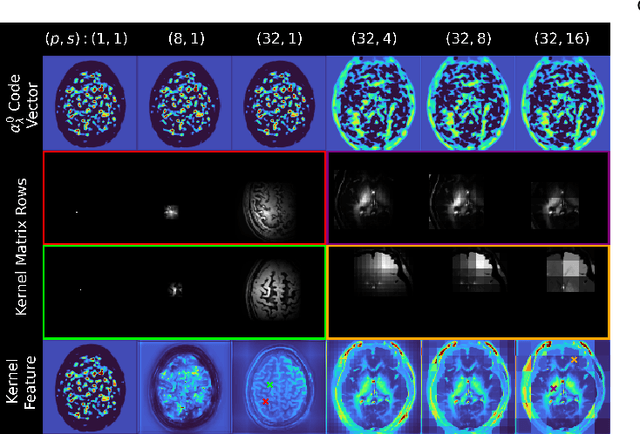
Low-dose positron emission tomography (PET) image reconstruction methods have potential to significantly improve PET as an imaging modality. Deep learning provides a promising means of incorporating prior information into the image reconstruction problem to produce quantitatively accurate images from compromised signal. Deep learning-based methods for low-dose PET are generally poorly conditioned and perform unreliably on images with features not present in the training distribution. We present a method which explicitly models deep latent space features using a robust kernel representation, providing robust performance on previously unseen dose reduction factors. Additional constraints on the information content of deep latent features allow for tuning in-distribution accuracy and generalisability. Tests with out-of-distribution dose reduction factors ranging from $\times 10$ to $\times 1000$ and with both paired and unpaired MR, demonstrate significantly improved performance relative to conventional deep-learning methods trained using the same data. Code:https://github.com/cameronPain
Identification of brain states, transitions, and communities using functional MRI
Jan 26, 2021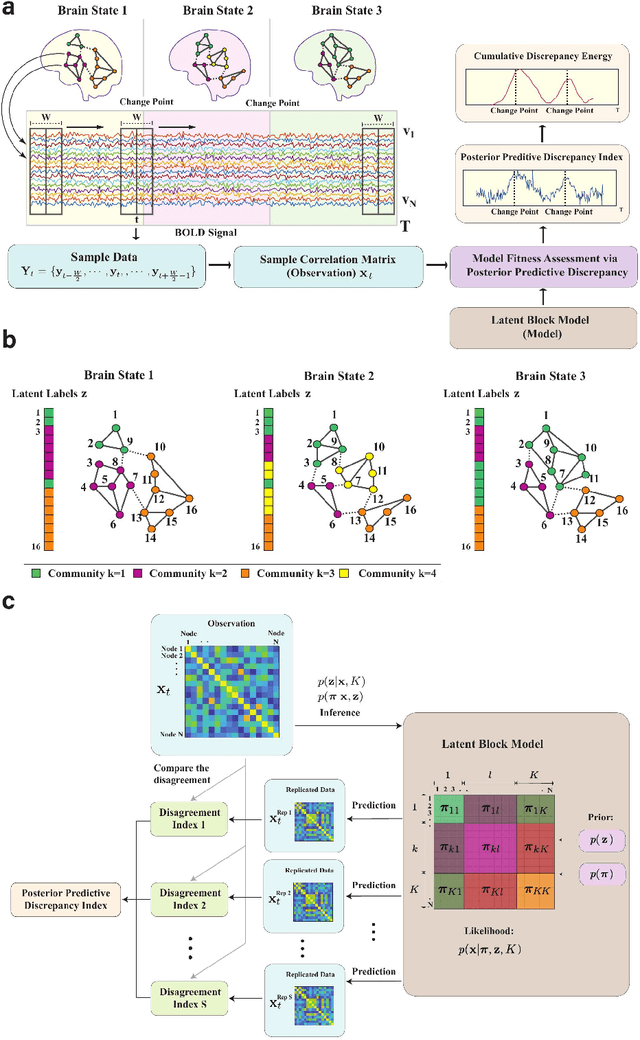
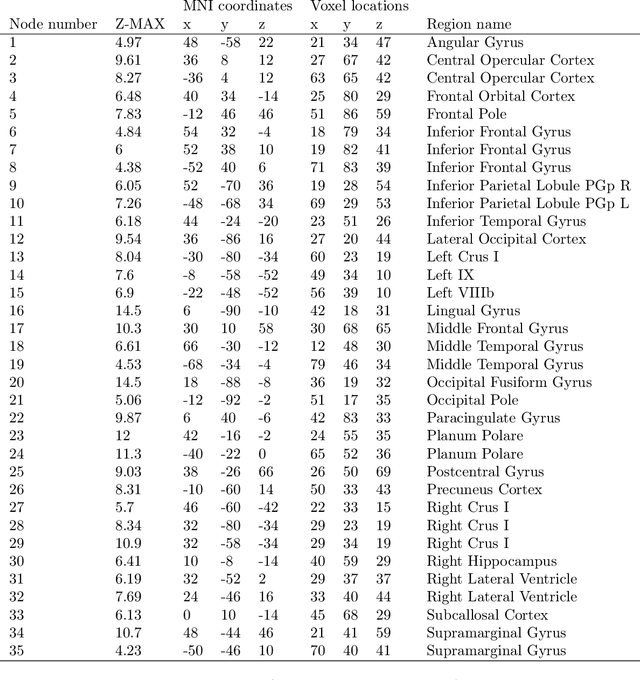
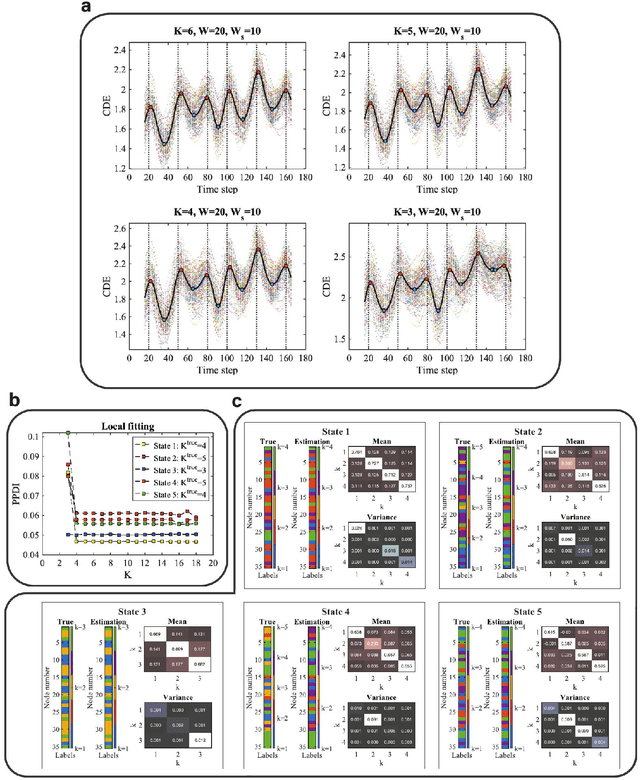
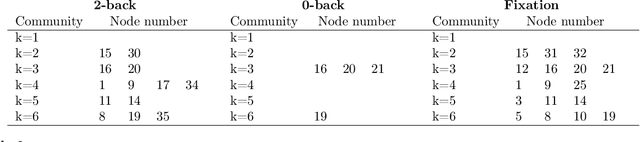
Brain function relies on a precisely coordinated and dynamic balance between the functional integration and segregation of distinct neural systems. Characterizing the way in which neural systems reconfigure their interactions to give rise to distinct but hidden brain states remains an open challenge. In this paper, we propose a Bayesian model-based characterization of latent brain states and showcase a novel method based on posterior predictive discrepancy using the latent block model to detect transitions between latent brain states in blood oxygen level-dependent (BOLD) time series. The set of estimated parameters in the model includes a latent label vector that assigns network nodes to communities, and also block model parameters that reflect the weighted connectivity within and between communities. Besides extensive in-silico model evaluation, we also provide empirical validation (and replication) using the Human Connectome Project (HCP) dataset of 100 healthy adults. Our results obtained through an analysis of task-fMRI data during working memory performance show appropriate lags between external task demands and change-points between brain states, with distinctive community patterns distinguishing fixation, low-demand and high-demand task conditions.