 Add to Chrome
 Add to Firefox
 Add to Edge
Learning-enabled Parameter Synthesis for Nonlinear Systems from Signal Temporal Logic
Jul 09, 2026
Signal Temporal Logic (STL) is increasingly used to describe interpretable objectives and constraints for optimal control and learning methods, especially when no target time series data is available. In this work, we propose to synthesize parameters for nonlinear systems that robustly satisfy continuous-time STL specifications for uncertain initial conditions. To this end, we use gradient-based optimization along with set-based reachability verification to efficiently learn in high-dimensional parameter spaces while providing provable satisfaction guarantees for the optimized parameters. We demonstrate the effectiveness and scalability of our method on three systems with up to 18 parameter dimensions.

Any-Body Guard: Universal Safeguarding for Manipulation Policies via Action Masking
Jun 21, 2026Ensuring safety of learning-enabled robotic manipulation across diverse embodiments and tasks still requires significant manual engineering. Existing approaches typically rely on heuristically designed fallback controllers or complex forward invariance assessments. These methods are often too conservative for task success, too computationally expensive for real-time execution, too heuristic to provide useful safety guarantees, or too engineering-heavy to transfer between setups. In this paper, we propose a universal safeguarding approach, X-Safe, which reasons directly in the robot's configuration space to provide formal probabilistic guarantees for collision avoidance. By operating in the configuration space, our method transfers across embodiments while relying solely on an object-based, quasi-static scene representation and a forward kinematics model of the robotic manipulator. Thus, X-Safe provides useful formal safety guarantees without requiring additional data, or engineering effort for different embodiments or scenes. We demonstrate X-Safe for diverse embodiments and policies, both in simulation and on hardware. We observe less degradation in task performance compared to state-of-the-art safeguarding, no collisions on hardware experiments, and empirically corroborate our formal guarantees.
Multi-Step Gaussian Process Propagation for Adaptive Path Planning
Apr 21, 2026Efficient and robust path planning hinges on combining all accessible information sources. In particular, the task of path planning for robotic environmental exploration and monitoring depends highly on the current belief of the world. To capture the uncertainty in the belief, we present a Gaussian process based path planning method that adapts to multi-modal environmental sensing data and incorporates state and input constraints. To solve the path planning problem, we optimize over future waypoints in a receding horizon fashion, and our cost is thus a function of the Gaussian process posterior over all these waypoints. We demonstrate this method, dubbed OLAhGP, on an autonomous surface vessel using oceanic algal bloom data from both a high-fidelity model and in-situ sensing data in a monitoring scenario. Our simulated and experimental results demonstrate significant improvement over existing methods. With the same number of samples, our method generates more informative paths and achieves greater accuracy in identifying algal blooms in chlorophyll a rich waters, measured with respect to total misclassification probability and binary misclassification rate over the domain of interest.
Learning Agile Paths from Optimal Control
Nov 30, 2022
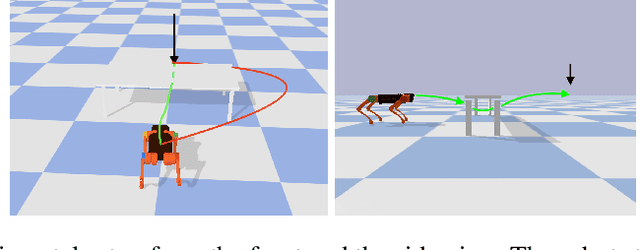

Efficient motion planning algorithms are of central importance for deploying robots in the real world. Unfortunately, these algorithms often drastically reduce the dimensionality of the problem for the sake of feasibility, thereby foregoing optimal solutions. This limitation is most readily observed in agile robots, where the solution space can have multiple additional dimensions. Optimal control approaches partially solve this problem by finding optimal solutions without sacrificing the complexity of the environment, but do not meet the efficiency demands of real-world applications. This work proposes an approach to resolve these issues simultaneously by training a machine learning model on the outputs of an optimal control approach.