 Add to Chrome
 Add to Firefox
 Add to Edge
Cluster, Route, Escalate: Cascaded Framework for Cost-Aware LLM Serving
Jun 25, 2026
Efficient deployment of large language models (LLMs) in production forces a trade-off between accuracy and cost. Operators often default to a single model that is either expensive for easy queries or insufficient for hard ones. To address this challenge, we propose a two-stage cascaded solution. Stage 1 clusters incoming queries and assigns each cluster to its most cost-effective model. The cost budget for this routing process is set by an interpretable hyperparameter, tuned offline. Stage 2 adds a quality estimation (QE) cascade; when an output from Stage 1 is judged low-quality, the query is escalated to a stronger model. This ensures only hard or low-confidence cases reach the expensive models. On the test datasets, the cascaded system retains 97-99% of the strongest model's accuracy while reducing Time Per Output Token (TPOT). It requires only task-correctness labels and adapts to changes in the model pool without manual reconfiguration.

UCB-driven Utility Function Search for Multi-objective Reinforcement Learning
May 01, 2024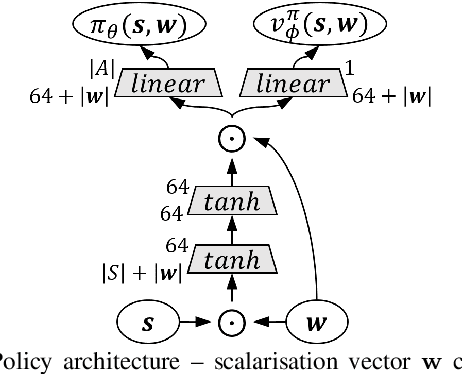
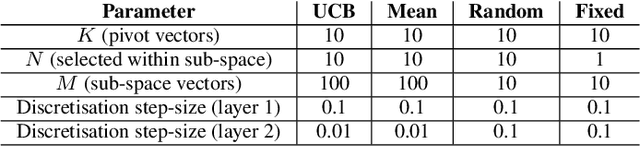

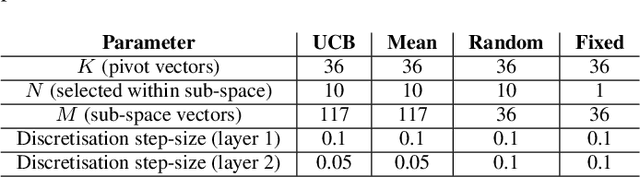
In Multi-objective Reinforcement Learning (MORL) agents are tasked with optimising decision-making behaviours that trade-off between multiple, possibly conflicting, objectives. MORL based on decomposition is a family of solution methods that employ a number of utility functions to decompose the multi-objective problem into individual single-objective problems solved simultaneously in order to approximate a Pareto front of policies. We focus on the case of linear utility functions parameterised by weight vectors w. We introduce a method based on Upper Confidence Bound to efficiently search for the most promising weight vectors during different stages of the learning process, with the aim of maximising the hypervolume of the resulting Pareto front. The proposed method is shown to outperform various MORL baselines on Mujoco benchmark problems across different random seeds. The code is online at: https://github.com/SYCAMORE-1/ucb-MOPPO.
Offline Contextual Bandits for Wireless Network Optimization
Nov 11, 2021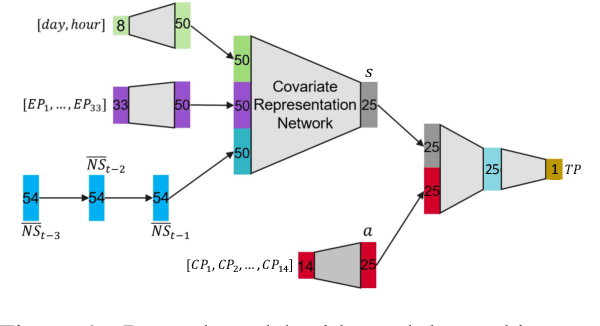


The explosion in mobile data traffic together with the ever-increasing expectations for higher quality of service call for the development of AI algorithms for wireless network optimization. In this paper, we investigate how to learn policies that can automatically adjust the configuration parameters of every cell in the network in response to the changes in the user demand. Our solution combines existent methods for offline learning and adapts them in a principled way to overcome crucial challenges arising in this context. Empirical results suggest that our proposed method will achieve important performance gains when deployed in the real network while satisfying practical constrains on computational efficiency.