 Add to Chrome
 Add to Firefox
 Add to Edge
RFDM: Residual Flow Diffusion Model for Efficient Causal Video Editing
Feb 06, 2026
Instructional video editing applies edits to an input video using only text prompts, enabling intuitive natural-language control. Despite rapid progress, most methods still require fixed-length inputs and substantial compute. Meanwhile, autoregressive video generation enables efficient variable-length synthesis, yet remains under-explored for video editing. We introduce a causal, efficient video editing model that edits variable-length videos frame by frame. For efficiency, we start from a 2D image-to-image (I2I) diffusion model and adapt it to video-to-video (V2V) editing by conditioning the edit at time step t on the model's prediction at t-1. To leverage videos' temporal redundancy, we propose a new I2I diffusion forward process formulation that encourages the model to predict the residual between the target output and the previous prediction. We call this Residual Flow Diffusion Model (RFDM), which focuses the denoising process on changes between consecutive frames. Moreover, we propose a new benchmark that better ranks state-of-the-art methods for editing tasks. Trained on paired video data for global/local style transfer and object removal, RFDM surpasses I2I-based methods and competes with fully spatiotemporal (3D) V2V models, while matching the compute of image models and scaling independently of input video length. More content can be found in: https://smsd75.github.io/RFDM_page/

EDiT: Efficient Diffusion Transformers with Linear Compressed Attention
Mar 20, 2025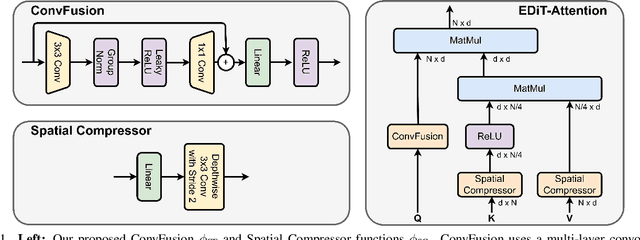
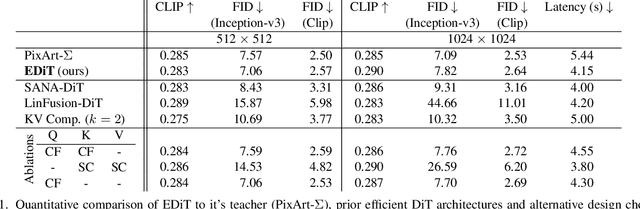
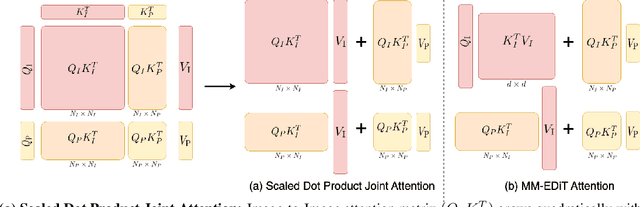
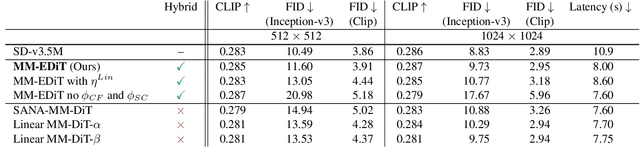
Diffusion Transformers (DiTs) have emerged as a leading architecture for text-to-image synthesis, producing high-quality and photorealistic images. However, the quadratic scaling properties of the attention in DiTs hinder image generation with higher resolution or on devices with limited resources. This work introduces an efficient diffusion transformer (EDiT) to alleviate these efficiency bottlenecks in conventional DiTs and Multimodal DiTs (MM-DiTs). First, we present a novel linear compressed attention method that uses a multi-layer convolutional network to modulate queries with local information while keys and values are spatially aggregated. Second, we formulate a hybrid attention scheme for multi-modal inputs that combines linear attention for image-to-image interactions and standard scaled dot-product attention for interactions involving prompts. Merging these two approaches leads to an expressive, linear-time Multimodal Efficient Diffusion Transformer (MM-EDiT). We demonstrate the effectiveness of the EDiT and MM-EDiT architectures by integrating them into PixArt-Sigma(conventional DiT) and Stable Diffusion 3.5-Medium (MM-DiT), achieving up to 2.2x speedup with comparable image quality after distillation.
Upcycling Text-to-Image Diffusion Models for Multi-Task Capabilities
Mar 14, 2025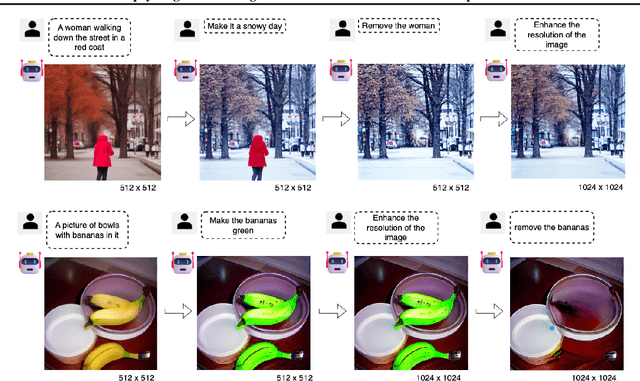
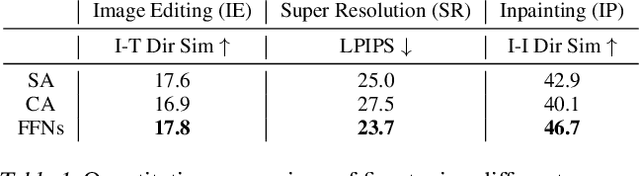
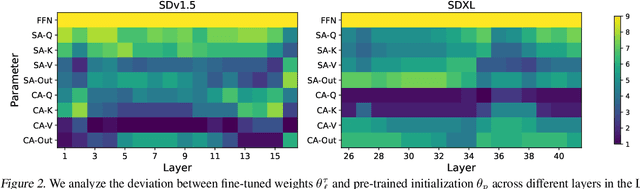
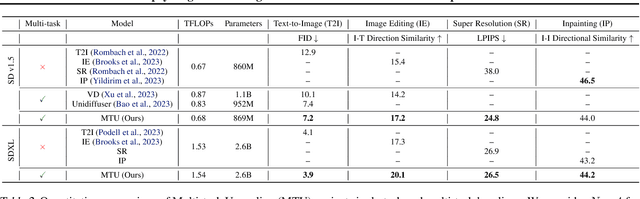
Text-to-image synthesis has witnessed remarkable advancements in recent years. Many attempts have been made to adopt text-to-image models to support multiple tasks. However, existing approaches typically require resource-intensive re-training or additional parameters to accommodate for the new tasks, which makes the model inefficient for on-device deployment. We propose Multi-Task Upcycling (MTU), a simple yet effective recipe that extends the capabilities of a pre-trained text-to-image diffusion model to support a variety of image-to-image generation tasks. MTU replaces Feed-Forward Network (FFN) layers in the diffusion model with smaller FFNs, referred to as experts, and combines them with a dynamic routing mechanism. To the best of our knowledge, MTU is the first multi-task diffusion modeling approach that seamlessly blends multi-tasking with on-device compatibility, by mitigating the issue of parameter inflation. We show that the performance of MTU is on par with the single-task fine-tuned diffusion models across several tasks including image editing, super-resolution, and inpainting, while maintaining similar latency and computational load (GFLOPs) as the single-task fine-tuned models.