 Add to Chrome
 Add to Firefox
 Add to Edge
ProtoPointNet: Prototype-Based Interpretable Classification of 3D Dental Point Clouds with Verifiable Spatial Activations
Jul 14, 2026
Prototype-based networks provide inherently interpretable classification by linking predictions to learned exemplars, but their use in 3D point clouds and clinical surface-pair reasoning remains limited. We introduce ProtoPointNet, a prototype-based model for dental occlusion classification from registered upper--lower intraoral arch pairs. Each point is encoded by a 14-dimensional descriptor combining local surface geometry, curvature, and explicit inter-arch displacement and clearance, exposing occlusal relationships to prototype matching. A shared multi-task point-cloud backbone learns axis-specific prototype heads for sagittal-left, sagittal-right, vertical, transverse, and midline classification. To support limited clinical data, we train prototypes from scratch using auxiliary supervision and encoder-freeze hand-off. On Bits2Bites, ProtoPointNet achieves mean test macro-F1 of 0.724 and AUROC of 0.825, with strongest performance on vertical (F1 0.828) and sagittal-left classification (F1 0.807). Projected prototype activations localise to anatomically plausible regions, including posterior molars and premolars for cross-bite evidence and anterior incisors for bite-depth evidence. These results support prototype-based reasoning as a transparent, spatially grounded alternative to black-box 3D classifiers for dental surface-pair analysis.

Tooth morphometry using quasi-conformal theory
Jan 07, 2019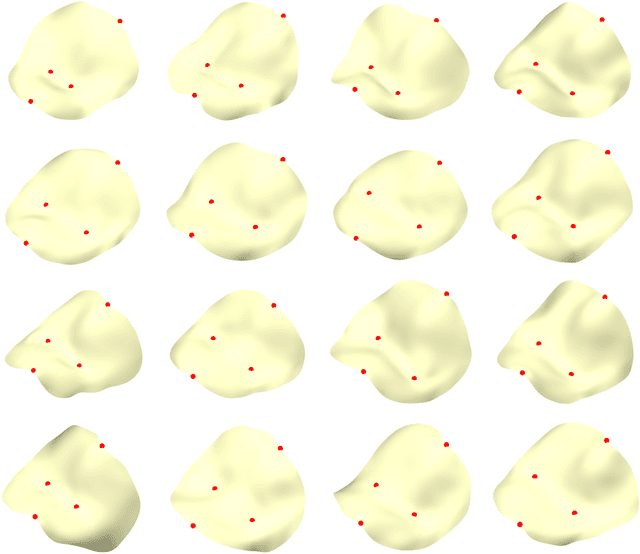
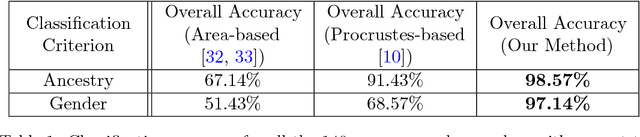
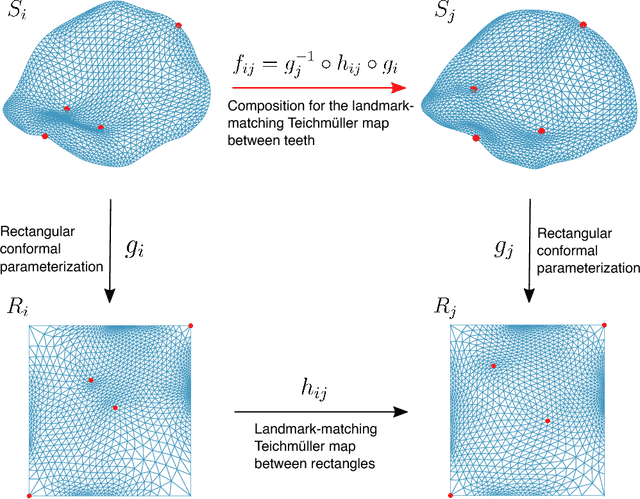
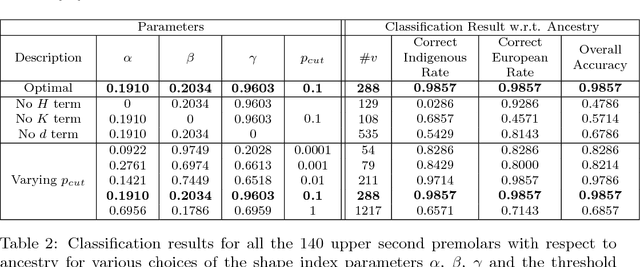
Shape analysis is important in anthropology, bioarchaeology and forensic science for interpreting useful information from human remains. In particular, teeth are morphologically stable and hence well-suited for shape analysis. In this work, we propose a framework for tooth morphometry using quasi-conformal theory. Landmark-matching Teichm\"uller maps are used for establishing a 1-1 correspondence between tooth surfaces with prescribed anatomical landmarks. Then, a quasi-conformal statistical shape analysis model based on the Teichm\"uller mapping results is proposed for building a tooth classification scheme. We deploy our framework on a dataset of human premolars to analyze the tooth shape variation among genders and ancestries. Experimental results show that our method achieves much higher classification accuracy with respect to both gender and ancestry when compared to the existing methods. Furthermore, our model reveals the underlying tooth shape difference between different genders and ancestries in terms of the local geometric distortion and curvatures.