 Add to Chrome
 Add to Firefox
 Add to Edge
ProtoPointNet: Prototype-Based Interpretable Classification of 3D Dental Point Clouds with Verifiable Spatial Activations
Jul 14, 2026
Prototype-based networks provide inherently interpretable classification by linking predictions to learned exemplars, but their use in 3D point clouds and clinical surface-pair reasoning remains limited. We introduce ProtoPointNet, a prototype-based model for dental occlusion classification from registered upper--lower intraoral arch pairs. Each point is encoded by a 14-dimensional descriptor combining local surface geometry, curvature, and explicit inter-arch displacement and clearance, exposing occlusal relationships to prototype matching. A shared multi-task point-cloud backbone learns axis-specific prototype heads for sagittal-left, sagittal-right, vertical, transverse, and midline classification. To support limited clinical data, we train prototypes from scratch using auxiliary supervision and encoder-freeze hand-off. On Bits2Bites, ProtoPointNet achieves mean test macro-F1 of 0.724 and AUROC of 0.825, with strongest performance on vertical (F1 0.828) and sagittal-left classification (F1 0.807). Projected prototype activations localise to anatomically plausible regions, including posterior molars and premolars for cross-bite evidence and anterior incisors for bite-depth evidence. These results support prototype-based reasoning as a transparent, spatially grounded alternative to black-box 3D classifiers for dental surface-pair analysis.

Robust Mitigation of Age-Dependent Confounding Effects via Sample-Difficulty Decorrelation
May 19, 2026Age dependent performance disparities in medical image classification often arise because age acts as a confounder, linking imaging morphology with disease prevalence. In practice, disparities can manifest as overdiagnosis at ages where disease prevalence is higher and underdiagnosis at ages where prevalence is lower, and can worsen under train test shifts in the age distribution. Conventional mitigation approaches that enforce strict age invariance may suppress diagnostically meaningful information encoded in age. We therefore propose a robust framework that mitigates the effects of age-dependent confounding by targeting spurious age linked trends rather than enforcing invariance. Following a warm-up phase, we characterize sample difficulty and model its age-dependent trends in a label-conditioned manner. We decorrelate age from dominant age difficulty trends using robust, Huber weighted affinity weights, attenuating confounding-driven shortcuts while preserving clinically meaningful, nonlinear age information. We further introduce an Age Coverage Score that scales the decorrelation penalty by minibatch age variance to ensure stable optimization under limited age diversity. Across two radiology datasets, our approach reduces age dependent true and false positive disparities with minimal AUC impact and remains robust to increasing train test age distribution shifts.
Worst-Group Equalized Odds Regularization for Multi-Attribute Fair Medical Image Classification
May 19, 2026Diagnostic performance in medical AI varies systematically across demographic groups, yet subgroup AUC can mask clinically important disparities. At a fixed inference-time operating point, some groups may exhibit over-diagnostic behaviour, characterized by elevated true and false positive rates, while others show under-diagnostic patterns with reduced true and false positive rates. These opposing tendencies can cancel in aggregate AUCs while producing meaningful inequities in clinical decision-making. Motivated by the need to assess and mitigate such disparities at the operating point and across multiple demographic attributes simultaneously, we propose a worst-group equalized-odds margin regularizer. The proposed regularizer explicitly targets subgroup-level deviations on both the true positive and false positive sides at inference. At each update, the method identifies subgroups defined by explicit demographic attributes (e.g., age, sex, and race) that exhibit the most extreme margin deviations and applies a unified penalty, enabling fairness optimization across multiple demographic axes without requiring explicit intersectional constraints. Across two medical imaging datasets in realistic multi-label settings, our method consistently reduces disparities in Equalized Odds and Equalized Opportunity with minimal impact on AUC, preserving diagnostic performance while improving fairness.
Detecting hip fractures with radiologist-level performance using deep neural networks
Nov 17, 2017
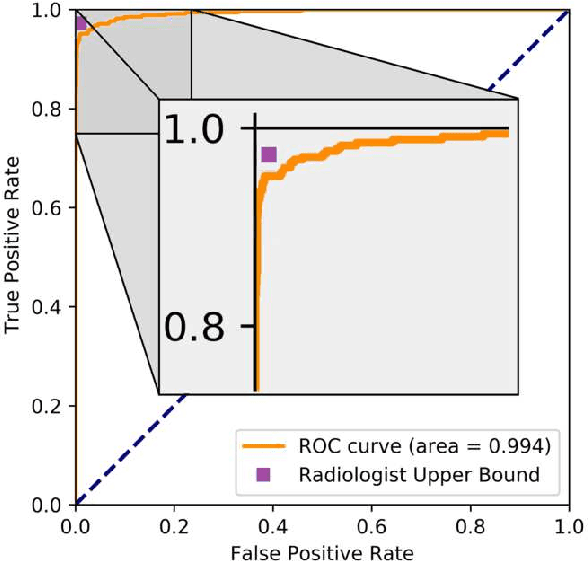
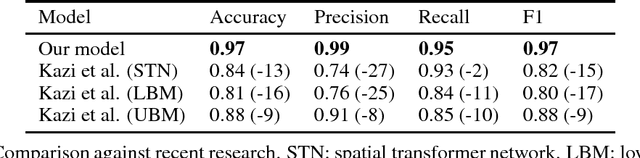

We developed an automated deep learning system to detect hip fractures from frontal pelvic x-rays, an important and common radiological task. Our system was trained on a decade of clinical x-rays (~53,000 studies) and can be applied to clinical data, automatically excluding inappropriate and technically unsatisfactory studies. We demonstrate diagnostic performance equivalent to a human radiologist and an area under the ROC curve of 0.994. Translated to clinical practice, such a system has the potential to increase the efficiency of diagnosis, reduce the need for expensive additional testing, expand access to expert level medical image interpretation, and improve overall patient outcomes.