 Add to Chrome
 Add to Firefox
 Add to Edge
SynPre-FL: Synthetic data-driven pretraining integrated Federated Learning training framework
Jul 21, 2026
Federated learning (FL) offers a promising approach to privacy-preserving clinical risk prediction, but its deployment remains limited by restricted data sharing, client heterogeneity, class imbalance, and the lack of realistic tabular electronic health record (EHR) benchmarks. Synthetic data generation may alleviate data scarcity, yet its integration with federated optimisation has received limited systematic study. We propose SynPre-FL, a unified framework combining high-fidelity synthetic EHR generation with synthetic-pretrained FL for robust prediction under non-IID conditions. A latent autoencoder-diffusion model generates privacy-preserving synthetic cohorts, which are used to warm-start federated training. This pretraining is followed by heterogeneity-aware optimisation using class-balanced local objectives, proximal regularisation, and adaptive server aggregation. Post-hoc calibration and federated-safe explainability support reliable and interpretable risk estimates. Experiments show that the synthetic generator preserves univariate, bivariate, and multivariate structure while protecting against membership-inference and reconstruction attacks. The generated data achieve strong downstream utility under TSTR, TRTS, and model-based evaluations. Across federated settings with 5, 10, and 15 heterogeneous clients, SynPre-FL consistently improves robustness and scalability over baseline methods, especially under severe non-IID fragmentation. Calibration improves probability reliability, while SHAP analysis produces stable and clinically coherent feature attributions across federation sizes. SynPre-FL therefore provides a practical and reproducible framework for combining synthetic data with FL to enable privacy-aware, interpretable, and robust clinical prediction from distributed tabular EHR data.

A comprehensive analysis of PINNs: Variants, Applications, and Challenges
May 28, 2025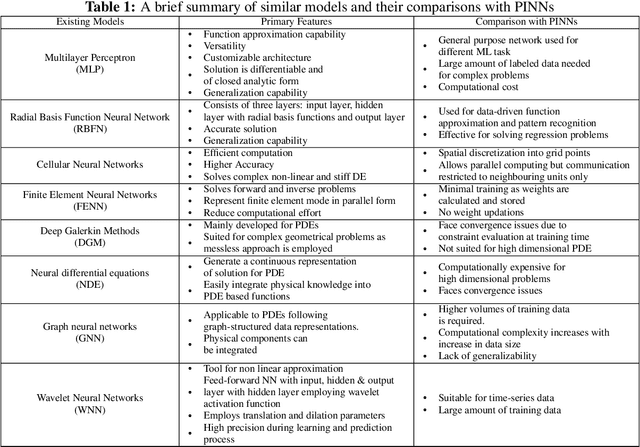
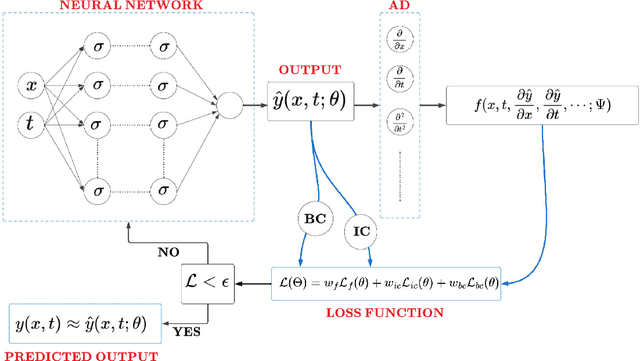
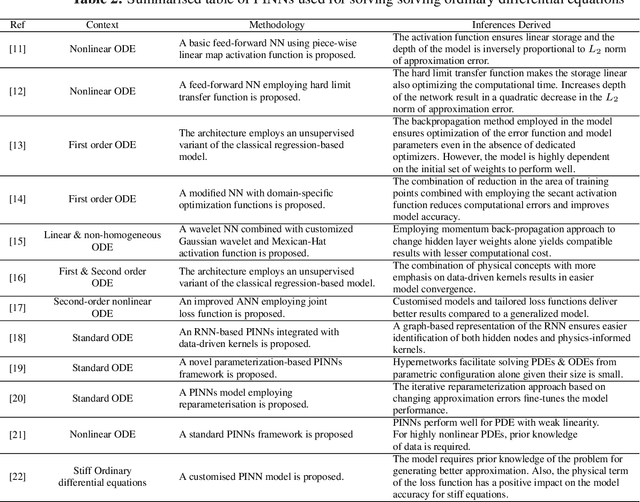
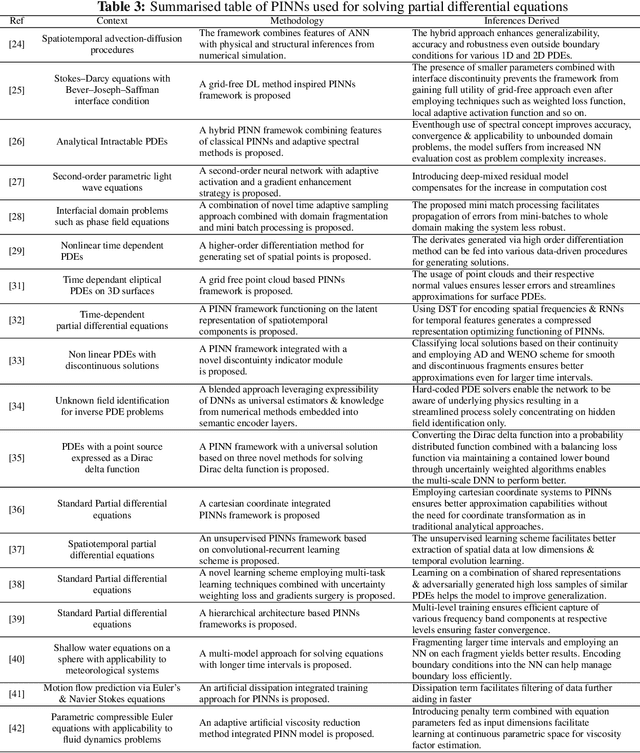
Physics Informed Neural Networks (PINNs) have been emerging as a powerful computational tool for solving differential equations. However, the applicability of these models is still in its initial stages and requires more standardization to gain wider popularity. Through this survey, we present a comprehensive overview of PINNs approaches exploring various aspects related to their architecture, variants, areas of application, real-world use cases, challenges, and so on. Even though existing surveys can be identified, they fail to provide a comprehensive view as they primarily focus on either different application scenarios or limit their study to a superficial level. This survey attempts to bridge the gap in the existing literature by presenting a detailed analysis of all these factors combined with recent advancements and state-of-the-art research in PINNs. Additionally, we discuss prevalent challenges in PINNs implementation and present some of the future research directions as well. The overall contributions of the survey can be summarised into three sections: A detailed overview of PINNs architecture and variants, a performance analysis of PINNs on different equations and application domains highlighting their features. Finally, we present a detailed discussion of current issues and future research directions.