 Add to Chrome
 Add to Firefox
 Add to Edge
Infeasible optimization problems and the hierarchical augmented Lagrangian method in imitation learning
May 30, 2026
Imitation learning (IL) is an effective approach to train complex robotics policies. Recent works have introduced hard constraints into imitation-learning optimization problems to ensure safety, stability, and robustness of the learned policy. However, we argue that these constraints are sometimes infeasible, which can lead to unstable or difficult training dynamics. We study a simple remedy for such situations based on recent theoretical results on the augmented Lagrangian method in infeasible settings. We show that our approach drives the learned policy toward the solution of a closest-feasible constrained IL problem with desirable properties. The method is illustrated on a toy driving example with a total-acceleration constraint and pedestrian-safety constraints, a setting in which infeasibility can naturally arise while still allowing a safe learned policy.

FATROP : A Fast Constrained Optimal Control Problem Solver for Robot Trajectory Optimization and Control
Mar 29, 2023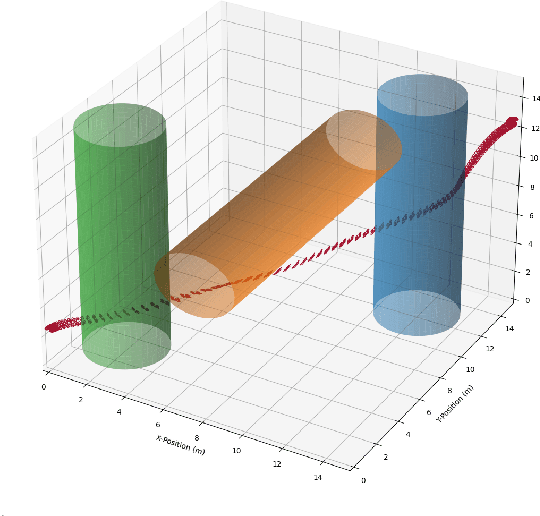

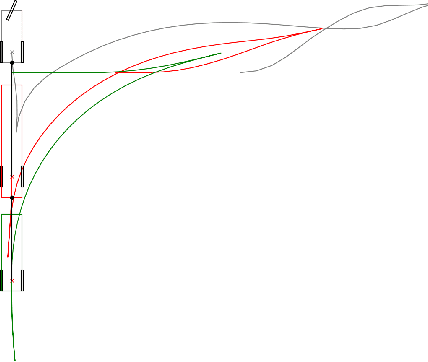
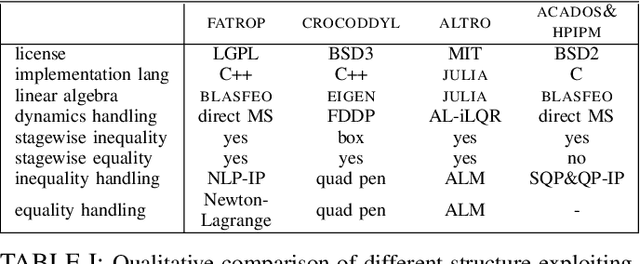
Trajectory optimization is a powerful tool for robot motion planning and control. State-of-the-art general-purpose nonlinear programming solvers are versatile, handle constraints in an effective way and provide a high numerical robustness, but they are slow because they do not fully exploit the optimal control problem structure at hand. Existing structure-exploiting solvers are fast but they often lack techniques to deal with nonlinearity or rely on penalty methods to enforce (equality or inequality) path constraints. This works presents FATROP: a trajectory optimization solver that is fast and benefits from the salient features of general-purpose nonlinear optimization solvers. The speed-up is mainly achieved through the use of a specialized linear solver, based on a Riccati recursion that is generalized to also support stagewise equality constraints. To demonstrate the algorithm's potential, it is benchmarked on a set of robot problems that are challenging from a numerical perspective, including problems with a minimum-time objective and no-collision constraints. The solver is shown to solve problems for trajectory generation of a quadrotor, a robot manipulator and a truck-trailer problem in a few tens of milliseconds. The algorithm's C++-code implementation accompanies this work as open source software, released under the GNU Lesser General Public License (LGPL). This software framework may encourage and enable the robotics community to use trajectory optimization in more challenging applications.