 Add to Chrome
 Add to Firefox
 Add to Edge
Riding Brainwaves in LLM Space: Understanding Activation Patterns Using Individual Neural Signatures
Mar 23, 2026
Consumer-grade EEG is entering everyday devices, from earbuds to headbands, raising the question of whether language models can be adapted to individual neural responses. We test this by asking whether frozen LLM representations encode person-specific EEG signals, directions in activation space that predict one person's brain activity but not another's. Using word-level EEG from 30 participants reading naturalistic sentences (ZuCo corpus), we train a separate linear probe for each person, mapping hidden states from a frozen Qwen 2.5 7B to that individual's EEG power. Person-specific probes outperform a single population probe on every EEG feature tested; for high-gamma power, the person-specific probe achieves rho = 0.183, a ninefold improvement over the population probe (rho = 0.020, p < 10^-4). A negative control, fixation count, shows no person-specific advantage (p = 0.360); fixation count reflects word length and frequency rather than individual cognition. The individual directions are temporally stable (split-half cosine = 0.824), non-transferable across people (self rho = 0.369 vs. other rho = 0.143, p < 10^-19), and distinct from the shared population signal: person-specific probes retain predictive power after the population component is removed. The person-specific signal concentrates in the model's deep layers, rising consistently with depth and peaking at Layer 24 of 28. The results are consistent across architectures (LLaMA 3.1 8B) and survive word-level confound controls. Frozen language models contain stable, person-specific neural directions in their deep layers, providing a geometric foundation for EEG-driven personalization.

Real Eyes Realize Faster: Gaze Stability and Pupil Novelty for Efficient Egocentric Learning
Mar 04, 2026Always-on egocentric cameras are increasingly used as demonstrations for embodied robotics, imitation learning, and assistive AR, but the resulting video streams are dominated by redundant and low-quality frames. Under the storage and battery constraints of wearable devices, choosing which frames to keep is as important as how to learn from them. We observe that modern eye-tracking headsets provide a continuous, training-free side channel that decomposes into two complementary axes: gaze fixation captures visual stability (quality), while pupil response captures arousal-linked moments (novelty). We operationalize this insight as a Dual-Criterion Frame Curator that first gates frames by gaze quality and then ranks the survivors by pupil-derived novelty. On the Visual Experience Dataset (VEDB), curated frames at 10% budget match the classification performance of the full stream, and naive signal fusion consistently destroys both contributions. The benefit is task-dependent: pupil ranking improves activity recognition, while gaze-only selection already dominates for scene recognition, confirming that the two signals serve genuinely different roles. Our method requires no model inference and operates at capture time, offering a path toward efficient, always-on egocentric data curation.
Personalized Counterfactual Framework: Generating Potential Outcomes from Wearable Data
Aug 20, 2025Wearable sensor data offer opportunities for personalized health monitoring, yet deriving actionable insights from their complex, longitudinal data streams is challenging. This paper introduces a framework to learn personalized counterfactual models from multivariate wearable data. This enables exploring what-if scenarios to understand potential individual-specific outcomes of lifestyle choices. Our approach first augments individual datasets with data from similar patients via multi-modal similarity analysis. We then use a temporal PC (Peter-Clark) algorithm adaptation to discover predictive relationships, modeling how variables at time t-1 influence physiological changes at time t. Gradient Boosting Machines are trained on these discovered relationships to quantify individual-specific effects. These models drive a counterfactual engine projecting physiological trajectories under hypothetical interventions (e.g., activity or sleep changes). We evaluate the framework via one-step-ahead predictive validation and by assessing the plausibility and impact of interventions. Evaluation showed reasonable predictive accuracy (e.g., mean heart rate MAE 4.71 bpm) and high counterfactual plausibility (median 0.9643). Crucially, these interventions highlighted significant inter-individual variability in response to hypothetical lifestyle changes, showing the framework's potential for personalized insights. This work provides a tool to explore personalized health dynamics and generate hypotheses on individual responses to lifestyle changes.
Graph-Augmented LLMs for Personalized Health Insights: A Case Study in Sleep Analysis
Jun 25, 2024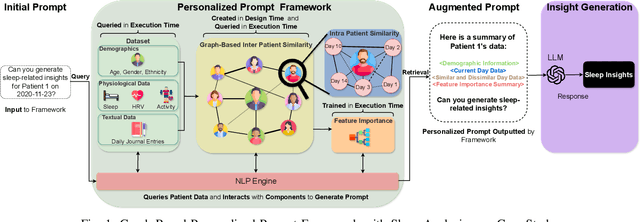

Health monitoring systems have revolutionized modern healthcare by enabling the continuous capture of physiological and behavioral data, essential for preventive measures and early health intervention. While integrating this data with Large Language Models (LLMs) has shown promise in delivering interactive health advice, traditional methods like Retrieval-Augmented Generation (RAG) and fine-tuning often fail to fully utilize the complex, multi-dimensional, and temporally relevant data from wearable devices. These conventional approaches typically provide limited actionable and personalized health insights due to their inadequate capacity to dynamically integrate and interpret diverse health data streams. In response, this paper introduces a graph-augmented LLM framework designed to significantly enhance the personalization and clarity of health insights. Utilizing a hierarchical graph structure, the framework captures inter and intra-patient relationships, enriching LLM prompts with dynamic feature importance scores derived from a Random Forest Model. The effectiveness of this approach is demonstrated through a sleep analysis case study involving 20 college students during the COVID-19 lockdown, highlighting the potential of our model to generate actionable and personalized health insights efficiently. We leverage another LLM to evaluate the insights for relevance, comprehensiveness, actionability, and personalization, addressing the critical need for models that process and interpret complex health data effectively. Our findings show that augmenting prompts with our framework yields significant improvements in all 4 criteria. Through our framework, we can elicit well-crafted, more thoughtful responses tailored to a specific patient.