 Add to Chrome
 Add to Firefox
 Add to Edge
Agreement Before Diversity: Verification-First Complementarity for Heterogeneous Language-Model Coordination
Aug 05, 2026
Heterogeneous language-model ensembles expand the space of candidate responses, yet they lack a principled criterion for when a newly generated answer should supersede an already supported one. We decouple candidate headroom from replacement authority, rendering the latter as an explicit, auditable object. Our proposed method, Agreement-Before-Diversity (ABD), is a frozen, label-free decision rule: an anchor answer is retained if two additional trusted samples corroborate it under a fixed equivalence relation; otherwise, it is replaced by a heterogeneous synthesis. For this gating mechanism, we prove two exact identities. The first shows that the accuracy gap relative to unconditional synthesis is determined jointly by the agreement coverage and the anchor's advantage on the protected subset. The second shows that the gap relative to never synthesizing reflects a contrast between authorized recovery and authorized destruction. Neither identity assumes independence or calibrated confidence, and the expected inference cost is approximately eight minus five times the coverage in number of calls. Under blind, exact-ID evaluation, ABD achieves 59.43% on the complete LiveCodeBench-v6 (vs. 52.57% for Single9 and 52.00% for HAC; n = 175) and 75.00% on an untouched GPQA-Diamond split (both controls at 72.78%; n = 180). Furthermore, these identities localize every aggregate difference to an enumerable protected stratum: no discordant items occur among the 3 protected cases on LiveCodeBench, where coverage bounds the gate's contribution to 1.71 points a priori; 13 versus 8 discordant cases among 132 on GPQA-Diamond; and 12 versus 0 among 71 under a frozen anchor perturbation. Diversity supplies potential; verification structure supplies authority.

The Order Is the Guarantee: Verifier-Budgeted Code Deletion with Static-First Learned Proposals
Aug 05, 2026Frontier coding models now match or exceed strong human reference points on programming benchmarks, yet benchmark success does not imply maintainable software. Prompt-driven "vibe coding" is additive: new branches, guards, and fallbacks accumulate faster than obsolete logic is removed. We study the inverse problem-how an Al system should remove code when execution-verification capacity is finite. We formulate redundant-code reduction as proposal scheduling: a ranker orders single-statement deletion candidates, an execution suite accepts the first candidate that passes, and a budget bounds how many candidates may be tested. Our central observation is that candidate order, not model confidence, is the control surface a deployment can reason about. DELSCOUT instantiates two schedules. Given representative target-domain validation, a five-slot budget spends three slots on deterministic shortest-first candidates and two on complementary learned candidates; across nine MBPP replications with 0.5B, 0.6B, and 8B rankers this raises verified-deletion coverage by 9.5% relative (+6.7 accepted tasks) while consuming slightly fewer verifier calls than the matched static baseline. Without such validation the same rankers can lose coverage under shift, so we instead evaluate the complete static prefix first and append learned candidates only afterwards; for a deterministic verifier this makes coverage and character reduction non-decreasing by construction, at a measured 4.8-62.5% increase in verifier calls. MBPP+ then erases the in-domain advantage, showing that scheduling governs search while the test suite alone governs what "preserving behavior" means. The result is an auditable division of labor: models widen the search for removable code, order bounds the damage a mis-ranked proposal can do, and execution retains authority over every committed deletion.
AlphaZero-Edu: Making AlphaZero Accessible to Everyone
Apr 20, 2025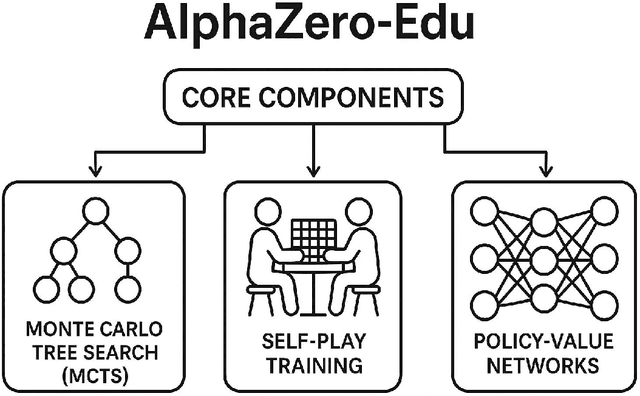
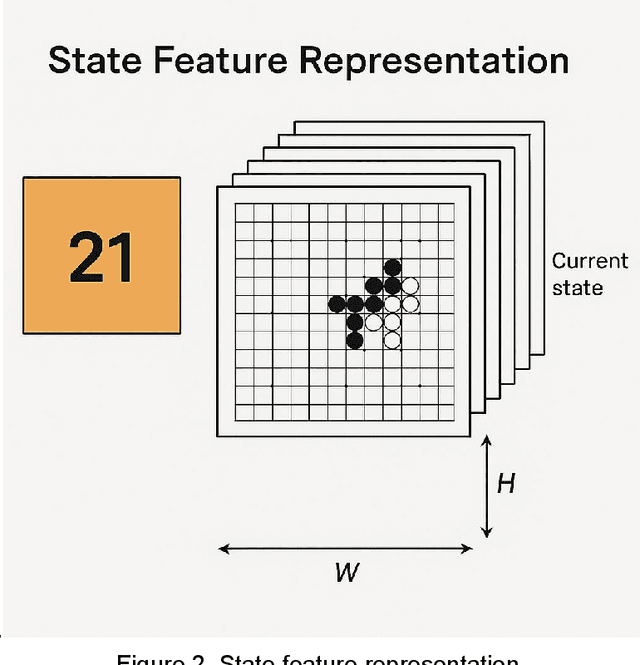
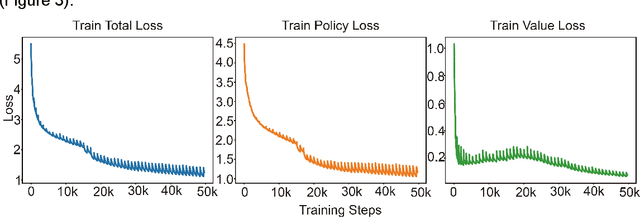
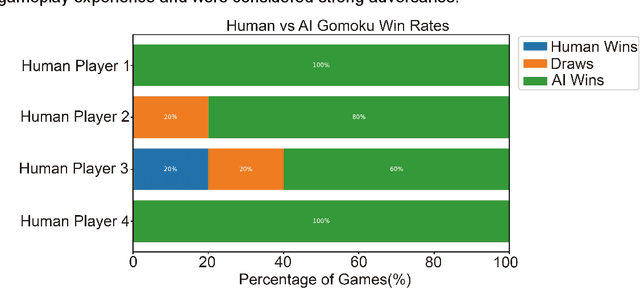
Recent years have witnessed significant progress in reinforcement learning, especially with Zero-like paradigms, which have greatly boosted the generalization and reasoning abilities of large-scale language models. Nevertheless, existing frameworks are often plagued by high implementation complexity and poor reproducibility. To tackle these challenges, we present AlphaZero-Edu, a lightweight, education-focused implementation built upon the mathematical framework of AlphaZero. It boasts a modular architecture that disentangles key components, enabling transparent visualization of the algorithmic processes. Additionally, it is optimized for resource-efficient training on a single NVIDIA RTX 3090 GPU and features highly parallelized self-play data generation, achieving a 3.2-fold speedup with 8 processes. In Gomoku matches, the framework has demonstrated exceptional performance, achieving a consistently high win rate against human opponents. AlphaZero-Edu has been open-sourced at https://github.com/StarLight1212/AlphaZero_Edu, providing an accessible and practical benchmark for both academic research and industrial applications.