 Add to Chrome
 Add to Firefox
 Add to Edge
Constraint Tax in Open-Weight LLMs: An Empirical Study of Tool Calling Suppression Under Structured Output Constraints
Jun 24, 2026
Tool Calling and Structured Output are two core capabilities of modern Agent systems, yet their interaction under joint deployment conditions remains insufficiently understood. This paper reports a reproducible phenomenon observed in a production Agent system: when Tool Calling and JSON Schema constraints are simultaneously enabled, multiple open-weight models cease invoking tools despite maintaining high schema compliance. We refer to this behavior as Tool Suppression. Through controlled experiments across multiple model families and deployment settings, we consistently reproduce Tool Suppression under joint constraints, while tool execution and schema compliance remain functional when evaluated independently. Further analysis reveals that JSON Schema constraints are compiled into grammar-based token masks, causing tool-call tokens to become unreachable during decoding. This provides an implementation-level explanation for the observed behavior. To interpret the phenomenon, we formulate the Constraint Priority Inversion (CPI) hypothesis, which suggests that schema satisfaction may dominate action-selection behavior under multiple simultaneous constraints. We present CPI as a behavioral hypothesis consistent with the observed evidence rather than a verified internal mechanism. To mitigate the problem, we propose Transparent Two-Pass Execution, an inference-time strategy that decouples tool execution from schema-constrained response generation. Experimental results show that this approach restores tool invocation while preserving structured output guarantees without requiring model retraining. These findings suggest that evaluating tool use and structured output separately may overlook important reliability issues in production Agent systems. Code, data, and docs will be released at https://github.com/Fzsama/Constrain-Tax-26-06.git.

EvoAgent: An Evolvable Agent Framework with Skill Learning and Multi-Agent Delegation
Apr 22, 2026This paper proposes EvoAgent - an evolvable large language model (LLM) agent framework that integrates structured skill learning with a hierarchical sub-agent delegation mechanism. EvoAgent models skills as multi-file structured capability units equipped with triggering mechanisms and evolutionary metadata, and enables continuous skill generation and optimization through a user-feedback-driven closed-loop process. In addition, by incorporating a three-stage skill matching strategy and a three-layer memory architecture, the framework supports dynamic task decomposition for complex problems and long-term capability accumulation. Experimental results based on real-world foreign trade scenarios demonstrate that, after integrating EvoAgent, GPT5.2 achieves significant improvements in professionalism, accuracy, and practical utility. Under a five-dimensional LLM-as-Judge evaluation protocol, the overall average score increases by approximately 28%. Further model transfer experiments indicate that the performance of an agent system depends not only on the intrinsic capabilities of the underlying model, but also on the degree of synergy between the model and the agent architecture.
Boosting Cooperative Coevolution for Large Scale Optimization with a Fine-Grained Computation Resource Allocation Strategy
Jul 24, 2018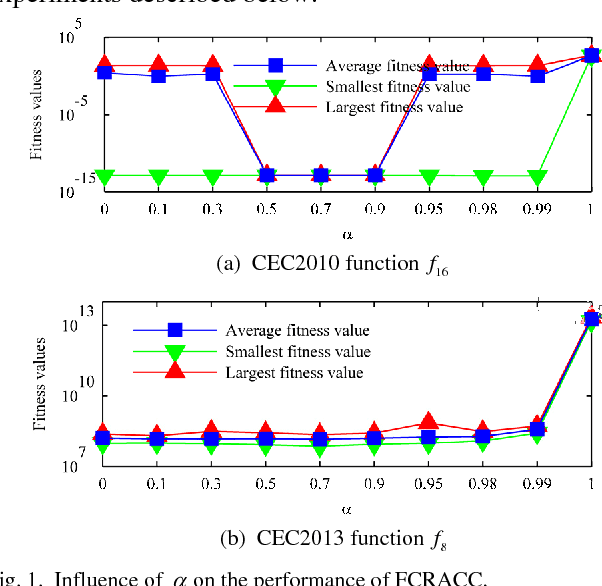
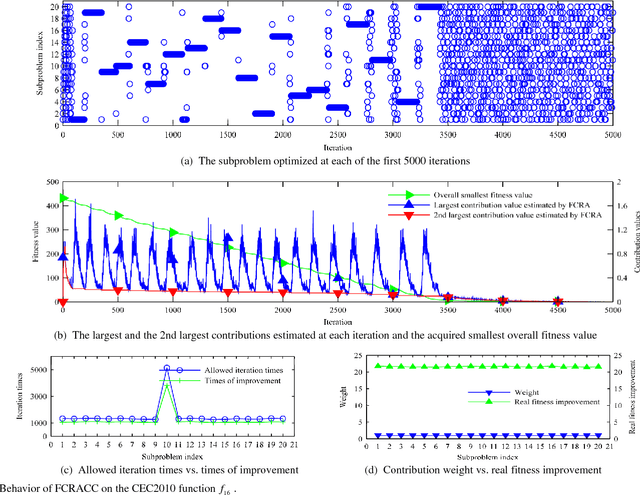
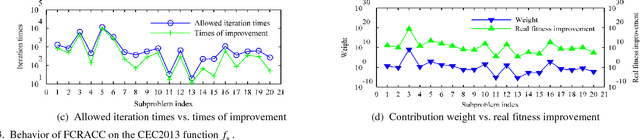
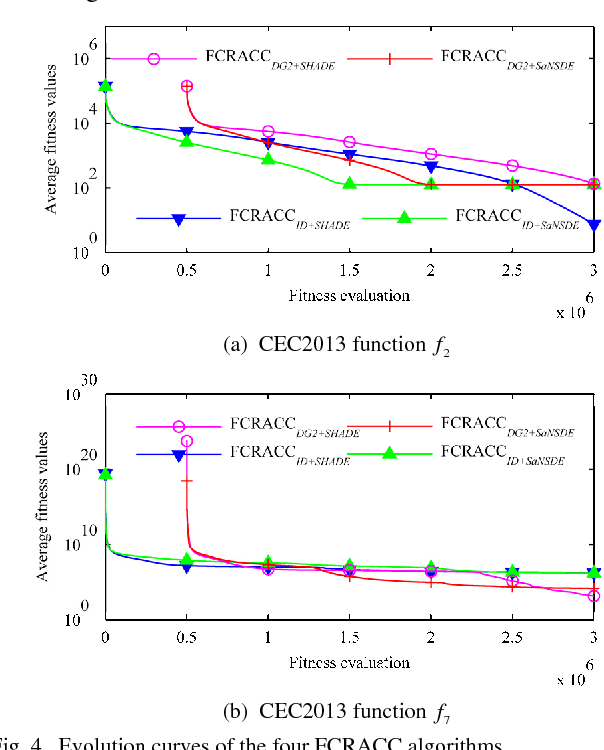
Cooperative coevolution (CC) has shown great potential in solving large scale optimization problems (LSOPs). However, traditional CC algorithms often waste part of computation resource (CR) as they equally allocate CR among all the subproblems. The recently developed contribution-based CC (CBCC) algorithms improve the traditional ones to a certain extent by adaptively allocating CR according to some heuristic rules. Different from existing works, this study explicitly constructs a mathematical model for the CR allocation (CRA) problem in CC and proposes a novel fine-grained CRA (FCRA) strategy by fully considering both the theoretically optimal solution of the CRA model and the evolution characteristics of CC. FCRA takes a single iteration as a basic CRA unit and always selects the subproblem which is most likely to make the largest contribution to the total fitness improvement to undergo a new iteration, where the contribution of a subproblem at a new iteration is estimated according to its current contribution, current evolution status as well as the estimation for its current contribution. We verified the efficiency of FCRA by combining it with SHADE which is an excellent differential evolution variant but has never been employed in the CC framework. Experimental results on two benchmark suites for LSOPs demonstrate that FCRA significantly outperforms existing CRA strategies and the resultant CC algorithm is highly competitive in solving LSOPs.