 Add to Chrome
 Add to Firefox
 Add to Edge
TriCLE: Tri-Modal Vision-Language Reasoning for Edge-Deployed Fine-Grained Clustering
Aug 04, 2026
Edge platforms used for aerial observation must interpret aircraft imagery under limited memory, limited compute, and intermittent connectivity. This setting is difficult for standard RGB-only recognition models and general-purpose vision-language models, especially when calibrated thermal and LiDAR aircraft data are unavailable. We present TriCLE, an application-oriented tri-modal vision-language system for aircraft taxonomic grouping under edge constraints. From a single RGB aircraft image, TriCLE generates a structure-preserving FLIR-style thermal view and a pseudo-LiDAR depth projection, then fuses the aligned views with task instructions in a compact Qwen3-VL backbone. The model is aligned to an expert aircraft taxonomy based on propulsion, airframe family, size, design era, and configuration, so its outputs reflect engineering-relevant similarity rather than only surface appearance. We evaluate supervised fine-tuning, rotation-preserving SFT, and three policy-alignment strategies: GRPO, GSPO, and DAPO. Sequence-level GSPO gives the strongest validation performance, reaching 88.33\% validation accuracy and 0.91 weighted F1 on valid aircraft outputs. On a held-out aircraft test partition, GSPO achieves 78.00\% accuracy and 0.793 weighted F1 while preserving 94.00\% parseable output formatting. After 4-bit quantization and attention-memory optimization, the aligned 4B model fits an 8GB deployment target and processes each tri-modal triplet in 1.48 seconds. These results support TriCLE as a practical prototype for interpretable, edge-feasible aircraft grouping, while emphasizing the need for further validation on real aligned thermal and LiDAR sensor streams.

Accurate Water Level Monitoring in AWD Rice Cultivation Using Convolutional Neural Networks
Dec 12, 2024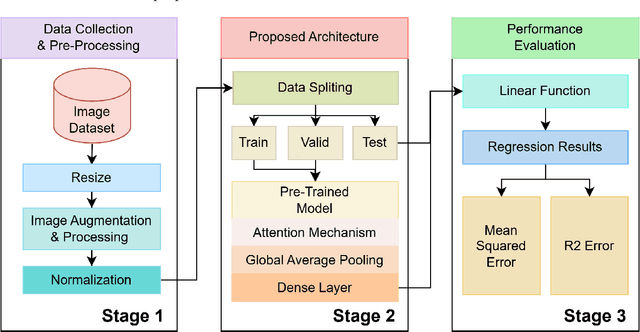
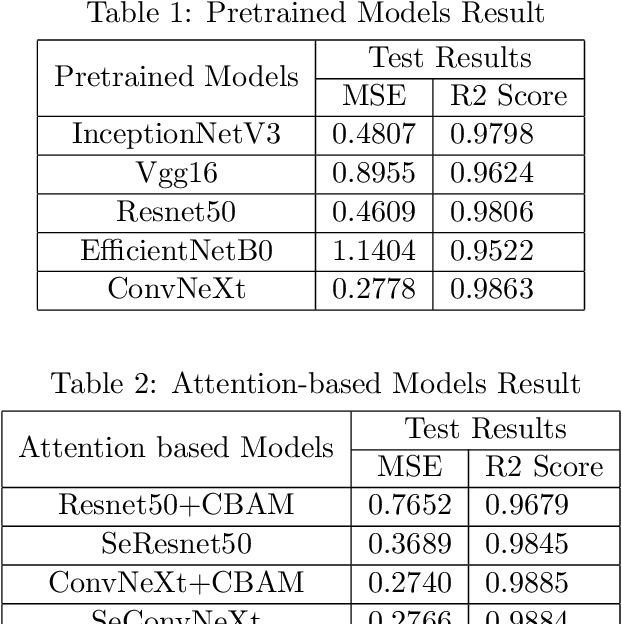
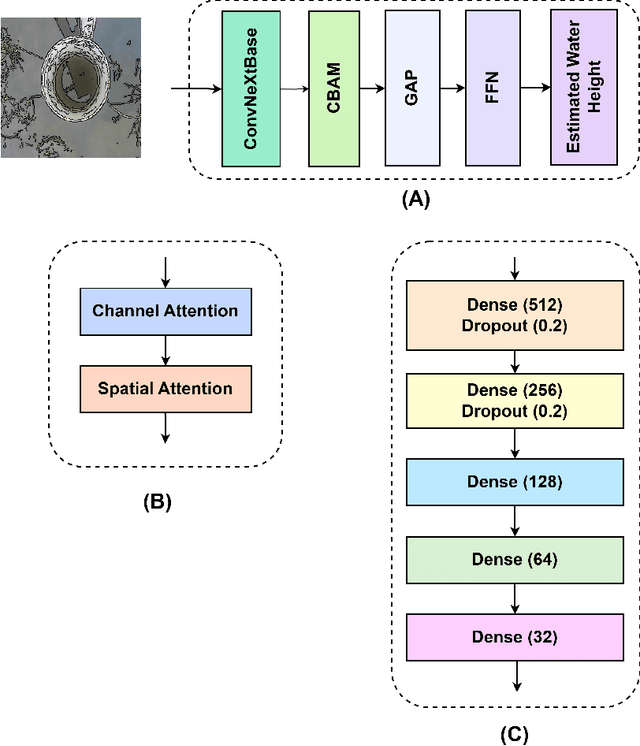

The Alternate Wetting and Drying (AWD) method is a rice-growing water management technique promoted as a sustainable alternative to Continuous Flooding (CF). Climate change has placed the agricultural sector in a challenging position, particularly as global water resources become increasingly scarce, affecting rice production on irrigated lowlands. Rice, a staple food for over half of the world's population, demands significantly more water than other major crops. In Bangladesh, Boro rice, in particular, requires considerable water inputs during its cultivation. Traditionally, farmers manually measure water levels, a process that is both time-consuming and prone to errors. While ultrasonic sensors offer improvements in water height measurement, they still face limitations, such as susceptibility to weather conditions and environmental factors. To address these issues, we propose a novel approach that automates water height measurement using computer vision, specifically through a convolutional neural network (CNN). Our attention-based architecture achieved an $R^2$ score of 0.9885 and a Mean Squared Error (MSE) of 0.2766, providing a more accurate and efficient solution for managing AWD systems.
A Dynamic Weighted Tabular Method for Convolutional Neural Networks
May 20, 2022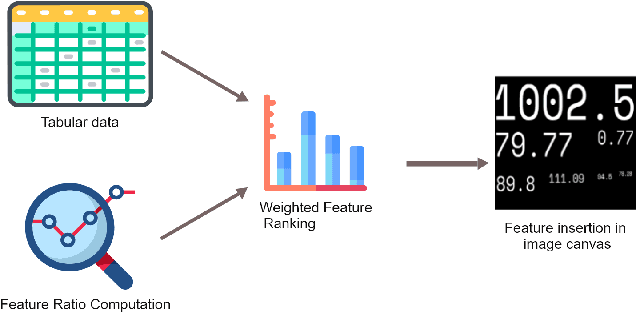
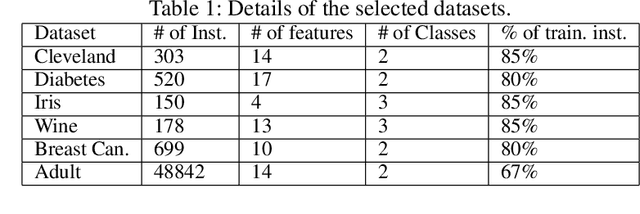
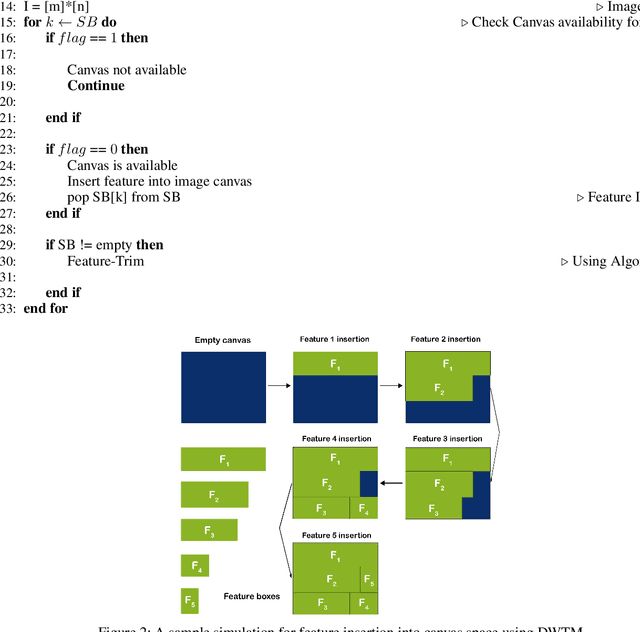
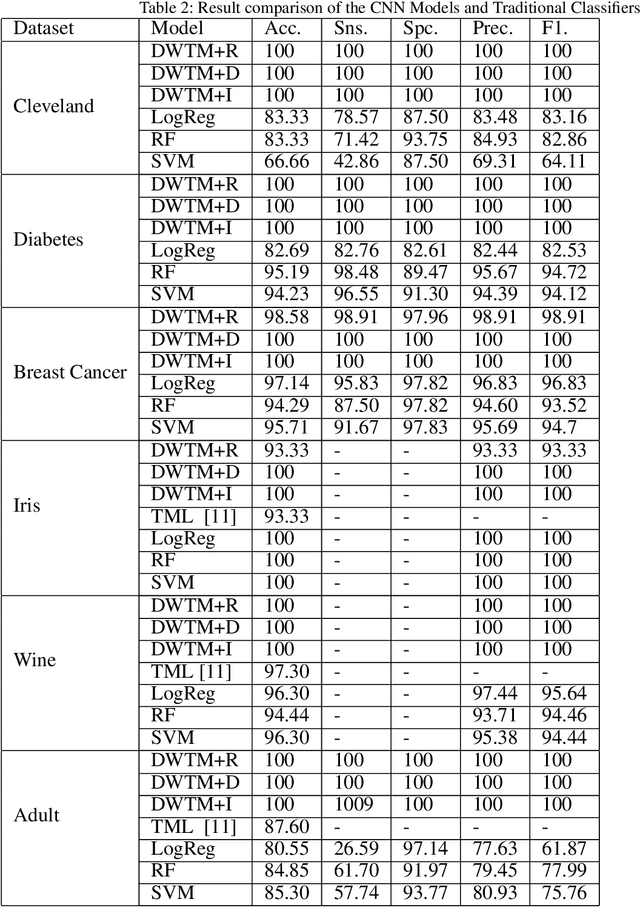
Traditional Machine Learning (ML) models like Support Vector Machine, Random Forest, and Logistic Regression are generally preferred for classification tasks on tabular datasets. Tabular data consists of rows and columns corresponding to instances and features, respectively. Past studies indicate that traditional classifiers often produce unsatisfactory results in complex tabular datasets. Hence, researchers attempt to use the powerful Convolutional Neural Networks (CNN) for tabular datasets. Recent studies propose several techniques like SuperTML, Conditional GAN (CTGAN), and Tabular Convolution (TAC) for applying Convolutional Neural Networks (CNN) on tabular data. These models outperform the traditional classifiers and substantially improve the performance on tabular data. This study introduces a novel technique, namely, Dynamic Weighted Tabular Method (DWTM), that uses feature weights dynamically based on statistical techniques to apply CNNs on tabular datasets. The method assigns weights dynamically to each feature based on their strength of associativity to the class labels. Each data point is converted into images and fed to a CNN model. The features are allocated image canvas space based on their weights. The DWTM is an improvement on the previously mentioned methods as it dynamically implements the entire experimental setting rather than using the static configuration provided in the previous methods. Furthermore, it uses the novel idea of using feature weights to create image canvas space. In this paper, the DWTM is applied to six benchmarked tabular datasets and it achieves outstanding performance (i.e., average accuracy = 95%) on all of them.