 Add to Chrome
 Add to Firefox
 Add to Edge
An HFM-Inspired Random Access Preamble Design for NTN under High Doppler
Aug 14, 2026
Non-terrestrial networks (NTNs) are a key enabler of ubiquitous 6G connectivity, but the high orbital velocity and long propagation distances in low-Earth orbit (LEO) NTN operation introduce large Doppler shifts and substantial delay uncertainty that challenge New Radio (NR) physical random access channel (PRACH) design. Conventional Zadoff Chu (ZC) and linear frequency modulated (LFM) preambles are particularly vulnerable, as Doppler induced ambiguity and delay Doppler coupling degrade timing estimation and preamble identification. This paper proposes a hyperbolic frequency modulation (HFM) inspired PRACH preamble for robust synchronization and reliable identification under uncompensated or unknown Doppler, detected with a conventional matched filter receiver so that the gains reflect the preamble design. A unified delay Doppler ambiguity function framework characterizes the self and cross ambiguity behavior of ZC, LFM, and HFM inspired preambles, and a scaling-factor based codebook ensures multi-user separability. Simulation results under NTN channel conditions confirm higher detection probability, lower timing root mean square error (RMSE), and improved peak to sidelobe and integrated sidelobe levels compared with ZC and frequency-domain superposed LFM baselines.

Temporal Broadening-Aware Multiplexing for Joint Sensing and Communication in THz Band
Jul 22, 2026High-resolution wireless sensing has become an integral component of futuristic 6G networks alongside high-rate communication. Terahertz (THz) band enables both functions through its extremely large bandwidth, providing sub-centimeter level sensing precision and multi-gigabit data rates. However, THz propagation suffers from severe channel impairments such as molecular absorption (MoA) and the resulting temporal broadening effect (TBE). For sensing, TBE causes temporal spreading of received echoes, leading to degraded range resolution and necessitating long guard intervals between consecutive sensing pulses to avoid overlap. These guards, while necessary for far sensing receiver (Rxsens), cause latency and inefficient temporal use. To overcome this limitation, this paper proposes a TBE-aware multiplexing framework that exploits the distance-dependent nature of TBE to enable interference-free coexistence of sensing and communication (S&C) pulses. A guard interval preallocated for the worst-case TBE at far Rxsens is opportunistically reused to embed a low-power single-carrier communication pulse for a nearby user experiencing minimal broadening. Limited TBE confines S&C pulses within their designated slots at short distances, while the broadened and attenuated communication pulse at the distant Rxsens becomes negligible, eliminating the need for successive interference cancellation (SIC). Simulation results reveal that compared with power-domain non-orthogonal multiple access (PD-NOMA) and fixed-guard alternative, the proposed scheme achieves superior bit-error rate, sensing accuracy, and latency performance, with up to 66.5% latency reduction under heavy traffic.
A Multi-Objective Learning Approach for Adaptive Waveform Selection in Integrated Sensing and Communications Systems
Mar 14, 2026Integrated Sensing and Communications (ISAC) has emerged as a key enabler for sixth generation (6G) wireless systems by jointly supporting data transmission and environmental awareness within a unified framework. However, communication and sensing functionalities impose inherently conflicting performance requirements, particularly in heterogeneous networks where users may demand sensing only, communication only, or joint services. Selecting a waveform that satisfies diverse service demands therefore becomes a challenging multi objective decision problem. In this paper, a multi objective learning approach for adaptive waveform selection in ISAC systems is proposed. A simulation driven evaluation framework is developed to assess multiple waveform candidates across communication, sensing, and joint performance metrics. Instead of enforcing scalar utility aggregation, waveform performance is represented in a multi dimensional objective space where Pareto optimal candidates are identified for each scenario. A dataset is generated by varying user demand distributions and channel conditions, and multi-label targets are constructed based on Pareto dominance. Machine learning models are trained to learn the mapping between network conditions and Pareto optimal waveform sets, enabling fast waveform selection under dynamic network states. Simulation results demonstrate that the proposed framework effectively adapts waveform selection to heterogeneous service requirements while preserving sensing communication trade offs, providing a forward-looking perspective for 6G and beyond ISAC deployments.
A Temporal Broadening-Aware Pulse Width Adaptation Scheme for ISI Mitigation and Energy Efficiency in THz Communication
May 01, 2025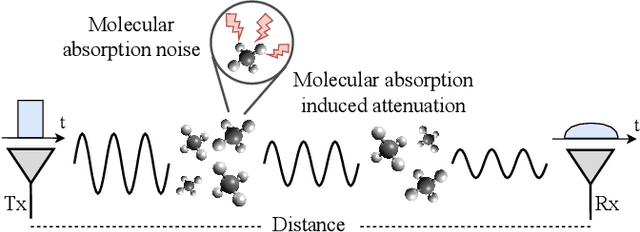
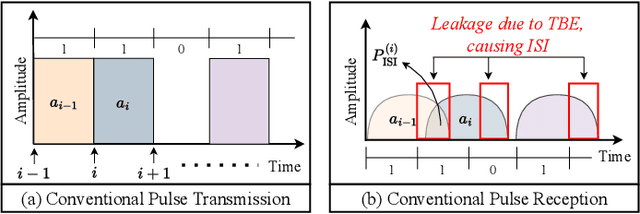
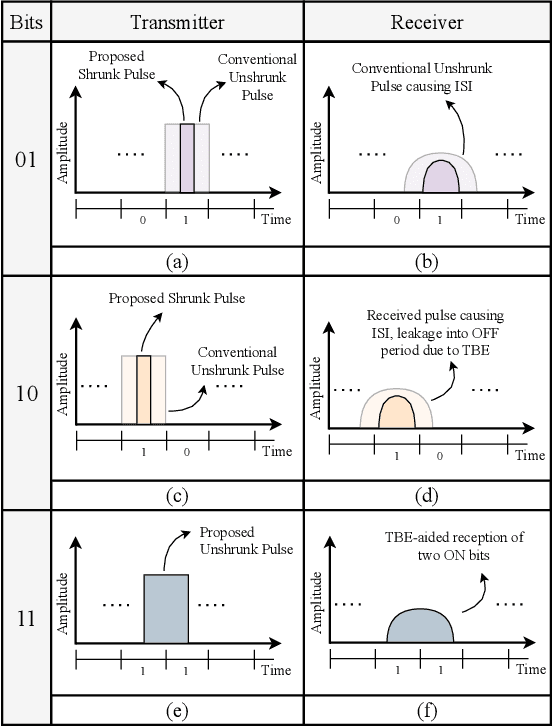
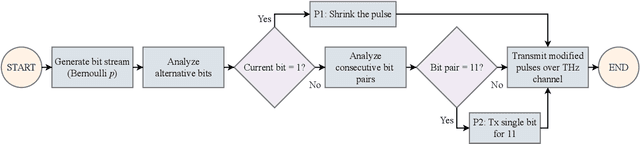
Terahertz (THz) communication ensures the provision of ultra-high data rates owing to its abundant bandwidth; however, its performance is impeded by complex propagation mechanisms. In particular, molecular absorption induces a temporal broadening effect (TBE), which causes pulse spreading and inter-symbol interference (ISI), especially in ON-OFF keying-based systems. To address this, we propose an adaptive pulse-width transmission scheme that dynamically adjusts pulse durations based on the anticipated TBE. This approach suppresses ISI by confining energy within symbol durations while also exploiting TBE constructively to reduce pulse transmissions in specific bit patterns, leading to improved energy efficiency (EE) as an additional advantage of the proposed scheme. Analytical derivations and simulation results confirm that the proposed scheme substantially improves EE and bit error rate under practical THz channel conditions.
Polarization-Aware Antenna Selection for Joint Radar and Communication in XL-MIMO Systems
Mar 27, 2025A key challenge in dual-polarized multiplexing for joint radar and communication (JRC) systems is cross-polarization (cross-pol) leakage caused by depolarization. In conventional MIMO systems, depolarization arises solely from the channel; however, in XL-MIMO systems, non-stationary properties of the array cause additional polarization shifts at each antenna element, further degrading JRC performance. This paper introduces a channel model incorporating polarization shifts due to the propagation channel and antenna elements in the near-field. We also propose an antenna selection (AS) scheme that dynamically chooses antennas based on polarization imbalance and cross-pol leakage, enhancing spectral efficiency, symbol error rate, and radar detection probability. Simulations show that the proposed AS significantly outperforms traditional methods, providing scalable benefits for XL-MIMO JRC systems.
Joint Adaptive OFDM and Reinforcement Learning Design for Autonomous Vehicles: Leveraging Age of Updates
Dec 24, 2024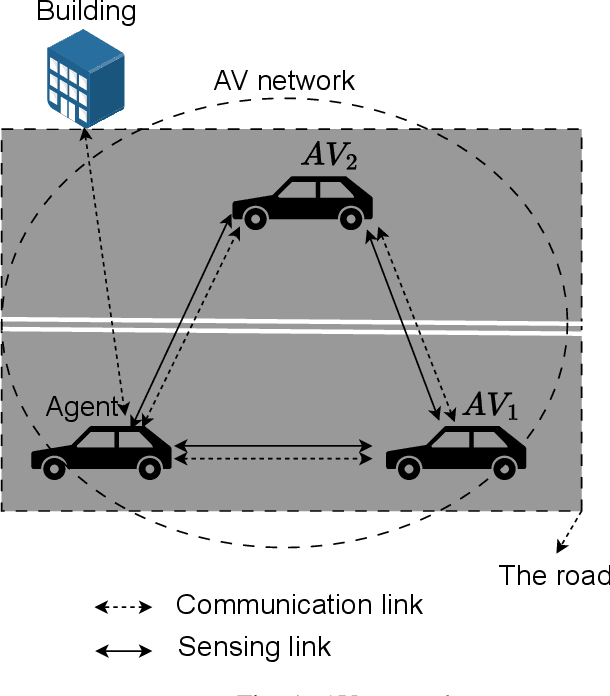
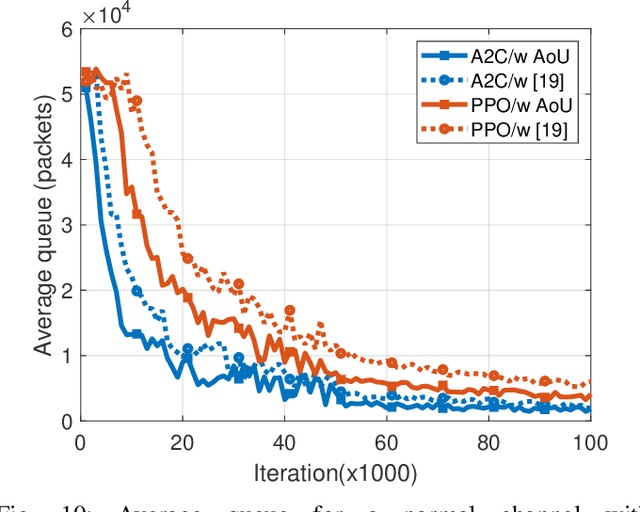
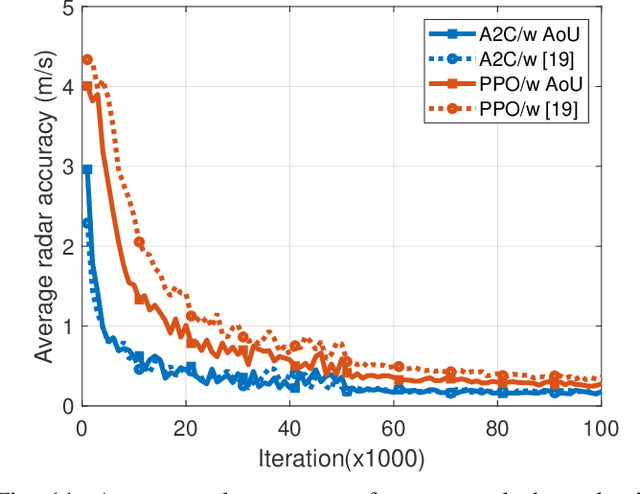
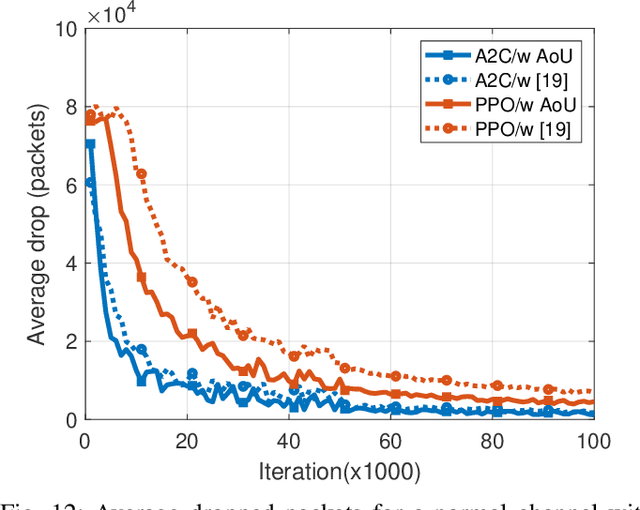
Millimeter wave (mmWave)-based orthogonal frequency-division multiplexing (OFDM) stands out as a suitable alternative for high-resolution sensing and high-speed data transmission. To meet communication and sensing requirements, many works propose a static configuration where the wave's hyperparameters such as the number of symbols in a frame and the number of frames in a communication slot are already predefined. However, two facts oblige us to redefine the problem, (1) the environment is often dynamic and uncertain, and (2) mmWave is severely impacted by wireless environments. A striking example where this challenge is very prominent is autonomous vehicle (AV). Such a system leverages integrated sensing and communication (ISAC) using mmWave to manage data transmission and the dynamism of the environment. In this work, we consider an autonomous vehicle network where an AV utilizes its queue state information (QSI) and channel state information (CSI) in conjunction with reinforcement learning techniques to manage communication and sensing. This enables the AV to achieve two primary objectives: establishing a stable communication link with other AVs and accurately estimating the velocities of surrounding objects with high resolution. The communication performance is therefore evaluated based on the queue state, the effective data rate, and the discarded packets rate. In contrast, the effectiveness of the sensing is assessed using the velocity resolution. In addition, we exploit adaptive OFDM techniques for dynamic modulation, and we suggest a reward function that leverages the age of updates to handle the communication buffer and improve sensing. The system is validated using advantage actor-critic (A2C) and proximal policy optimization (PPO). Furthermore, we compare our solution with the existing design and demonstrate its superior performance by computer simulations.
Optimal Joint Radar and Communication User Association in Cell-Free mMIMO Systems
Aug 27, 2024



The cell-free massive multiple-input multiple-output (CF-mMIMO) systems are crucial for 6G development due to their high spectral efficiency and uniform user-experienced data rates. A key aspect of CF-mMIMO is user association (UA) and optimal cluster formation. Traditional methods focusing solely on communication-related metrics fall short in this context, as sensing is becoming integral to 6G. This study delves into a framework for joint radar and communication (JRC) in CF-mMIMO systems and investigates JRC-based UA techniques. We propose a novel method to optimize UA, enhancing both communication spectral efficiency and sensing accuracy. Existing literature has not explored this dual requirement integration for UA. Our proposed two-step scheme optimizes UA clusters for both communication and sensing. The first step involves selecting access points (APs) based on channel quality, followed by a second step that further refines the selection by choosing APs from the initial group that are also optimal for sensing. We utilize the signal-clutter plus noise ratio to exclude APs with clutter in front of the user equipment (UE) and the AP view angle, ensuring that radar echoes are received only from the specific UE, not the surrounding clutter. Theoretical analysis and simulations demonstrate that the same APs optimized for communication are not necessarily optimal for sensing, highlighting the need for schemes that incorporate sensing requirements in UA. The results show the effectiveness of the proposed method, showing its potential to improve CF-mMIMO system performance in JRC scenarios.