 Add to Chrome
 Add to Firefox
 Add to Edge
An HFM-Inspired Random Access Preamble Design for NTN under High Doppler
Aug 14, 2026
Non-terrestrial networks (NTNs) are a key enabler of ubiquitous 6G connectivity, but the high orbital velocity and long propagation distances in low-Earth orbit (LEO) NTN operation introduce large Doppler shifts and substantial delay uncertainty that challenge New Radio (NR) physical random access channel (PRACH) design. Conventional Zadoff Chu (ZC) and linear frequency modulated (LFM) preambles are particularly vulnerable, as Doppler induced ambiguity and delay Doppler coupling degrade timing estimation and preamble identification. This paper proposes a hyperbolic frequency modulation (HFM) inspired PRACH preamble for robust synchronization and reliable identification under uncompensated or unknown Doppler, detected with a conventional matched filter receiver so that the gains reflect the preamble design. A unified delay Doppler ambiguity function framework characterizes the self and cross ambiguity behavior of ZC, LFM, and HFM inspired preambles, and a scaling-factor based codebook ensures multi-user separability. Simulation results under NTN channel conditions confirm higher detection probability, lower timing root mean square error (RMSE), and improved peak to sidelobe and integrated sidelobe levels compared with ZC and frequency-domain superposed LFM baselines.

Temporal Broadening-Aware Multiplexing for Joint Sensing and Communication in THz Band
Jul 22, 2026High-resolution wireless sensing has become an integral component of futuristic 6G networks alongside high-rate communication. Terahertz (THz) band enables both functions through its extremely large bandwidth, providing sub-centimeter level sensing precision and multi-gigabit data rates. However, THz propagation suffers from severe channel impairments such as molecular absorption (MoA) and the resulting temporal broadening effect (TBE). For sensing, TBE causes temporal spreading of received echoes, leading to degraded range resolution and necessitating long guard intervals between consecutive sensing pulses to avoid overlap. These guards, while necessary for far sensing receiver (Rxsens), cause latency and inefficient temporal use. To overcome this limitation, this paper proposes a TBE-aware multiplexing framework that exploits the distance-dependent nature of TBE to enable interference-free coexistence of sensing and communication (S&C) pulses. A guard interval preallocated for the worst-case TBE at far Rxsens is opportunistically reused to embed a low-power single-carrier communication pulse for a nearby user experiencing minimal broadening. Limited TBE confines S&C pulses within their designated slots at short distances, while the broadened and attenuated communication pulse at the distant Rxsens becomes negligible, eliminating the need for successive interference cancellation (SIC). Simulation results reveal that compared with power-domain non-orthogonal multiple access (PD-NOMA) and fixed-guard alternative, the proposed scheme achieves superior bit-error rate, sensing accuracy, and latency performance, with up to 66.5% latency reduction under heavy traffic.
A Temporal Broadening-Aware Pulse Width Adaptation Scheme for ISI Mitigation and Energy Efficiency in THz Communication
May 01, 2025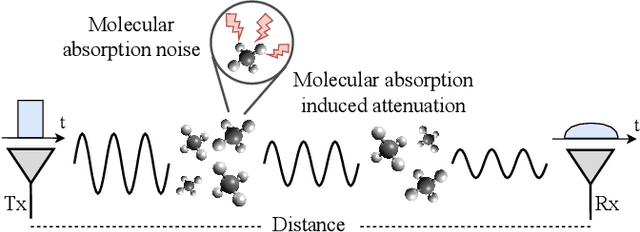
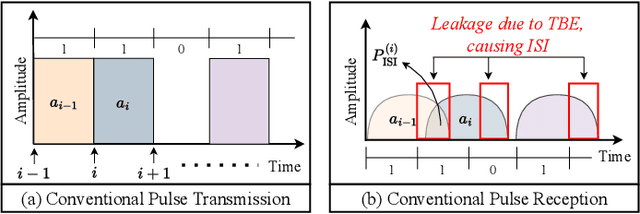
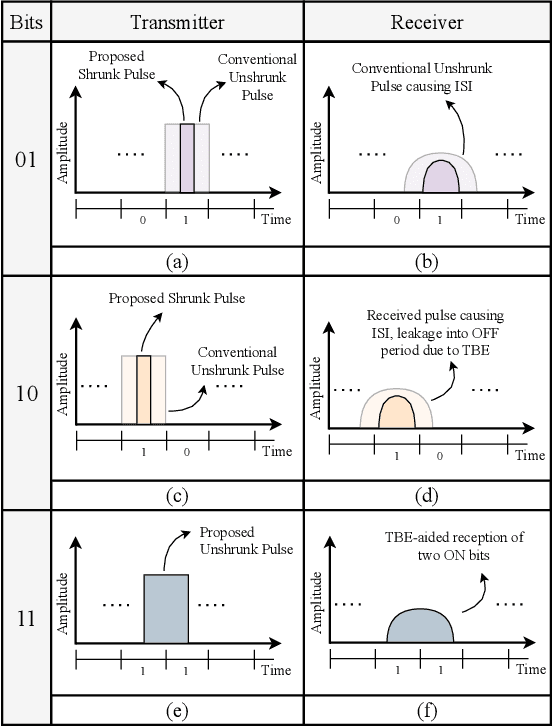
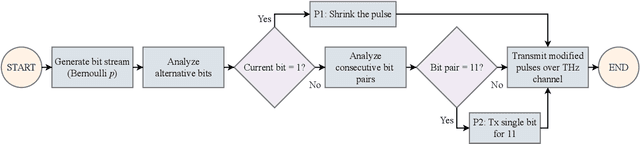
Terahertz (THz) communication ensures the provision of ultra-high data rates owing to its abundant bandwidth; however, its performance is impeded by complex propagation mechanisms. In particular, molecular absorption induces a temporal broadening effect (TBE), which causes pulse spreading and inter-symbol interference (ISI), especially in ON-OFF keying-based systems. To address this, we propose an adaptive pulse-width transmission scheme that dynamically adjusts pulse durations based on the anticipated TBE. This approach suppresses ISI by confining energy within symbol durations while also exploiting TBE constructively to reduce pulse transmissions in specific bit patterns, leading to improved energy efficiency (EE) as an additional advantage of the proposed scheme. Analytical derivations and simulation results confirm that the proposed scheme substantially improves EE and bit error rate under practical THz channel conditions.